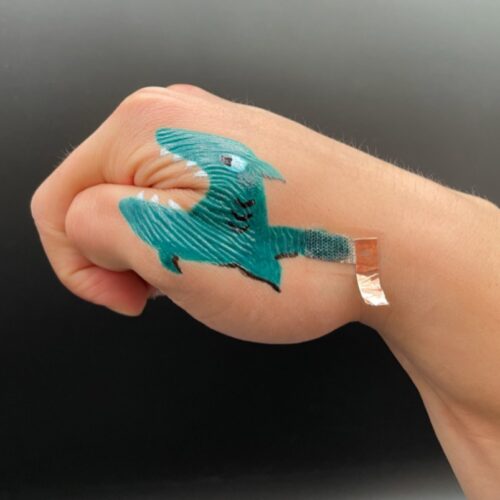
Researchers at Pennsylvania State University have reported a conductive ink that can be brushed onto skin in customized, colorful patterns and then used as an electrode once it dries. The team described the work in a paper published in the Proceedings of the National Academy of Sciences.
The point is practical: wearable biosensors often have to make clean electrical contact with bodies that are curved, hairy, sweaty, and inconveniently human. Existing epidermal electronics can be thin and comfortable, but getting them to sit where the signal is strongest, and to stay useful across irregular skin, remains a materials problem rather than a vibes problem.
The Penn State approach replaces a prefabricated patch with an ink applied directly to the body. According to the researchers, the material is conductive after drying, so the painted design functions as an electrode for biomonitoring. The reported work also emphasizes appearance: the ink can be used in colorful custom designs, which matters if a device is supposed to be worn outside a lab without looking like a medical afterthought.
Why paint changes the engineering problem
Skin-mounted electronics, often called e-tattoos, are not new. Researchers have been putting ultrathin electronic structures on skin for more than a decade. These systems typically use temporary-tattoo-style transfer methods rather than conventional adhesives, and they can be thin enough that wearers barely notice them.
Those earlier e-tattoos can collect electrical measurements from the body. They can also be built to sense other signals, including temperature and strain, by embedding circuit elements in ultrathin polymer layers. That makes them useful as a platform for soft, close-contact monitoring, at least when the surface and placement cooperate.
The catch, according to the PNAS paper’s framing, is that biosignals are distributed across the body rather than politely concentrated under one convenient sticker. Covering a larger area often requires electrode layouts tailored to the wearer and the measurement site. Curved or hairy surfaces add another nuisance, because a flat transferred device may not conform well enough to maintain good contact.
A paintable electrode changes that workflow. Instead of designing and placing a separate film for each geometry, a researcher or clinician could apply the sensing material along the needed path on the skin itself. The source material does not report clinical use or commercial availability, so the result should be read as a research demonstration rather than a product launch.
Part of a broader push beyond sticker sensors
The Penn State work sits alongside other attempts to make skin-worn electronics less fussy. In 2024, researchers reported polymer-based conductive inks that could be printed onto a person’s scalp to record brain waves, including through hair. That line of work points toward mobile EEG monitoring outside clinical settings, though the usual caveat applies: a lab result is not the same thing as a deployable medical system.
The shared idea is straightforward. If the body is the measurement site, the electronics need to deal with the body’s shape and surface rather than forcing the body to accommodate the electronics. Painted and printed conductive inks are one way researchers are trying to make that less awkward.
This story draws on original reporting from Ars Technica.