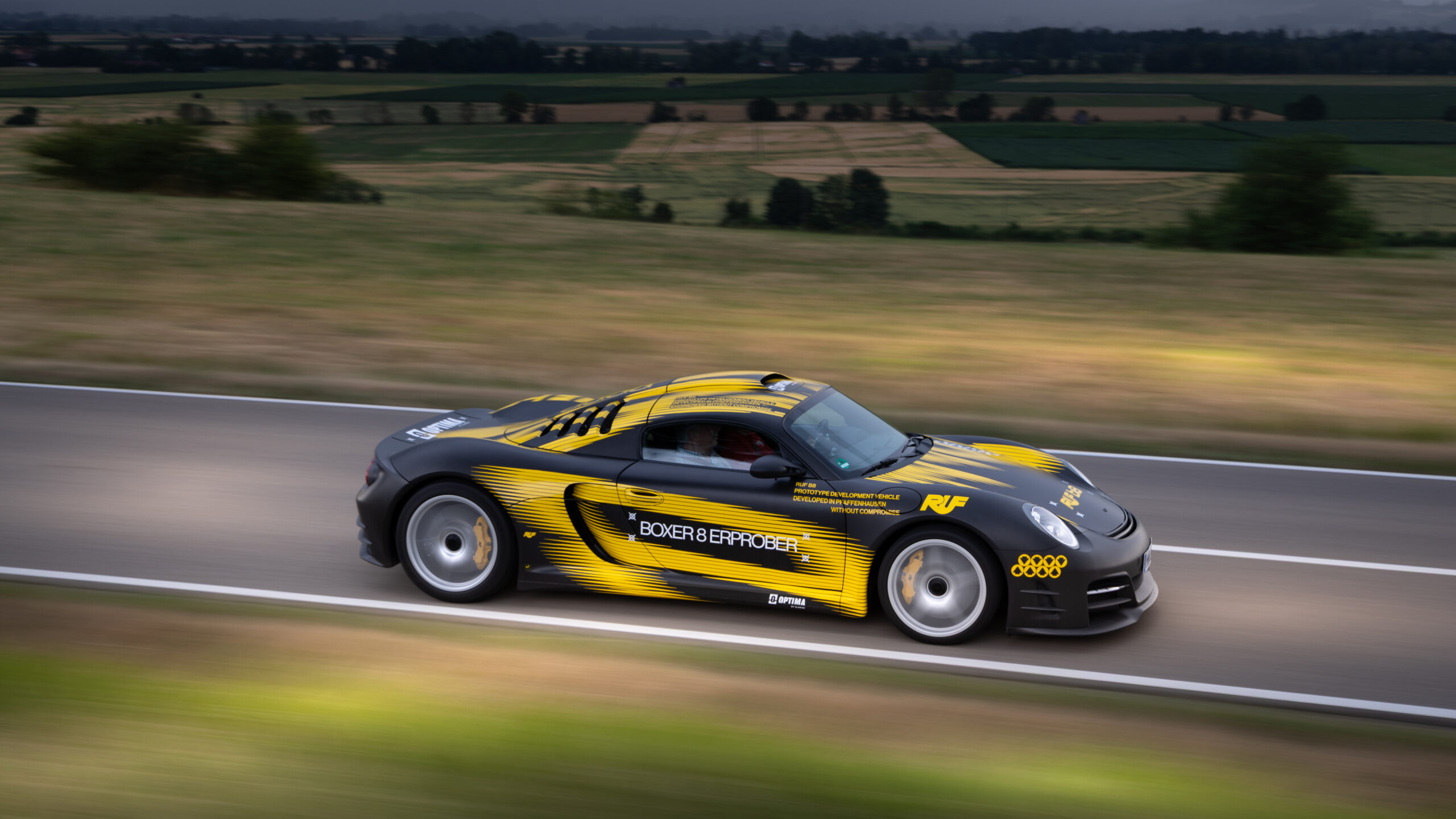
Ruf used the Goodwood Festival of Speed in England to publicly start a new engine, the B8, a 4.8-liter flat-eight rated at more than 1,000 hp, according to Ars Technica. For a small German performance-car company whose old public shorthand was “Porsche tuner,” that is the point: Ruf is still working in the visual and mechanical neighborhood of the 911, but it is building its own hardware.
The B8 was installed in a lengthened CTR3 test car that Ruf calls the “Erprober,” German for tester. Ruf planned to send the car up Goodwood’s hillclimb with Tanner Faust driving, Ars Technica reported. The company has not released a full specification sheet for the engine, so the public numbers are limited: 4.8 liters, more than 1,000 hp, or 745 kW, and 737 lb-ft, or 1,000 Nm, of torque.
The useful detail is the cylinder layout. Ruf’s recent cars, including the SCR and Rodeo, use horizontally opposed six-cylinder engines. The B8 keeps the flat-engine idea, where cylinders lie opposite each other rather than standing in a V or inline layout, but adds two cylinders. Ruf has not yet said how the engine is fed, cooled, governed, or packaged beyond its installation in the CTR3-based mule.
Ruf is not just rebadging old 911s
Ruf’s Porsche connection is real, and it is also incomplete. The company became familiar to many video-game players through Gran Turismo 2, where Ruf cars served as a workaround because Porsche’s video-game rights were held elsewhere at the time, Ars Technica noted. That history tends to flatten what Ruf now does.
German authorities have treated Ruf as a distinct manufacturer rather than a tuner for years, according to Ars Technica. The company’s 1983 BTR was the first car to carry a Ruf vehicle identification number instead of the VIN Porsche had stamped on the chassis. That distinction matters because a VIN is not a sticker for vibes; it marks who manufactured the vehicle for regulatory purposes.
Ruf pushed further away from donor-car logic in 2007 with the CTR3. That car still made its ancestry obvious, but it moved the engine to the middle rather than keeping the 911’s rear-engine arrangement. Its frame chassis was developed by Ruf with Multimatic, according to Ars Technica.
More recent Ruf models such as the SCR and Rodeo have used carbon monocoque chassis made by Ruf. They still resemble 964-era Porsche 911s, but under the skin they are not just restored old bodies with louder intent.
What Ruf has shown, and what it has not
The B8’s debut is a public proof point, not a full engineering disclosure. Ruf has shown the engine running in a development car and attached two headline figures to it. It has not published the complete technical data needed to judge the design against other high-output engines.
Photos released by Ruf and described by Ars Technica show the B8 mounted in the mule, along with lead engineer Marc Brunner and Alois Ruf Jr. That gives the project names and metal, which is better than a teaser render. The rest is still under the cover Ruf has chosen to keep on it.
This story draws on original reporting from Ars Technica.


