Lt. Gen. Doug Schiess, President Donald Trump’s nominee to become the next chief of the US Space Force, told senators that commercial contractors should not own or lease out space weapon systems capable of damaging satellites, other assets, or people.
The answer matters because the Pentagon is putting more military work into orbit while buying more services from private satellite operators. Commercial space companies already provide communications, imagery, and other support to US forces. The harder question is whether that model should extend to orbital weapons. Schiess’s answer, given at a July 16 Senate Armed Services Committee nomination hearing, was no.
Sen. Jack Reed of Rhode Island, the committee’s top Democrat, raised the issue by pointing to companies seeking to lease space assets that function as military weapons. Reed said last year’s National Defense Authorization Act barred temporary ownership of space weapon systems, and he compared leased orbital weapons to a military renting rifles or fighter jets. He said this year’s defense policy bill further clarifies that the Space Force must hold title to such systems.
Schiess said commercial leasing can make sense for missions such as satellite communications and space domain awareness, the military term for tracking objects and threats in orbit. But he drew a line at systems that could cause harm. In those cases, Schiess told Reed, the capability should be fully owned and controlled by the Space Force.
He also pointed to hybrid arrangements used by the National Reconnaissance Office, where contractors may operate government-owned satellites. Schiess said those systems still have a military member or NRO civilian serving as mission director. If confirmed, he said, he would work with Reed on the issue and agreed that Space Force personnel, known as Guardians, must control those systems.
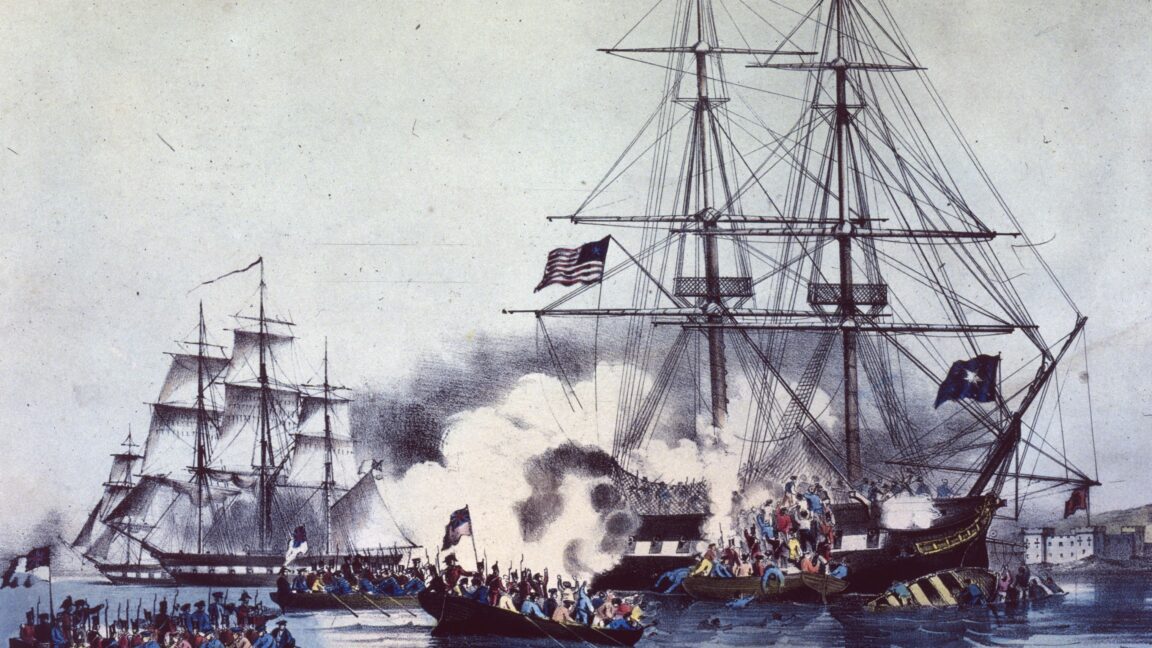
The legal ghost in the room is privateering, the old practice of governments authorizing private ships to capture or destroy enemy vessels. The US Constitution gives the government power to grant letters of marque and reprisal. Presidents John Adams and James Madison used privateers in conflicts with France and Britain, and the Continental Navy relied on them during the American Revolution. The US government has not used the practice since the War of 1812, though the Confederacy commissioned privateers during the Civil War.
Privateering is now prohibited under international law, but some lawmakers have tried to revive the concept in modern form. Sen. Mike Lee of Utah and Rep. Tim Burchett of Tennessee introduced legislation last year aimed at using privateering against drug cartels. Lee and Burchett introduced another bill this month that would authorize letters of marque and reprisal for cyber operations. In a statement, Lee said the bill would let “American digital privateers” raid cartels, cybercriminals, and foreign adversaries and share seized assets with the federal government.
Space is where that 18th-century idea gets awkward fast. The US Space Force has used privately owned satellites in military exercises that simulate offensive and defensive responses in low-Earth orbit. Those satellites do not carry weapons, according to the report, aside from the theoretical and debris-generating option of physically ramming another spacecraft.
Actual space weapons are moving from thought experiment to procurement fight. US military officials believe Russia is operationalizing a co-orbital anti-satellite weapon system, alongside ground-launched anti-satellite missiles. The Pentagon’s planned Golden Dome missile defense shield is designed to include space-based interceptors in low-Earth orbit, which could theoretically be used against spacecraft. Some aerospace and defense companies are developing interceptor prototypes with private investment, while others are using a mix of private and public funding.
Congress has already tried to fence off one version of that future. Last year’s defense authorization law, signed by Trump in December, prohibited the Pentagon from fielding a privatized or subscription-based missile defense interceptor capability. If such a system is built, the law says it must be owned and operated by the US military.
The Space Force is also in line for far more money. The Trump administration requested $71.1 billion for the service in fiscal 2027, nearly 80 percent above its roughly $40 billion 2026 budget. Lawmakers appear likely to approve something between $50 billion and $60 billion.
Schiess’s testimony does not settle space warfare rules, which remain thin and contested. It does show where the nominee wants to put the control point: commercial companies may build and operate pieces of the machine, but the trigger for a space weapon should stay in government hands.
This story draws on original reporting from Ars Technica.