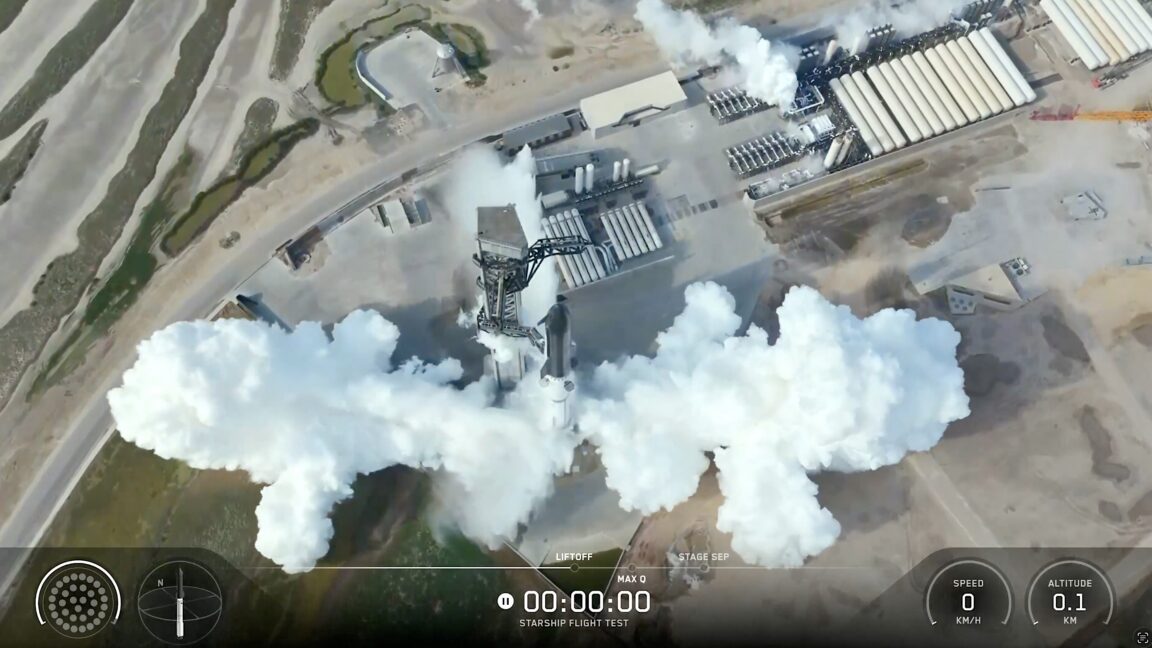
SpaceX stopped a Starship launch attempt at the instant it was supposed to leave the pad Thursday after the Super Heavy booster failed its engine-start sequence at Starbase in South Texas.
The halt matters because this flight was meant to test fixes to the upgraded Starship V3 stack after engine trouble on the previous mission. Instead, SpaceX now has another Raptor problem to inspect before it can try again with the more than 400-foot vehicle.
The company had been targeting a 5:45 pm local launch from its site near the US-Mexico border. SpaceX loaded the rocket with more than 11.5 million pounds of liquid methane and liquid oxygen, according to the company’s launch coverage, and the countdown ran to zero before onboard and ground systems stopped the attempt.
Elon Musk, SpaceX’s founder and chief executive, said on X that “some of the engines didn’t start,” which triggered the automatic abort. He later said teams would replace two Raptor engines on the Super Heavy booster and that the most likely timing for another attempt was early next week. SpaceX did not immediately give a firm launch date.
What failed at the pad
Super Heavy uses 33 methane-burning Raptor engines. Each can produce more than half a million pounds of thrust, and they do not all start as one neat fireball. The booster is supposed to ignite them in a staggered sequence after the pad’s water-cooled flame diverter comes online to absorb some of the heat, blast, and vibration.
SpaceX has not said how many engines failed during Thursday’s start attempt. A status graphic on the company’s livestream showed four of the 33 engines not lighting, according to Ars Technica space reporter Stephen Clark.
The rocket uses SpaceX’s third-generation Raptor engine and the Starship V3 design. This planned launch, Flight 13, would be the second full-scale Starship mission to fly that combination. The first V3 flight in May was mostly successful, but it still produced a short list of engine-related homework.
Why Flight 13 was supposed to matter
SpaceX said after the May mission that differences in Starship upper-stage engine startup affected the Super Heavy booster’s flip after stage separation, leaving the booster pointed about 90 degrees away from the intended direction. The company said it changed the startup sequence to better tolerate timing variation and improve the booster’s flip maneuver.
The May flight also saw some Super Heavy engines fail to restart for the booster’s landing burn. That prevented the company from completing a controlled splashdown in the Gulf of Mexico. SpaceX has already shown it can bring earlier Starship V2 boosters back toward the launch site, but it has not yet demonstrated the same with the V3 vehicle.
Starship’s upper stage had its own issue on Flight 12. One of its six Raptor engines shut down early, though the vehicle still flew toward a targeted water landing in the Indian Ocean. SpaceX skipped an attempted in-space Raptor relight because of the problem. That relight remains one of the test objectives for Flight 13.
A clean Starship V3 test would move SpaceX closer to an orbital flight profile, which the company needs before using Starship for Starlink deployment and orbital refueling tests. Those capabilities are also tied to NASA’s Artemis lunar lander plans, where Starship is supposed to play a central role. Thursday’s abort is a reminder that the path still runs through getting dozens of engines to behave at once, which is the least glamorous and most necessary part of the show.
This story draws on original reporting from Ars Technica.