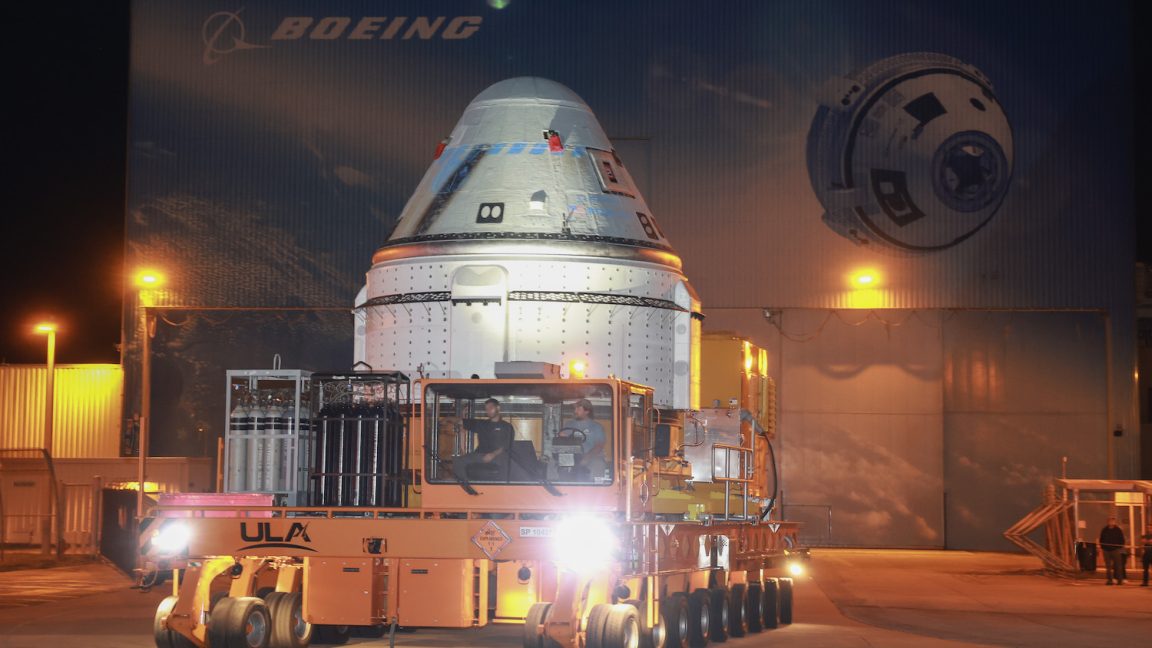
A Starliner launch 2026 is back on the table after Boeing told investors that work to correct problems on the spacecraft is progressing, and Ars Technica reported that the next major blocker may be finding room at the International Space Station.
Boeing Chief Executive Officer Kelly Ortberg discussed Starliner during the company’s quarterly earnings call Tuesday, in response to an analyst question about Boeing’s space work. He said the company’s redesign work on Starliner’s known problems was “going quite well” and that Boeing felt good about its progress.
Those problems center on Starliner’s propulsion system, according to Ars. The issue became serious during the spacecraft’s first crewed mission in 2024, when NASA astronauts Butch Wilmore and Sunny Williams flew to the station on Starliner but later returned to Earth aboard SpaceX’s Crew Dragon in early 2025.
NASA had previously classified that 2024 Starliner crewed flight as a Type A mishap, a label the agency uses for serious failures. NASA Administrator Jared Isaacman said in February that the agency and Boeing needed to identify and reduce Starliner’s risks before the spacecraft flew again. He did not give a date for the next test at the time.
When could Starliner launch again?
Starliner could fly a cargo mission to the International Space Station this year, according to Ars, if NASA and Boeing can line up a launch slot with an available docking port and station crew time to unload the vehicle. An official confirmed to Ars that port availability is now the main factor in the timing.
The next flight would carry cargo rather than crew. That matters because it gives NASA and Boeing a lower-risk way to test whether the fixes to Starliner’s propulsion problems work in orbit before putting astronauts back on the vehicle.
Ortberg said Boeing still needs to coordinate the launch schedule with NASA. He told analysts he did not currently expect that scheduling issue to create a cost problem, while acknowledging that Boeing and NASA still have uncertainty to settle.
If that cargo test succeeds and the propulsion changes satisfy NASA, a crewed Starliner mission could follow in late 2027, Ars reported.
Why Boeing cares about timing
More delay would add pressure to a program that has already been expensive for Boeing. The company signed a fixed-price Commercial Crew contract with NASA in 2014, which means Boeing carries much of the cost burden when development runs long. Ars reported that Boeing has taken about $2 billion in charges tied to Starliner delays and extra testing after software and propulsion failures.
Starliner’s future also intersects with a larger problem for U.S. human spaceflight. SpaceX’s Crew Dragon is currently the proven ride to low Earth orbit, and Ars reported that SpaceX has been telling industry officials it plans to retire Crew Dragon, which launches on Falcon 9, no later than 2030.
That could complicate NASA’s plans if the International Space Station operates into the early 2030s. It also affects companies planning private space stations, which need transportation for crews and are having trouble negotiating those services, according to Ars.
Starliner would not be a clean substitute. Its service module, which contains the propulsion hardware, is discarded after each mission and burns up in the atmosphere. Ars cited sources saying that module costs tens of millions of dollars. Starliner also lacks a long-term certified rocket after United Launch Alliance retires Atlas V. ULA’s Vulcan could be used, but it would need human-rating work and would cost more than Falcon 9, according to Ars.
Boeing has explored selling space assets including Starliner, The Wall Street Journal previously reported. Ars reported that no sale has closed, with one person saying Boeing’s asking price has been too high. Blue Origin, one possible buyer with enough money to matter, has chosen to keep developing its own crew vehicle instead.
This story draws on original reporting from Ars Technica.