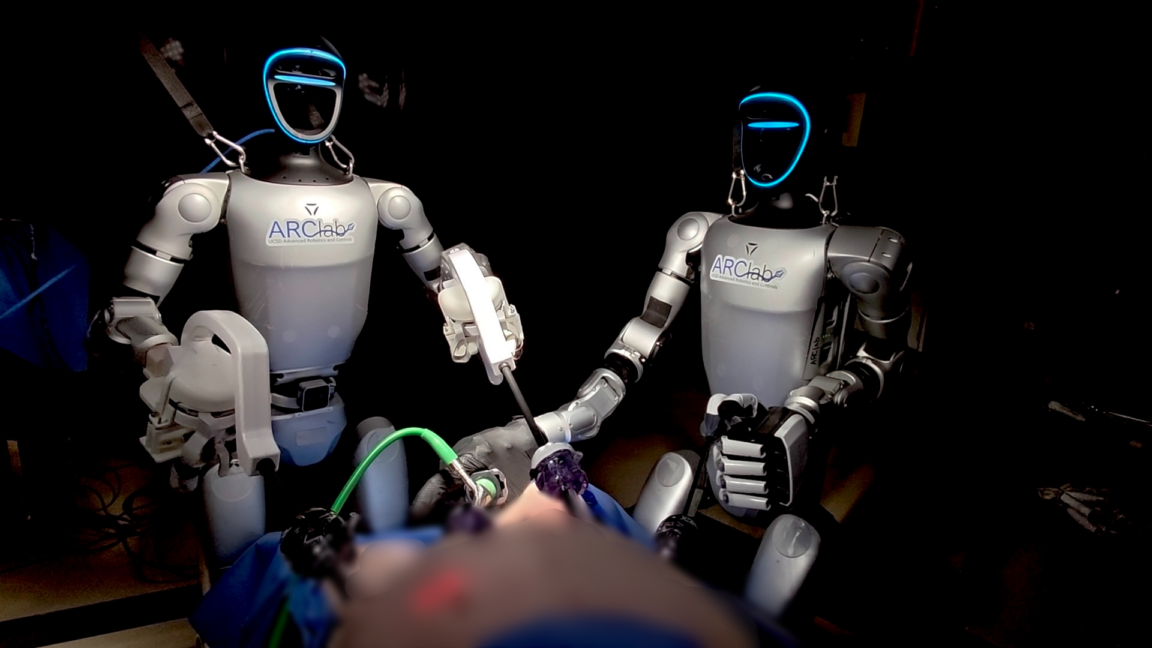
Surgeons at the University of California San Diego remotely controlled humanoid robots to remove gallbladders from two live pigs, according to a preclinical study published in Nature. The robots were not operating on their own. Human surgeons drove the instruments, watched through a stereo display and used a console to translate hand movements into surgical motion.
The work is a useful reality check for the humanoid robot boom. The experiment showed that a small, relatively cheap general-purpose robot can be adapted for minimally invasive surgery in animals. It also showed why hospitals are not about to swap cleared surgical systems for bipedal lab hardware with tool adapters and calibration breaks.
The UC San Diego team used Unitree’s G1 humanoid robot, a 5-foot, roughly 60-pound machine made by the Chinese robotics company Unitree. The basic G1 starts at $13,500 before shipping, but versions with the dexterous hands needed for this kind of work can rise above $67,000, according to pricing cited by the researchers and product listings.
That is still far below the price of specialized surgical systems such as Intuitive Surgical’s da Vinci system, which can cost from hundreds of thousands to several million dollars. Da Vinci systems are also large, with reported weights around 1,800 pounds. Shanglei Liu, an assistant professor of surgery at UC San Diego School of Medicine, told UC San Diego Today that the humanoid approach uses less money and less operating-room space, which could make deployment easier in rural sites, military settings or space.
That comparison has limits. Intuitive’s da Vinci system has regulatory clearances from the US Food and Drug Administration and other agencies, and it has been studied across clinical procedures. The UC San Diego humanoid system, nicknamed Surgie by the researchers, is still an animal-trial prototype.
How the setup worked
The researchers built physical mounts so the robots could hold surgical tools, then wrote software to map a surgeon’s hand motions to the instruments attached near the robots’ wrists. A control station used a PC, a stereo headset for visual feedback and a foot pedal that let the surgeon connect or disconnect hand movements from robot motion.
In the first pig surgery, a human surgeon stood next to the robot as an assistant. In the second, two teleoperated humanoid robots worked together, according to UC San Diego Today and the Nature paper.
The procedure exposed the awkward parts. The team had to stop for minutes at a time to recalibrate the robots or reposition a body or arm so the instruments lined up correctly. UC San Diego Today said the operations took much longer than comparable procedures performed with existing surgical robot systems.
The G1’s compact frame also worked against it. The paper notes an arm span of 450 millimeters, far shorter than the 1.6 to 1.8 meters typical of an adult human. Limited reach and range of motion added work for the operators, who had to handle the robot’s constraints while also doing surgery.
Latency is another unresolved problem. The researchers wrote that current teleoperated humanoid systems commonly respond after delays measured in hundreds of milliseconds, while prior studies suggest surgical robots should ideally stay below 150 milliseconds. In practice tasks, both new surgical residents and experienced surgeons generally moved faster using da Vinci Research Kit hardware than the humanoid controls.
Michael Yip, a UC San Diego professor of electrical and computer engineering, told UC San Diego Today that the group is also studying autonomous surgical assistants that could help with general operating-room tasks, including getting tools or cleaning. For now, the confirmed result is narrower: surgeons can control humanoid robots well enough to complete gallbladder removal in live pigs, with a lot of engineering help and a long list of caveats.
This story draws on original reporting from Ars Technica.


