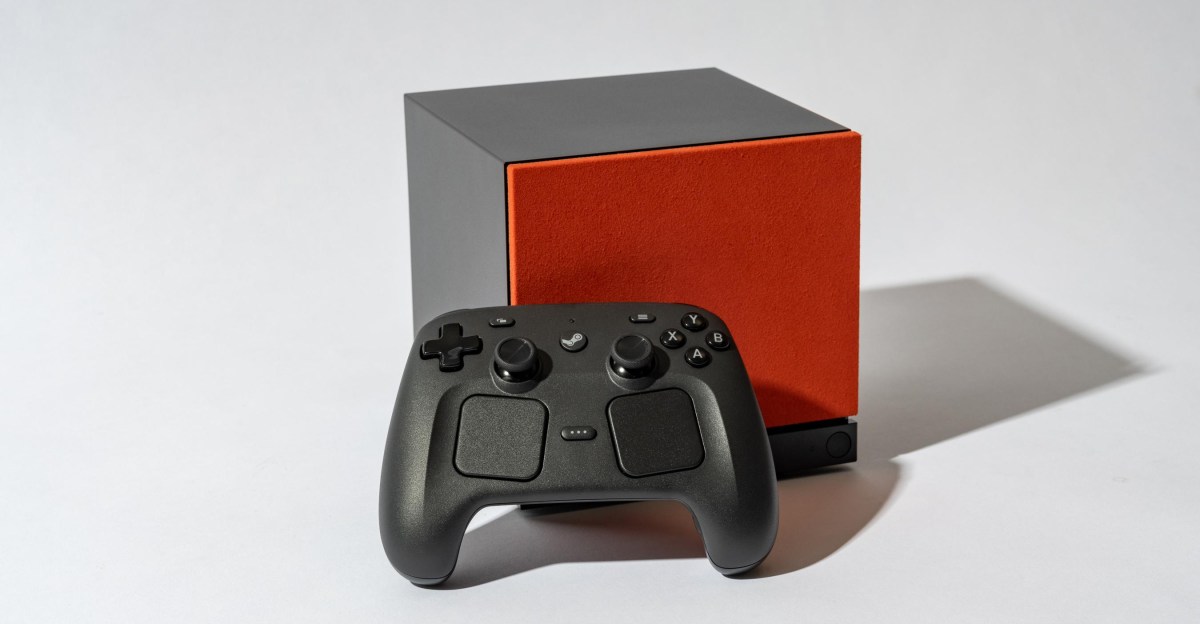
Valve’s revived Steam Machine is getting the kind of reaction hardware companies usually try to buy with launch trailers: a reviewer who knows the downsides and still wants one. The Verge’s Jay Peters wrote that after roughly two weeks using Valve’s small gaming PC, he would pay the $1,049 asking price, even though his colleague Sean Hollister gave the device a 6 in The Verge’s review.
The appeal, according to Peters, is not that Valve has built a miracle console. He points to the Steam Machine’s obvious problems: it is expensive, it is competing with console hardware that has been around for six years, and its GPU cannot be upgraded later. That last bit matters for a box meant to sit near a TV for years while PC games keep getting heavier. Physics remains undefeated, even in cube form.
What Valve appears to have nailed, in Peters’ account, is the boring part that living-room PCs often botch: fitting into a normal setup without turning the cabinet into a thermal crime scene. Peters describes the Steam Machine as a 6-inch cube that sits easily in his TV console, takes up less room than a PlayStation 5 or Xbox Series X, and can be moved to a desk without rearranging the whole workspace.
Why Steam users may care
Peters already owns a PS5 and Xbox Series X, but he said neither console can access the hundreds of games in his Steam library. They also do not use Steam cloud saves, which let him move progress between a Steam Deck and Steam Machine, and they do not support his preferred Steam Controller or PC game mods.
That is the actual pitch, stripped of console-war incense: Valve is selling a box for people who already live in Steam. Peters said games look better and run more smoothly on the Steam Machine than on his Steam Deck when used from the couch, while the Steam Machine avoids the fan noise he hears from the handheld in that role.
He said he could not recall hearing the Steam Machine while playing games including Final Fantasy VII Remake Intergrade, 007 First Light and Balatro. He also said it starts quickly from a button press, works with his Sonos Beam soundbar, and gets him into games within seconds. His PS5, Xbox Series X and Steam Deck can also do that, but Peters wrote that he did not miss them during his Steam Machine test period.
The waitlist problem
The machine Peters tested is not one he gets to keep. He said he signed up to buy one but was not selected, and he has no timeline for getting off Valve’s waitlist. That pushed him to consider building a PC instead.
That alternative has its own mess. Peters said a friend offered him an RTX 3070 Ti graphics card and a 1TB SSD, which could let him build a system that is more powerful and more upgradable than Valve’s box. But he noted that small cases such as the Fractal Ridge and Velka 7 would be tight fits for his TV console, and he doubts a homebuilt PC would be as quiet as Valve’s machine.
Software is another catch. Peters noted that SteamOS is not available for Nvidia GPUs yet, which would likely leave him using Steam Big Picture mode on Windows or a Linux distribution such as Bazzite. Neither, in his view, matches the SteamOS experience he already knows from the Steam Deck.
He also may buy nothing. Peters said he returned to using a Steam Deck connected to his TV with an 8BitDo Ultimate 2 Wireless Controller and found it worked better than he remembered. For many games he plays, he said, the Steam Deck already performs well enough, with portability included.
Valve’s problem, based on Peters’ account, is a good one and an annoying one: the Steam Machine may be exactly right for some Steam-heavy households, but those people still need Valve to let them buy it.
This story draws on original reporting from The Verge.