What is entropy, really? In a WIRED physics explainer, Rhett Allain, an associate professor of physics at Southeastern Louisiana University, says the familiar “messy room” version gets the concept wrong enough to be annoying. Entropy is not a cosmic excuse for your desk. It is a way to count how many microscopic arrangements can produce the same visible state.
Allain frames the issue through the split between what matter is doing at atomic scale and what people can actually measure. A sealed box of air, for example, has molecules moving in countless changing positions and velocities. Those microscopic configurations are microstates. The pressure you measure, such as 14.7 pounds per square inch at sea level in his example, is a macrostate. Many microstates can correspond to that same macrostate.
What does entropy actually mean?
Entropy measures how many microscopic arrangements fit a given overall condition of a system. A state with more possible arrangements has higher entropy and is more likely to occur, which is the bit the “disorder” shorthand tends to mangle.
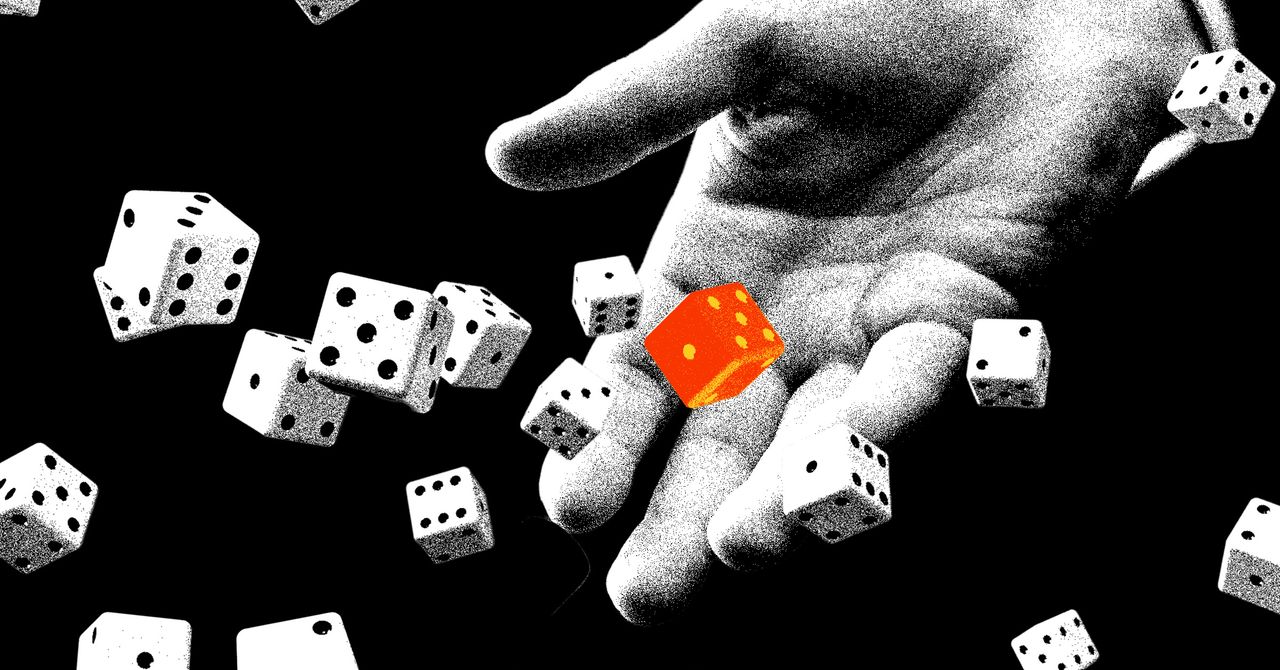
Allain uses dice to make the probability machinery visible. A six-sided die has six possible outcomes; a 20-sided die has more, so in that limited sense it has higher entropy. With three six-sided dice, the possible ordered rolls total 216. A sum of 18 can happen only one way, with all three dice landing on 6, giving odds of 1 in 216, or about 0.4 percent.
A sum of 10 is much easier to get. Allain counts 27 ordered ways to roll it, for a probability of 27 in 216, or 12.5 percent. The “10” macrostate has higher entropy because more microstates lead to it. No invisible entropy gremlin is pushing the dice. The arithmetic is doing the work.
The same logic applies to heat. Allain describes dropping a 120-degree Fahrenheit copper ball into 50-degree water. Experience says the ball cools and the water warms until their temperatures meet somewhere in between. At the particle level, warming means atoms and molecules gain kinetic energy. If the water gains 50 joules of thermal energy, the copper loses 50 joules, preserving total energy.
Physics does not forbid the reverse in the accounting sense. A copper ball could, in principle, gain 10 joules while the colder water loses 10 joules, because energy would still be conserved. Allain’s point is that such a distribution is so unlikely that it is useless as a practical expectation.
He then moves to tiny model objects, where atoms can occupy discrete energy levels, as quantum mechanics requires. If two small objects share a fixed total of 10 energy units, putting them in contact allows energy to be rearranged while the total stays fixed. In one example, an object with two atoms holding 2 units and another with three atoms holding 8 units has fewer arrangements than a split of 4 and 6 units, which Allain counts as 30 possible combinations.
The formal version, as Allain writes it, is entropy S equals Boltzmann’s constant multiplied by the natural logarithm of the number of microstates, Ω. Real systems are not toy dice: one drop of water contains about 1.7 sextillion water molecules. With numbers that large, the most probable energy distribution dominates so thoroughly that thermodynamics treats heat flow from hotter matter to colder matter as a law. Under the hood, Allain says, it is probability with an absurdly large sample size.
This story draws on original reporting from WIRED.