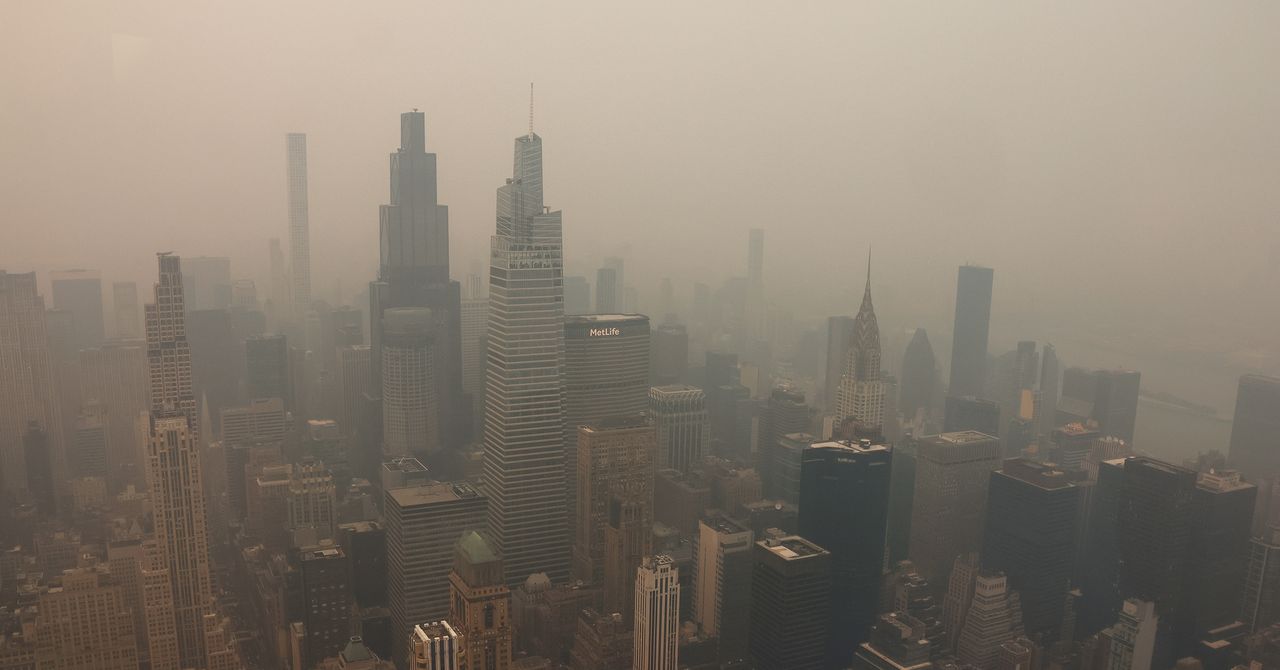
Argentina and Spain are scheduled to play the World Cup final on Sunday just outside New York City, with Lionel Messi and Lamine Yamal among the marquee names. The timing is awkward in the least poetic way: wildfire smoke from Canada has pushed air quality across parts of the Midwest and East Coast into dangerous territory, and FIFA has not shown that it has a specific plan for smoke exposure.
New York state issued an air quality alert Thursday as readings reached “unhealthy” and “very unhealthy” levels. State officials advised residents to avoid outdoor time where possible. The Environmental Protection Agency’s AirNow map showed smoke affecting more than a dozen states in recent days.
Air quality near the stadium remained in the unhealthy range Friday morning, according to AirNow data cited by Grist. Forecasts called for conditions to improve to “moderate” by kickoff, but wildfire smoke is not a tidy calendar invite. Wind can move it around, and the stadium is open-air, so there is no roof to seal if conditions worsen.
That leaves players and fans breathing whatever shows up. Smoke exposure can cause coughing, headaches, throat irritation and other symptoms. It can pose greater risks for children, older adults and people with asthma or other respiratory conditions. For elite athletes, the basic mechanics are not subtle: they inhale far more air during hard exertion than someone sitting in the stands complaining about stoppage time.
Spain trained outdoors in New Jersey on Thursday during the air quality episode, according to the Associated Press. Courtney Howard, an emergency physician and official with the Global Climate and Health Alliance, told the AP that athletes “shouldn’t be practicing outside” when wildfire pollution reaches hazardous ranges.
FIFA and the New York City Department of Health did not immediately respond to Grist’s requests for comment. In an earlier statement to Grist, FIFA described heat protocols, including required water breaks, but did not identify a comparable procedure for air quality. FIFA said last month that “climate-related risks” are considered in tournament planning and handled with host cities, stadium operators and national agencies.
That answer does not say what happens when the air is bad. Other leagues have managed to write down actual triggers, which is the boring paperwork that becomes useful when the sky turns orange.
- The National Women’s Soccer League adds hydration breaks when the air quality index reaches 101, a level considered unhealthy for sensitive groups.
- The NWSL cancels or postpones matches when AQI rises above 200, categorized as very unhealthy.
- A women’s soccer game at Citi Field in New York used additional hydration breaks Thursday under that policy.
- Major League Baseball rescheduled a Philadelphia game this week because of smoke.
- Major League Soccer canceled a Chicago match because of smoke.
Nicholas Watanabe, a University of South Carolina professor who studies sport and entertainment management, told Grist that FIFA appears unready for wildfire smoke, even if the final avoids the worst conditions. He said the expected improvement before Sunday could allow FIFA to proceed without a crisis, but described the episode as a warning for sports bodies.
The concern is broader than one final. FIFA has already drawn criticism during this tournament over heat policies. Trinity Rodman, who played in the smoke-affected NWSL match in New York, told Fox News that if players need hydration breaks every 15 minutes, “then we shouldn’t be playing the game.”
Climate stress is also hitting other outdoor sports. Tour de France yellow jersey holder Tadej Pogačar recently questioned whether the race should take place in summer after wildfires, smoke and extreme heat affected this year’s event, telling Cycling Weekly he would change the calendar if he could.
Athletes generally do not control those calendars. Governing bodies do. Watanabe told Grist that FIFA and other competitions need regulations and a comprehensive plan for climate risks. Sunday may still go ahead in cleaner air. That would be luck, not a protocol.
This story draws on original reporting from WIRED.