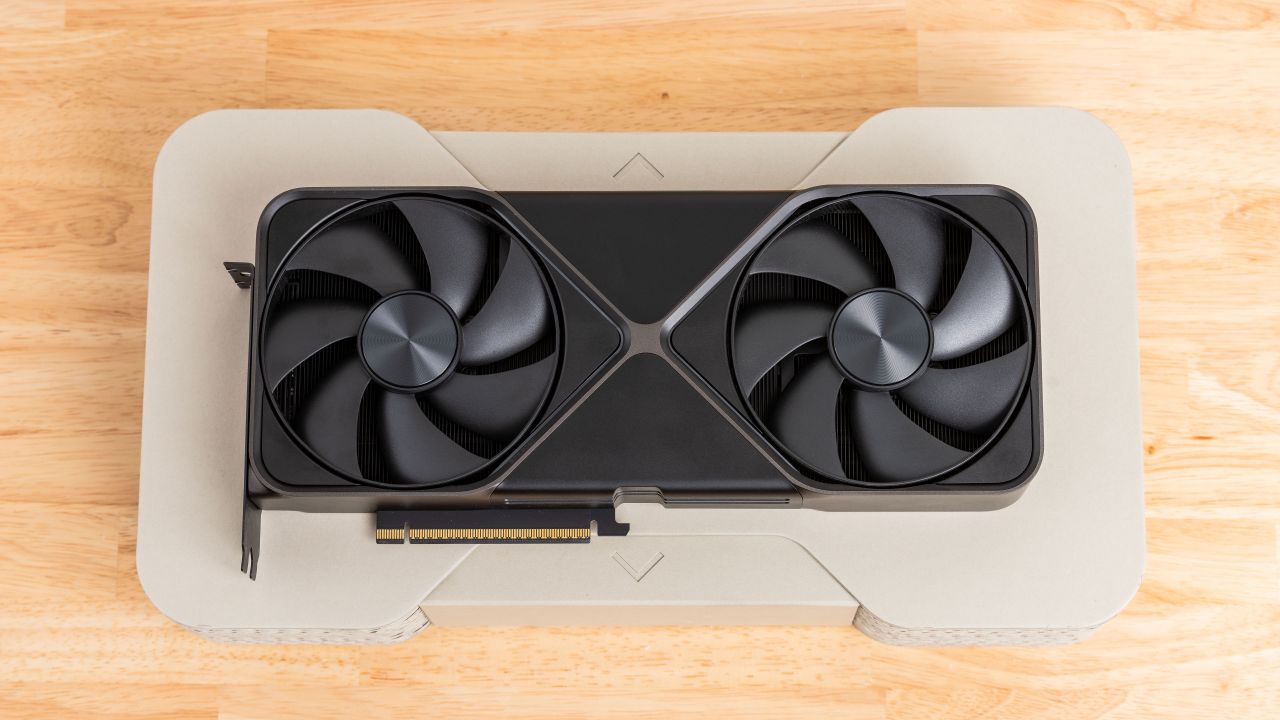
Nvidia’s mid-cycle RTX 50 Super graphics cards are reportedly waiting on memory economics, not silicon. VideoCardz, citing a source at a board partner, reported that at least one Nvidia partner already has RTX 50 Super hardware, but that Nvidia has put the launch on hold because 3GB GDDR7 memory chips cost too much.
That is the part of the graphics card business that tends to get buried under shader counts and marketing names. The rumored Super cards use higher-density 3GB GDDR7 modules instead of the 2GB chips used on existing RTX 50-series cards, according to VideoCardz and Tom’s Hardware. The attraction is obvious: Nvidia and its partners can raise VRAM capacity without redesigning the memory bus.
The bill of materials is the problem. Tom’s Hardware, citing the same reporting, said 3GB GDDR7 modules currently cost two to three times as much as 2GB versions. If that pricing holds, board partners face an ugly choice: sell the cards above Nvidia’s intended retail targets, or build products with margins so thin that shipping them may not make sense.
More memory, same bus
The reported lineup includes the RTX 5080 Super, RTX 5070 Ti Super, RTX 5070 Super, and RTX 5050 9GB. VideoCardz reported that the RTX 5080 Super and RTX 5070 Ti Super are expected to pair 24GB of GDDR7 with a 256-bit memory bus. The RTX 5070 Super is said to use 18GB of memory on a 192-bit bus.
The math explains why 3GB chips matter. A 256-bit consumer GPU memory interface typically uses eight memory packages. With 2GB packages, that gives a 16GB card. Swap in 3GB packages and the same board layout can reach 24GB. A 192-bit card using six packages moves from 12GB to 18GB the same way. The extra capacity comes from denser chips, not a wider interface.
That also means the memory supplier, not just Nvidia’s GPU die, becomes a launch gate. Tom’s Hardware reported that Nvidia stopped bundling VRAM with GPU dies for board partners in late 2025 as memory supply tightened. Under that reported policy, card makers must buy their own memory in a market already under pressure.
Memory shortage hits the product calendar
SK hynix has warned that 2027 could be the worst year of the current memory shortage and has said the crunch may last until 2030, according to Tom’s Hardware. The same publication has also reported that Nvidia’s newer AI systems have seen memory costs rise sharply, with memory accounting for 25% of the bill of materials.
The pressure appears to have reached Nvidia’s gaming GPU schedule. Tom’s Hardware reported that Nvidia did not announce a new GPU at CES 2026, the first such gap in five years, after using prior CES events to introduce RTX 30-series and RTX 40-series products and refreshes.
Nvidia has not, according to the available reporting, publicly detailed how it plans to resolve the RTX 50 Super memory issue. The practical options are limited: wait for 3GB GDDR7 pricing to improve, accept higher retail prices, or ask board partners to eat costs they may not be willing to absorb. For buyers, the result is the same for now: more VRAM is apparently ready on paper, while the memory market decides when it becomes a product.
This story draws on original reporting from Tom's Hardware.