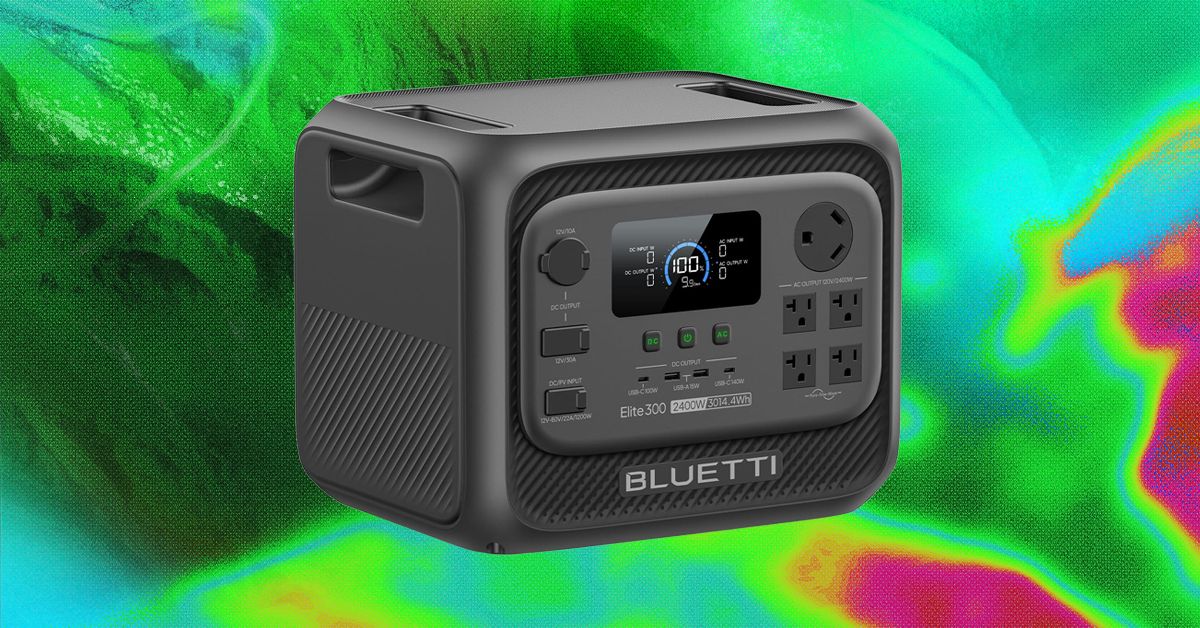
WIRED has updated its 2026 portable power station guide, naming Bluetti’s Elite 300 as its top overall pick after testing battery stations across capacities from 768 watt-hours to 6.4 kilowatt-hours.
The useful bit for buyers is the testing spread. These boxes are not magic generator replacements. They are battery packs with inverters, AC outlets, USB ports and charging circuitry stuffed into one case. Capacity tells you roughly how long they can run gear; output tells you what they can run without tripping. WIRED’s Simon Hill reported measured performance, charging behavior, port layouts, noise and handling, which is the stuff that actually decides whether a “portable” power station is portable or just a back injury with sockets.
Bluetti leads the overall list
WIRED picked the Bluetti Elite 300 as the best overall portable power station. Hill said the unit’s 3,014-watt-hour lithium iron phosphate battery is packed into a chassis closer in size to many 2,000-watt-hour models. In testing, he said it delivered around 85 percent of its rated capacity with smaller devices and less demanding appliances.
The Elite 300 has a 2,400-watt maximum output and a 4,800-watt surge mode. Hill reported that it handled a UK kettle test by briefly exceeding the normal output ceiling, though boiling a full kettle used 7 percent of the battery. Fan noise stayed under 50 decibels during heavy use and dropped quickly below that once load fell under 2,400 watts, according to WIRED.
The drawbacks are physical. WIRED said the Elite 300 weighs just under 58 pounds, has no wheels and is not expandable. It can charge from AC to 80 percent in about 90 minutes at up to 2,300 watts, or fully charge in a little over two hours. Bluetti lists a five-year warranty, and WIRED cited current pricing of $1,099 at Amazon and Bluetti.
Camping and off-road picks split on durability
For camping, WIRED selected Jackery’s Explorer 1500 Ultra. Hill reported that it carries an IP65 rating for dust and rain resistance, is rated to survive a one-meter drop, and weighs just under 40 pounds. Its LiFePO4 battery has a 1,536-watt-hour capacity, a steady 1,800-watt output, a 3,600-watt surge rating and a 90-minute AC recharge time.
Hill said the Jackery came close to its claimed capacity in testing and could run small appliances, power tools and personal electronics. He also noted that its rubber port covers, needed for the weather rating, can be fiddly. WIRED listed it at $1,179 on Amazon and $999 direct from Jackery at the time of the update.
For overlanding, WIRED’s Scott Gilbertson picked Goal Zero’s 2026 Yeti 1500, citing its aluminum-heavy enclosure and design for high-vibration vehicle use. Gilbertson said the unit spent two weeks in the back of his truck on dirt roads in New Mexico and Arizona without damage.
The Yeti 1500 has a 1,505-watt-hour LiFePO4 battery, 2,000 watts of continuous AC output and 3,600 watts of surge capacity. Its 12-volt system is the differentiator: WIRED said its high-power 12V port can deliver 30 amps, compared with the 10-amp ceiling common on many similar batteries. Gilbertson said that makes it suitable for tying into many van and overlanding distribution panels. The price WIRED cited was $1,500.
Anker gets the smaller slot
WIRED named Anker’s Solix C1000 as the best small power station in the visible portion of the guide, listing it at $430 from Anker and Amazon after discounts. The guide also said its July 2026 update added a DJI power station, expanded the FAQ with home battery guidance and refreshed prices.
WIRED disclosed that its editors independently select featured products, while the publication may receive retailer compensation or affiliate revenue from purchases made through its links.
This story draws on original reporting from WIRED.