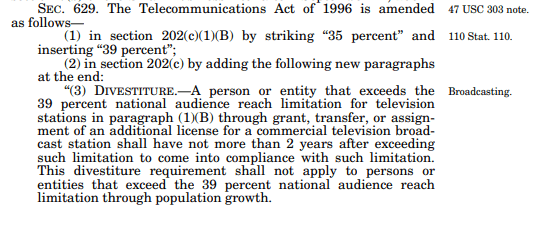
The FCC TV ownership cap is gone, at least as an agency rule. The Federal Communications Commission voted 2-1 on Aug. 6 to eliminate the National Television Ownership Rule, which had prevented one broadcast-station owner from reaching more than 39% of U.S. television households, according to Ars Technica. The agency will instead assess proposed combinations individually under its public-interest standard.
That is a consequential change for station owners seeking larger mergers. It is also an unresolved legal fight over whether the FCC can erase a limit Congress wrote into law.
Chairman Brendan Carr argued that the former cap restrained broadcasters as streaming companies, which do not face the same national reach limit, compete for audiences and advertising. Carr’s office said case-by-case review would let the commission approve transactions it finds serve the public interest and reject those it does not. At the FCC meeting, Carr said greater scale could help stations finance local programming and news coverage, Ars Technica reported.
Can the FCC remove the TV ownership cap without Congress?
The evidence so far does not settle that question. Carr says it can. Democratic Commissioner Anna Gomez, Rep. Frank Pallone and several current or former Republican officials cited by Gomez say it cannot.
The dispute turns on two different moments in the rule’s history. In 2003, the FCC raised the then-35% ceiling to 45%. Congress responded in 2004 by setting the cap at 39% in the Consolidated Appropriations Act, according to Colorado Public Radio and Pallone’s office. The law also removed the cap from the FCC’s regular quadrennial review of media-ownership rules.
Gomez said Congress deliberately made the 39% figure statutory and that only a later act of Congress can alter it. Her position is shared, she said, by former FCC Commissioner Mike O’Rielly, former House Majority Leader Tom DeLay, and Senate Commerce Committee Chair Ted Cruz. Cruz told CPR News he had serious concerns about whether the agency has authority to make the change.
Carr relies in part on a 2002 decision from the U.S. Court of Appeals for the D.C. Circuit. That ruling described Congress’s earlier 35% instruction as a starting point for the FCC to consider further change. Carr also said prior FCC chairs had taken the view that the commission could modify the cap outside the quadrennial-review process. The complication is chronological rather than mystical: the decision came before Congress enacted the 2004 39% provision and restricted the agency’s review process.
What does case-by-case review mean for broadcasters?
Instead of blocking a deal once a buyer’s stations would exceed a fixed national audience threshold, the FCC says it will weigh that deal on its own facts under the public-interest standard. That gives the commission more discretion over transactions that would once have crossed the 39% line.
Broadcaster advocates have argued that ownership restrictions should be updated. Curtis LeGeyt of the National Association of Broadcasters told a Senate hearing that rules applied only to broadcasters were no longer sustainable while cable, technology and streaming companies face different constraints, CPR News reported.
Opponents see the same discretion as a route to greater concentration. Pallone, the ranking Democrat on the House Energy and Commerce Committee, said in February that changing the cap would require congressional action and could favor the largest station groups. Those are his assertions, not a judicial finding.
Free Press has said it plans to sue to block the FCC’s action, according to Ars Technica. Any such challenge could test the competing readings of the 2004 law, but no court outcome is established in the available reporting.
This story draws on original reporting from Techdirt.