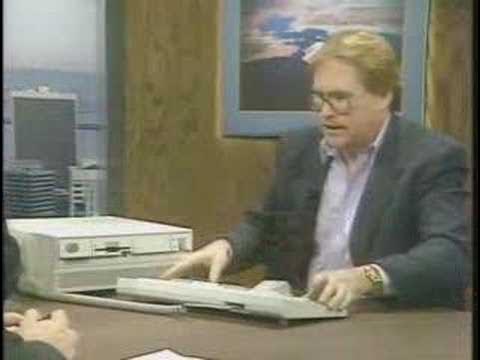
A public YouTube clip gives a compact time capsule of the John Dvorak IBM PS/2 reaction in 1987: respect for IBM’s mechanical engineering, real doubt about its performance, and a lot of side-eye at claims that the machine’s architecture was open.
The 7-minute, 35-second video, titled “Cranky Geeks 1987,” was uploaded by hayyoodotcom on March 23, 2008. Its description says John C. Dvorak appeared on Computer Chronicles in 1987 to discuss IBM’s then-new Personal System/2. The upload is public, listed under Science & Technology, and shows 27,376 views and 255 likes.
What did John Dvorak say about IBM PS/2?
Dvorak, identified in the segment as a contributing editor at PC Magazine, gave IBM credit for the PS/2’s compact case and internal design. He called the engineering inside the machine impressive, particularly the way parts could be removed and replaced without the tangle of cables common in older PCs.
His approval stopped there. Dvorak said the machine’s overall performance, apart from the hard disk behavior, looked dated rather than exceptional. He pointed to a benchmark display that he said showed the system running effectively at 9.8 MHz and criticized the memory design as using one wait state, which he described as old-fashioned. He also called the screen blurry and said the machine had several small irritations.
Dvorak also challenged the idea that IBM had delivered an open platform. In his view, the PS/2 was open only in a limited sense because IBM’s patents created legal risk for companies trying to copy parts of the system. He said clone manufacturers were spending time with lawyers trying to determine whether they could build compatible systems or even expansion cards without triggering patent claims.
Why did the PS/2 design matter to businesses?
The segment made clear that IBM’s target buyer was not the hobbyist who wanted a machine to admire on a desk. David Bunnell, identified as editor-in-chief of PC World, said the PS/2 line was likely to sell well in large companies with mainframe environments, but he did not see it as a machine people would “lust after.” He contrasted it with earlier systems such as the original IBM PC, the Macintosh and the Apple II, which he said had generated that kind of demand.
Dvorak’s hands-on demonstration centered on serviceability. He removed parts of the PS/2 case on camera and showed how components such as the hard disk were intended to slide out and be replaced. The demo was not perfectly smooth, which was funny in the way live computer television often is, but the point landed: IBM had designed the machine so service technicians could swap parts quickly inside large organizations.
Dvorak said that could reduce service-contract costs for big companies because repairs could be handled by replacing modules rather than tracing cables and components inside a more chaotic case. Bunnell agreed that the machines appeared aimed at large corporations, while saying their impact on small businesses, education and midsize companies was still uncertain.
What about clones, pricing and OS/2?
On cloning, Bunnell questioned whether the market needed direct PS/2 copies at all. He said machines already existed that matched the PS/2’s performance, and that OS/2, when available, was expected to move across other bus architectures. Dvorak added that the PS/2 bus was technically attractive for faster future systems, including 386-based machines, but he did not sound alarmed about clone makers missing out on IBM’s exact design.
Bunnell said IBM’s pricing looked high, while adding that computer makers often start with higher prices and later cut them. He also said the PS/2’s manufacturing costs were about 40% lower than the traditional IBM PC line, which in his view gave IBM room to reduce prices if needed.
Asked for the good and bad, Dvorak returned to the hardware. He said the PS/2 set a higher bar for internal engineering, with no cable mess inside and a design that looked suitable for robotic assembly. Bunnell pointed instead to OS/2 and its promise of moving beyond the 640K memory limit, enabling multitasking and new software categories, while cautioning that the timing of its release remained unresolved.
This story draws on original reporting from YouTube.