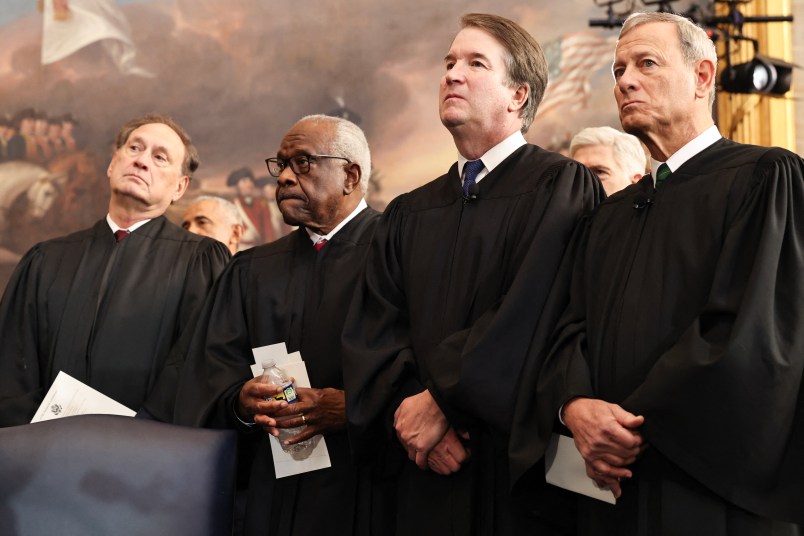
The Supreme Court has upheld the constitutionality of birthright citizenship in a 6-3 decision, according to Talking Points Memo, keeping intact one of the most contested readings of the 14th Amendment.
TPM’s Kate Riga reported on the majority ruling, while Josh Kovensky reported that the dissenting conservative justices signaled an interest in ending birthright citizenship. TPM founder and editor-in-chief Josh Marshall, writing in the site’s Backchannel newsletter, identified Justices Neil Gorsuch, Samuel Alito and Clarence Thomas as the dissenters.
The ruling matters because birthright citizenship determines who is a citizen from birth, a threshold question with consequences for legal status, political rights and family security. The fight is not a technical footnote. It is a dispute over whether the constitutional text adopted after the Civil War continues to do the work it has long been understood to do.
The precedent behind the ruling
Marshall pointed to United States v. Wong Kim Ark, the 1898 Supreme Court case that has long anchored the modern understanding of birthright citizenship. In his account, that decision is powerful evidence for the constitutional rule because the court reached it at a time when anti-Asian racism was entrenched in American politics and law.
Marshall argued that the late-19th-century court was not operating in an era especially friendly to equal citizenship claims. He noted that Plessy v. Ferguson, the decision associated with constitutional approval of segregation, had been decided two years earlier. Against that backdrop, he said, the text and intent of the 14th Amendment were too clear for the court in Wong Kim Ark to avoid.
That is the mechanism of the legal argument as Marshall framed it: the constitutional language did the heavy lifting. He said the dissenters in the 1898 case had little more than historical discomfort and policy objections, rather than a persuasive textual argument.
A ruling, and a reform argument
Marshall did not treat the new decision as a vindication of the current Supreme Court. He argued the opposite. In his view, the court’s occasional decision that reaches what he sees as the correct constitutional answer does not address what he called corruption and impunity at the court.
His sharpest criticism was reserved for the three dissenters. Marshall said that, in what he called a sane world, the dissents from Gorsuch, Alito and Thomas would justify impeachment and removal. That is Marshall’s argument, not a finding by any court or official body.
The split leaves two facts on the table. The court preserved birthright citizenship, according to TPM’s report. Three conservative justices opposed that result, and TPM’s coverage described their dissents as a marker that the legal campaign against birthright citizenship is not finished.
This story draws on original reporting from TPM – Talking Points Memo.