Katalyst sells a $3,000 home fitness suit that uses electrical muscle stimulation to make muscles contract during app-led workouts. The company’s pitch is blunt: users can get what Katalyst describes as the equivalent of a two-hour strength session in 20 minutes.
A monthlong 404 Media test found a less tidy reality. The reviewer said the suit caused pins and needles in the hands and feet, with foot tingling lasting for days, and left limbs numb and cold. It also interfered with rowing and swimming sessions the reviewer already used for regular exercise. The suit is being sent back.
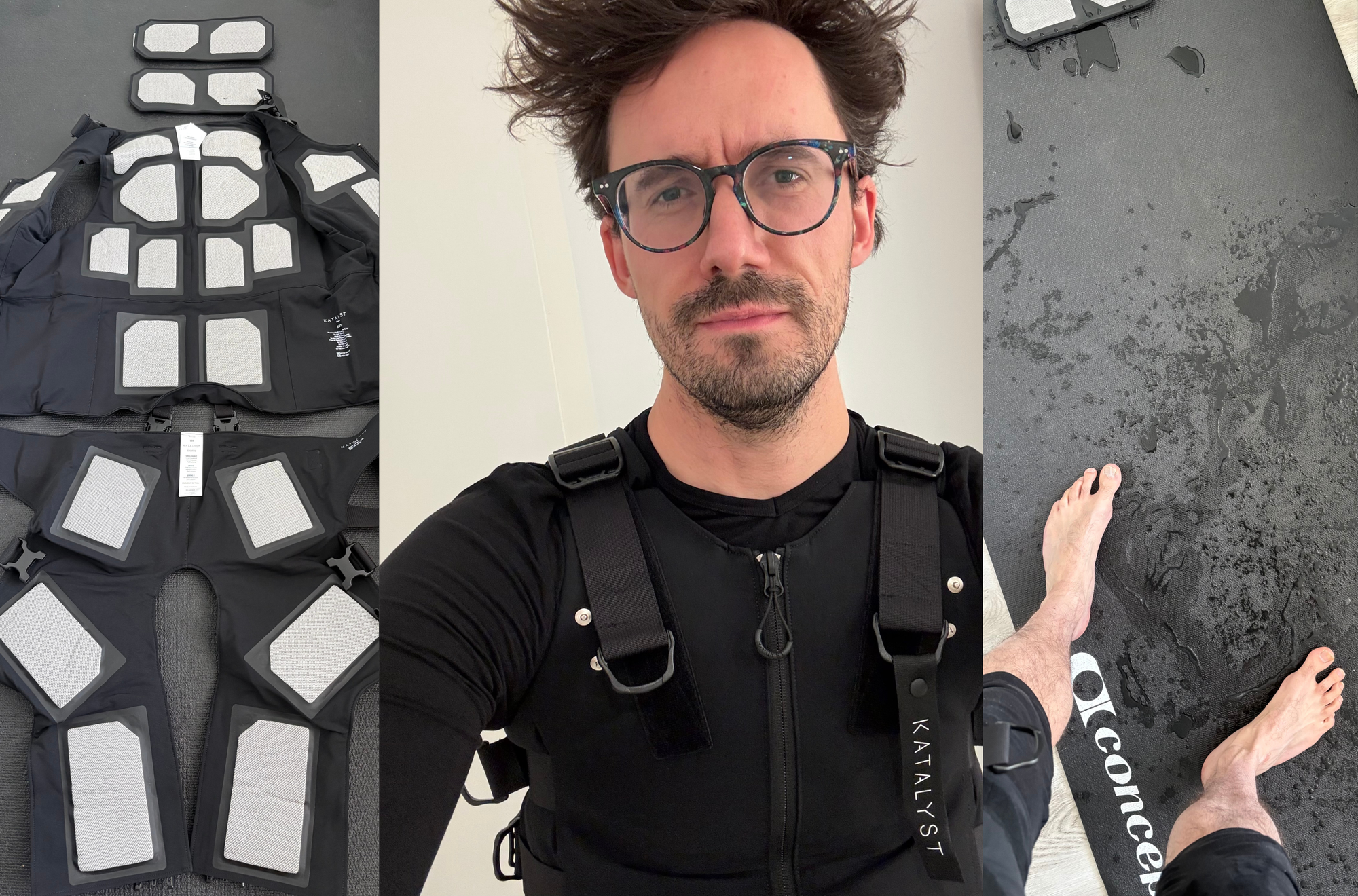
The hardware is more wet lab than gym bag. Katalyst’s setup uses a vest, shorts and arm straps with electrode pads that must be sprayed with water before use. Chief executive Brendan Kennedy told 404 Media that “more water is better.” Katalyst says the moisture improves conductivity between the electrodes and skin.
Once assembled, a battery pack connects to the suit, and the app leads the user through movements such as squats, lunges and deadlift-like motions. The pads send pulses that contract the muscles. During workouts, users can raise or lower stimulation levels in the app. The routine described by 404 Media uses four seconds of movement under stimulation followed by four seconds of rest, for a 20-minute session.
The appeal is obvious enough: less time, more contraction, no commute to a gym. George Clooney praised the suit in Esquire, saying his arms were “twice the size they’ve ever been.” Bloomberg Businessweek also reported favorably on the device.
Other users have reported strong results. AustinAfter40, a YouTuber who makes EMS-related videos, told 404 Media he gained 10 pounds of muscle in the first few months after getting an EMS suit in 2023 and later reached 20 pounds, while using little weight training. 404 Media noted that he earns money from affiliate links and has since moved to TitanBody, a Katalyst competitor.
The category is messy. EMS suit makers do not use a shared intensity scale, so a setting on Katalyst does not map cleanly to one from TitanBody, VisionBody or another brand. Katalyst is FDA-cleared, which means it can be marketed, but that is not the same as FDA approval. The device is in the FDA’s Class II category, described as moderate risk.
Researchers and trainers were split on the broader promise. Yong-Seok Jee, a Hanseo University professor who has researched EMS, told 404 Media that EMS can be useful for non-athletes as a time-efficient, low-impact option, especially for beginners, older adults or people with limited mobility. He also said it is not a replacement for exercise and depends on intensity, supervision and program design.
Casey Johnston, who writes the lifting-focused newsletter She’s a Beast and authored “A Physical Education,” was much harsher. She told 404 Media that Katalyst is not a replacement for strength training or an effective complement to it, and argued that the suit could interfere with learning proper movement and form.
Katalyst has also had business turbulence. Kennedy acquired the company in 2025 through Mont y Mer. He told 404 Media that founder and former CEO Bjoern Woltermann had “essentially bankrupted the company twice in six years” and had taken payment from more than 1,000 customers without producing their suits. Kennedy said he traveled to suppliers to get those orders made and that Katalyst now has inventory. Woltermann acknowledged 404 Media’s request for comment but did not respond before publication.
The test does not prove Katalyst cannot help some users. It does show the gap between a clean efficiency pitch and the daily mechanics of a wet, wired suit that shocks muscles on a schedule. For at least one motivated fitness-tech buyer, the promised shortcut made exercise worse.
This story draws on original reporting from 404 Media.