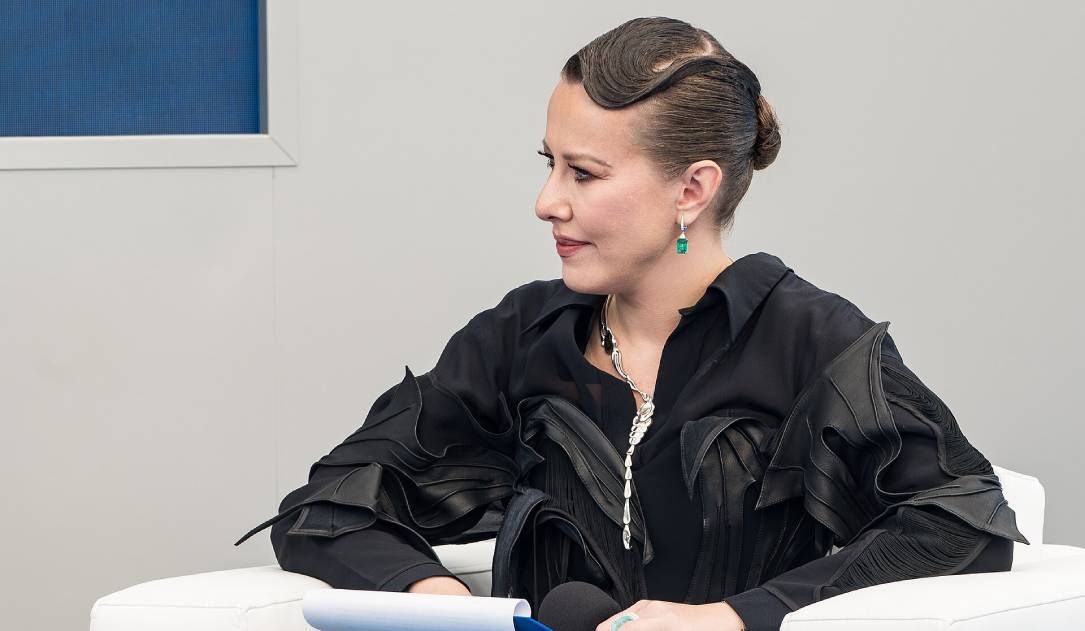
Russian journalist and media executive Ksenia Sobchak said hackers got into several of her Telegram channels last week through her email account, then used that access to publish screenshots they presented as private correspondence.
The posts appeared on the Telegram channels Sobchak and Bloody Lady. Sobchak’s news channel, Caution, News, later said the messages had been posted by attackers who had compromised the channels.
Sobchak said on Telegram that the attackers reached the channels through her email account. She did not describe the exact login or recovery path used, so the technical route remains unclear beyond her claim that email access was the entry point. In comments to the independent Russian outlet Meduza on Sunday, Sobchak said the screenshots were fake and had been placed on her hijacked channel “to serve someone’s interests.”
The material carried the watermark of Black Mirror, a hacker group that says it obtained more than 350 gigabytes of Sobchak’s data covering the years 2015 through 2026. Black Mirror has offered the alleged archive for sale on its Telegram channel, according to the group’s own posts.
Black Mirror claims a larger archive
Black Mirror published more material on July 9. The anonymous Telegram channel VChK-OGPU also released what it described as voice messages from the same cache.
According to Black Mirror, the archive includes conversations between Sobchak and senior Russian officials, as well as Andriy Yermak, described by the hackers as the former head of Ukraine’s presidential office. Those claims have not been independently verified, and neither the authenticity of the leaked files nor the size of the alleged archive has been confirmed.
That caveat matters. A compromised Telegram channel can make a forged leak look more credible because the material appears in a place readers already associate with the target. It does not prove the documents are genuine, and Sobchak has denied that the screenshots reflect real exchanges.
Black Mirror has been active since at least 2019, according to Radio Free Europe/Radio Liberty. The group has marketed alleged data stolen from people linked to the Russian state and has previously offered archives it claimed belonged to former Russian Defense Minister Sergei Shoigu and the late Wagner chief Yevgeny Prigozhin.
Sobchak’s political and media profile
Sobchak remains a prominent and polarizing figure in Russian public life. She is the daughter of Anatoly Sobchak, the former mayor of St. Petersburg. Russian media have described Anatoly Sobchak as President Vladimir Putin’s political mentor and a close family friend.
She ran against Putin in Russia’s 2018 presidential election. Critics, including analysts cited by the Carnegie Endowment for International Peace at the time, argued that her campaign fit the Kremlin’s practice of allowing controlled opposition figures to create the appearance of political competition without posing a serious threat to the incumbent.
Sobchak now runs Ostorozhno Media, a media holding that operates a YouTube channel and several Telegram news channels with millions of subscribers. That reach is why control of her Telegram accounts matters: a short-lived channel takeover can push disputed material to a large audience before the owner regains access or the provenance is sorted out.
This story draws on original reporting from The Record.