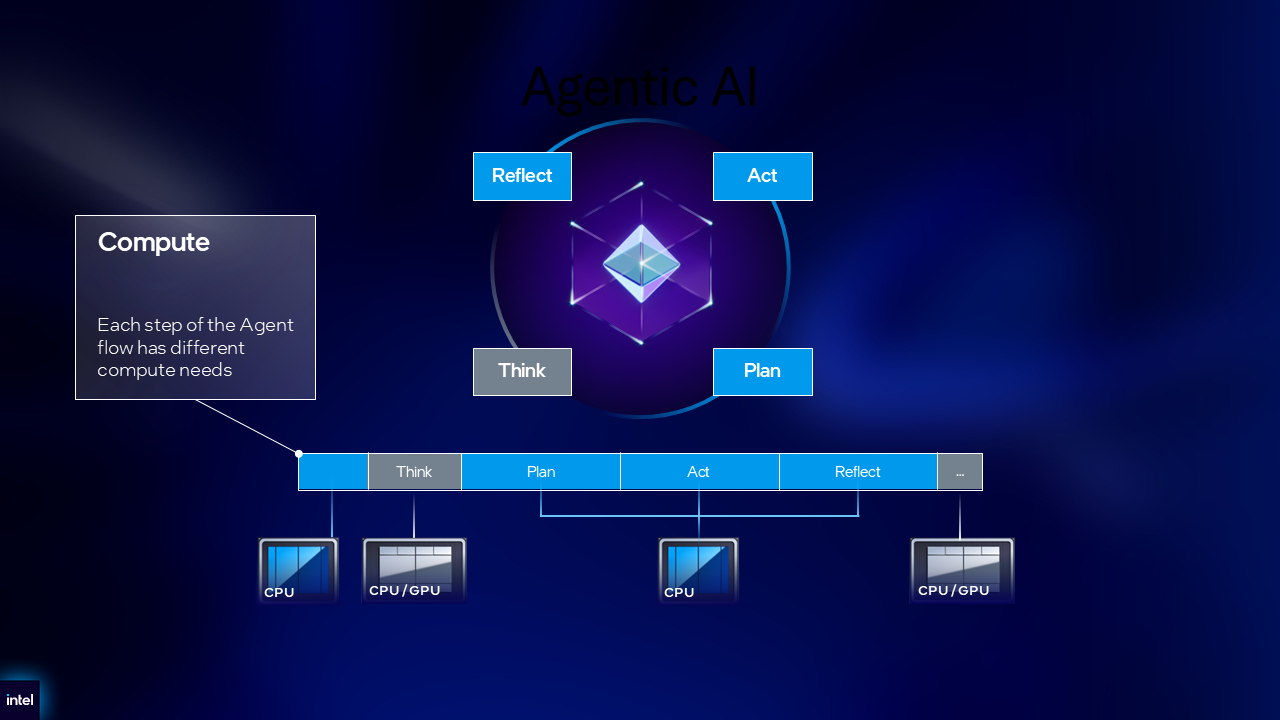
Agentic AI enterprise infrastructure should be treated as a full systems problem rather than a prettier chatbot deployment, Intel said after running thousands of workload experiments on AI agents. The company’s argument is blunt: if software agents are going to carry out business tasks across people, data, tools, and internal systems, the platform has to be engineered for capacity, access control, observability, memory, and predictable scaling.
Intel described agentic AI as workflow automation driven by software agents that can plan a task, call tools, read outputs, and retry after failures. That means the large language model is only one moving part. The less glamorous plumbing, including CPU capacity, data availability, policy-aware tool use, latency control, and governance, becomes the difference between a demo and something an enterprise can run without creating a new operational mess.
What does enterprise agentic AI need?
Intel said enterprise teams should judge agent platforms by business execution metrics, not only by model scores. In its view, operators need to know whether tasks finish successfully, how long they take, how many agents a compute fleet can support, what the user sees at the end of a workflow, and how costs change as concurrency rises.
The company listed six measures it considers more useful for production systems:
- Task success rate
- Cost per task
- Time per task
- Task throughput
- Agent density, measured as agents per virtual CPU
- Latency
That framing shifts capacity planning away from a raw count of agents. Intel said teams should think in agents per vCPU because the same density can behave similarly across different system sizes. Its example: 10 agents on an 8-vCPU system and 20 agents on a 16-vCPU system may show comparable behavior if the density is equal.
The right density depends on the workload. Intel said interactive copilots and user-facing assistants should generally run at lower density because response time is part of the product. Batch work, such as some IT automation, can often tolerate higher density if service targets allow it.
How did Intel test agent workloads?
Intel said it extended Terminal-Bench, an open source benchmarking harness for evaluating AI agents, adding profiling, telemetry, and replay capabilities. The goal was to see where agents spent time beyond LLM inference, which is where a lot of vendor storytelling tends to stop reading the stack trace.
To reduce noise from changing model responses, Intel used deterministic record-replay. It recorded LLM outputs once and replayed the same responses across runs, which the company said made comparisons more reliable by separating agent and system behavior from model variability.
The task set was deliberately broad, according to Intel. It included compilation, testing, database work, Boolean logic, interpretation, ray tracing, compression, linear algebra, video transcoding, and machine learning training. Intel said that mix was meant to resemble the variety of enterprise work more closely than a narrow inference benchmark would.
What should teams monitor?
Intel warned that average CPU utilization is a weak primary signal for agentic workloads. Agents may sit idle while waiting for model responses, then produce short compute-heavy bursts. Average utilization can look fine while queues form and users wait.
Intel recommends watching P95 task latency first, then checking sustained task duration to confirm whether a performance problem is building. In plain terms, latency shows when workflows are starting to get stuck before the average numbers look ugly enough to get someone paged.
On scaling, Intel said enterprises should usually add more systems rather than first building larger individual machines. The company said scale-out fits many agent workloads because agents are often semi-independent and have modest per-agent compute bursts. It also said scaling out can support high availability, improve performance, reduce cost, and help preserve a target agents-per-vCPU ratio.
Intel reserved scale-up for cases where agents need heavier parallel compute, shared state is hard to partition, memory locality matters, or licensing terms constrain deployment. The broader business target, Intel said, is not novelty chasing. It is production automation around workflows that already have rules and measurable service levels, including code creation, regression testing, ticket triage, market analysis, and security review.
This story draws on original reporting from MIT Technology Review.