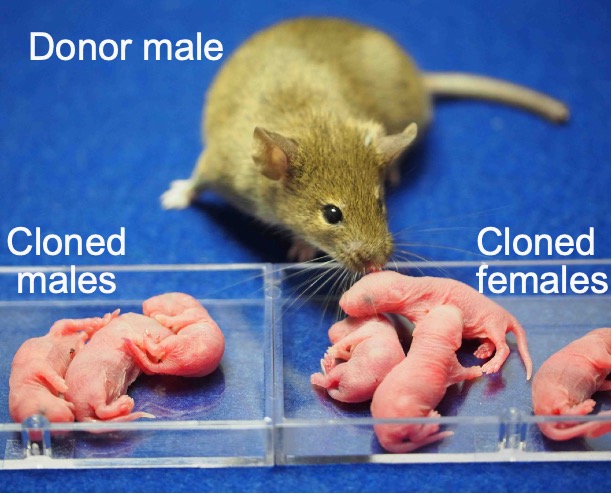
A Japan-based team has reported creating female clones of male mice by removing the donor cells’ Y chromosome before embryos were carried by surrogates. The result is a biological first worth parsing carefully: it is a mouse experiment, described in a bioRxiv preprint that has not undergone peer review, and it still required egg cells and surrogate mothers.
Takashi Ishiuchi of the University of Yamanashi and Shogo Matoba of the Riken BioResource Research Center led the work, according to MIT Technology Review. Their CRISPR-based method, called Y-CUT, was designed to make cells lose the Y chromosome during division.
Female mammals typically have two X chromosomes, while males typically have one X and one Y. The treated animals in this experiment were XO, carrying one X chromosome and no Y chromosome. The researchers reported that the XO pups grew up healthy and fertile.
How did researchers make female clones of male mice?
The team used a standard cloning setup: researchers put the DNA-containing nucleus from a donor cell into an egg cell whose own DNA had been removed. That reconstructed cell can develop into an embryo, which is then transferred to a surrogate.
For the reported female clones, the scientists made cloned cells from male mice, treated some with Y-CUT, and transferred the resulting embryos into surrogates. The female offspring were genetically identical to the male donor except that the Y chromosome was absent, MIT Technology Review reported.
The group also reported making female clones from cryopreserved male cells. It said cloned male and female mice created in those experiments mated and produced healthy pups. Those claims remain preliminary until other researchers can assess the preprint and reproduce the work.
Is this the same as making mice with two male parents?
No. The new work changes the sex-chromosome makeup of a clone derived from a male donor. It does not produce an animal from two male genetic parents.
A separate 2025 study used a far more elaborate route to make bipaternal mice: researchers edited 20 genes involved in genomic imprinting in male haploid embryonic stem cells, then combined a modified cell and sperm in an enucleated egg. Chemical & Engineering News reported that some of those mice reached adulthood, but they were sterile and had growth defects.
Genomic imprinting is one reason mammalian same-sex reproduction is such a technical headache. For certain genes, whether a copy is active depends on whether it came from a mother or a father. A 2004 two-mother mouse experiment likewise required specialized manipulation of egg-cell genetic material to address those parent-specific expression patterns, Science reported.
What could Y-CUT be used for?
Ishiuchi and Matoba see a possible conservation application where only male samples from an endangered species remain in frozen cell collections. In theory, a related method might generate females from those samples. That remains a proposal, not a demonstration in any endangered species or any mammal beyond mice.
The experiment also does not remove the practical dependence on eggs or surrogates. It changes a chromosome in a cloning workflow; it does not establish a route to mammalian reproduction without female biological material.
This story draws on original reporting from MIT Technology Review.