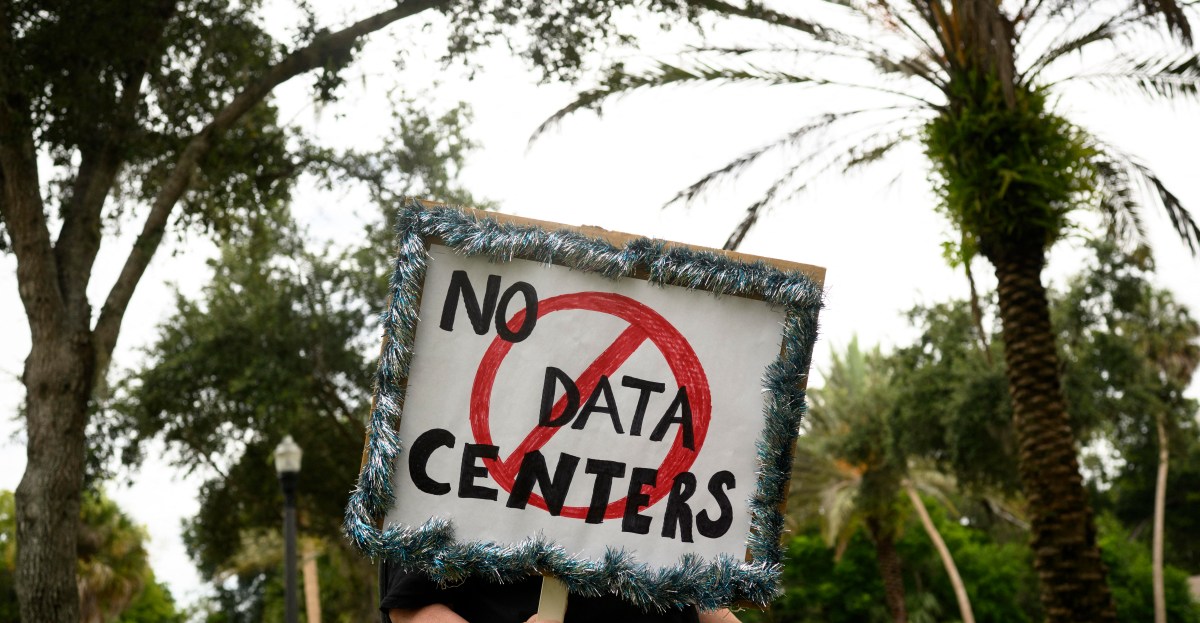
Florida’s data center backlash has moved well beyond the usual environmental and local-planning fights. In Hernando County, conservative residents are now pushing for a full ban on hyperscale projects after county commissioners approved a one-year moratorium in June, according to The Verge.
The protest outside the Spring Hill Branch Library drew fewer than a dozen people, The Verge reported, but it was part of a wider day of action tied to Humans First, a group that describes itself as a conservative movement focused on keeping AI’s future in the hands of ordinary people. The Hernando group, No Data Centers Hernando County, wants local officials to go further than a pause.
The complaints are familiar to anyone tracking data center fights: noise, water use, electricity demand, land use, and the sense that communities are being asked to host industrial infrastructure for benefits that flow somewhere else. In Hernando, residents also tied the projects to AI job losses, government surveillance, and dependence on Chinese-made components.
One protester, identified by The Verge as Carol, a 71-year-old retired country radio host and conservative, claimed nearby residents would hear data center noise around the clock. She also raised concerns about ChatGPT’s effect on users and repeated unverified claims about livestock and pollinators near data centers. Those claims are a reminder that the anti-data-center movement contains both grounded infrastructure complaints and a fair amount of static.
The politics are less noisy and more consequential. Gallup recently found that seven in 10 Americans oppose data centers being built near them, with opposition from nearly two-thirds of Republicans and 75 percent of Democrats surveyed. That gives local anti-data-center campaigns a rare bipartisan fuel source, even if the reasons vary by voter.
Florida Republicans face a local revolt
Humans First is led by Amy Kremer, a longtime conservative organizer associated with the Tea Party, Women for Trump, and Women for America First, according to The Washington Post. The Hernando protest still focused on county-level fights: zoning, utility costs, and whether local governments should make room for hyperscale facilities.
IBM defines hyperscale data centers as facilities of at least 10,000 square feet with a minimum power draw of 100 megawatts. That power is the point. AI companies need dense clusters of servers, networking gear, cooling systems, and utility connections to train and run large models. The same hardware that makes the services work also makes the facilities hard to hide from the grid and from neighbors.
Patti Zirhut, an organizer with No Data Center Hernando County, told The Verge she is a lifelong Republican but feels let down by Florida’s GOP leadership. She criticized Gov. Ron DeSantis as too friendly to development, even though DeSantis signed a May law requiring hyperscale data centers to pay their own utility costs and allowing local governments to regulate their water use. The Tampa Bay Times has reported that his administration also gave data center developers millions of dollars in tax breaks.
The issue is now bleeding into the governor’s race. Rep. Byron Donalds, the Republican front-runner, has supported data center construction and said in February that data centers will be part of American life. The Tallahassee Democrat reported that Donalds has received more than $5 million from Leading the Future, a pro-AI super PAC backed by tech investors including Andreessen Horowitz and Palantir co-founder Joe Lonsdale, plus $500,000 from American Mission, which is funded by Leading the Future. Donalds announced legislation Monday aimed at stopping data centers from raising utility bills, according to the Associated Press.
Politico reported that more than 20 Florida counties and municipalities have considered or passed data center moratoria. In Citrus County, a developer withdrew a proposed 800-acre project after commissioners approved a one-year freeze on rezoning applications, Fox 13 reported.
The industry is warning that moratoria tell companies to take their projects elsewhere. Dan Diorio of the Data Center Coalition told The Verge that such pauses could signal that an area is closed to data centers and other major development. For Hernando organizers, that appears to be a feature, not a bug.
This story draws on original reporting from The Verge.