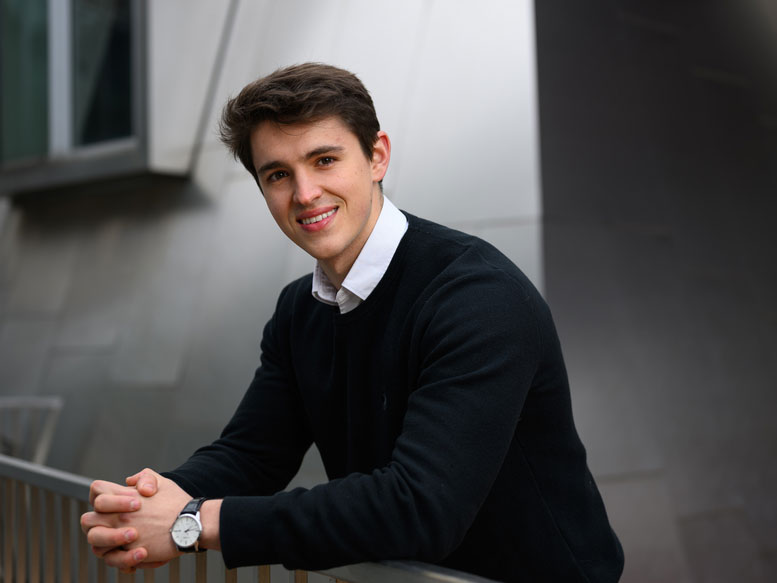
The “Humans aren’t electronics” essay by Strahinja Janjušević has been selected as one of three finalists for MIT’s 2026 Envisioning the Future of Computing Prize. Its premise is blunt: assistive systems that restore movement or perception cannot be handled as disposable gadgets when a user’s daily independence may depend on software, replacement hardware and the company behind them.
Janjušević, who recently completed a master’s degree in MIT’s Technology and Policy Program, frames the piece as a warning alongside an optimistic case for AI-enabled neural prosthetics. The prize is co-sponsored by MIT’s School of Humanities, Arts, and Social Sciences and the Schwarzman College of Computing’s Social and Ethical Responsibilities of Computing initiative, according to MIT Technology Review.
The essay opens in a fictional 2029, where a man with a spinal-cord injury relies on a brain-computer interface and AI-controlled exoskeleton to move. A failed license check then suspends the system’s motor functions. That episode is a thought experiment, not a report of a current device failure, and Janjušević’s forecasts about widespread AI prostheses and their risks remain proposals rather than established outcomes.
Why does the essay say humans aren’t electronics?
Janjušević argues that AI systems could make prosthetic control less cumbersome by interpreting a person’s intended movement rather than requiring users to issue a string of basic commands. In his description, a model could combine neural signals with information about a hand, an object and the surrounding physical situation to guide movement.
That possible gain creates a dependency problem, the essay argues. A system that depends on proprietary software, licensing, repairs and continued vendor support could leave its user exposed when any of those pieces disappear. Janjušević proposes new patient-protection standards, although the published excerpt does not say what those standards would require.
The essay points to Second Sight Medical Products’ Argus II program as a real case showing why post-sale support deserves attention. The company’s experience was more complicated than the essay’s dystopian shorthand. In 2022, the Foundation Fighting Blindness reported that Second Sight agreed to merge with Nano Precision Medicine after revenue shortfalls, worsened by the COVID-19 pandemic, led to significant cuts in operations.
Second Sight had stopped manufacturing and implanting Argus II in May 2019. Its acting chief executive said the company had fallen from more than 120 employees to 12 by May 2020, limiting the support it could provide. The company planned limited continued assistance for existing users, with replacement glasses or video-processing units available from constrained supplies on a case-by-case basis.
Argus II was FDA-approved in 2013 under a humanitarian device exemption. It paired glasses containing a camera and a video-processing unit with an implanted electronics package and electrode array near the retina. According to the Foundation Fighting Blindness, the system could allow some people with little or no vision to detect shapes, outlines, movement and perform basic visual tasks.
Janjušević’s point is not that an AI prosthesis exists today that can be remotely shut down after a subscription dispute. It is that designers, companies and policymakers should confront ownership, maintenance and corporate survival before function-restoring technology becomes more deeply embedded in the body.
This story draws on original reporting from MIT Technology Review.