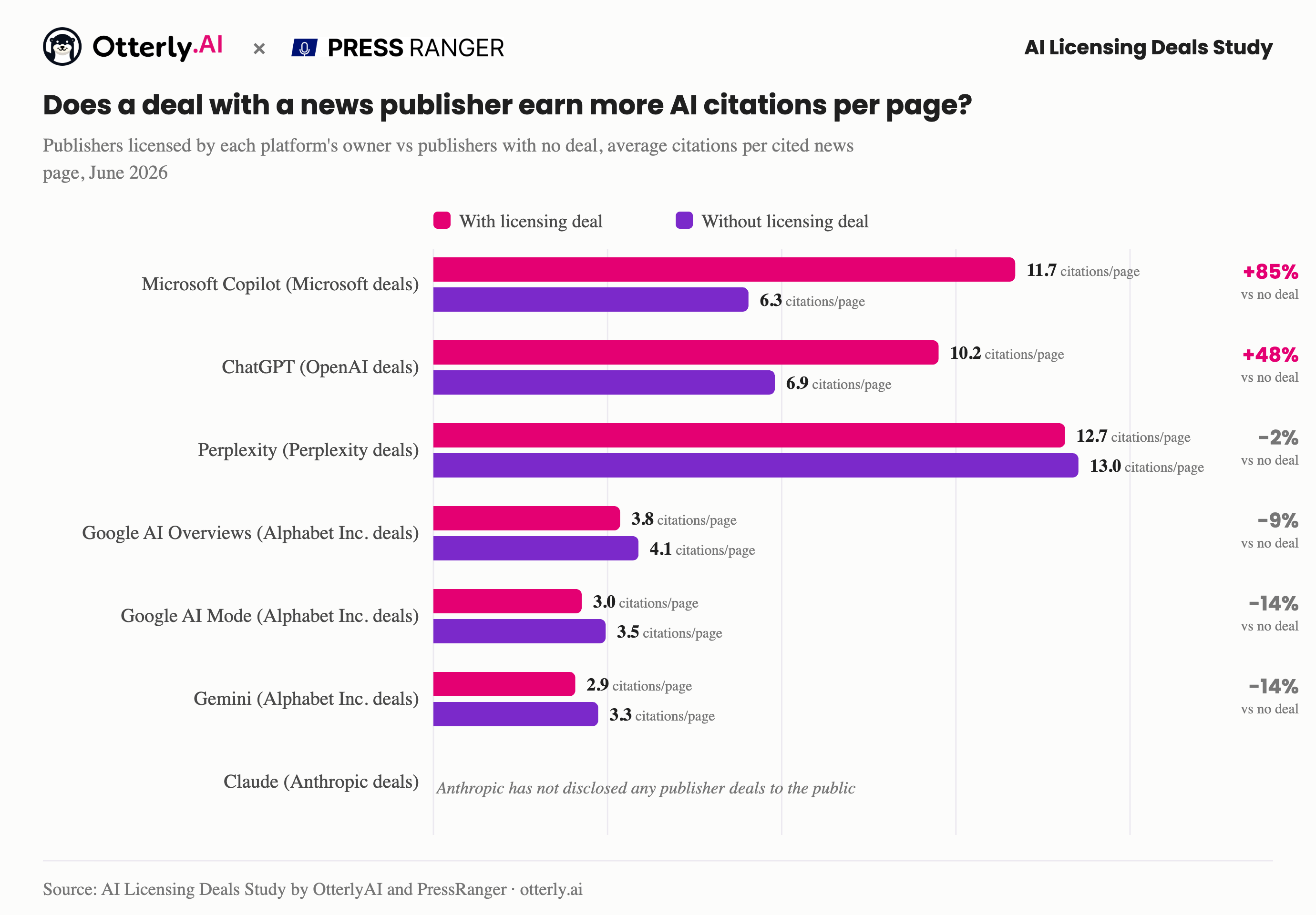
Press Ranger and OtterlyAI released a study on Aug. 20 reporting that publishers with OpenAI licensing agreements averaged more ChatGPT citations per page than publishers without such agreements. The OpenAI deals ChatGPT citations analysis puts the averages at 10.2 and 6.9, respectively, a 48% difference.
The result is an observational comparison, not proof that signing an OpenAI deal produces more citations. The companies did not describe controls for differences between the publisher groups, including their size, subject coverage, authority, output volume or mix of content. Those variables could also shape how frequently a page appears in AI answers.
The companies matched 129.3 million citations across more than 20 million cited URLs with 91 confirmed AI-publisher agreements covering 314 publisher domains. OtterlyAI collected citations during June across ChatGPT, Google AI Overviews, Google AI Mode, Perplexity, Microsoft Copilot, Gemini and Claude; Press Ranger supplied the agreement records.
Do OpenAI deals lead to more ChatGPT citations?
The study establishes a correlation in the partners' datasets, not a causal answer. Its platform-specific split is the interesting bit: publishers with OpenAI agreements received 57.9% of their AI citation volume from ChatGPT, according to the announcement. Publishers that had OpenAI-only deals reportedly received 112% more ChatGPT citations per page than unlicensed publishers.
Across all seven services, the OpenAI-agreement group averaged 10.7 citations per cited page, versus 7.3 for publishers without a deal, a reported 46% difference. The pattern did not repeat cleanly for other licensors: Google-licensed publishers were cited slightly less frequently than comparable unlicensed publishers in Google AI Overviews, while Perplexity-licensed publishers were at parity on Perplexity.
Publisher agreements can cover several rights, but the terms vary. OpenAI's 2023 agreement with Axel Springer provided for selected content to be summarized in ChatGPT with attribution and links, and for use of the publisher's content to advance model training. Those terms establish permissions, not how ChatGPT chooses citations for a particular answer.
The findings arrive from two companies with a commercial stake in AI-search measurement and visibility. OtterlyAI sells AI-search monitoring and optimization tools, while Press Ranger's AI-search visibility services include PR and distribution software. That does not settle the data either way, but it makes the study's limits worth keeping in view.
The announcement's own results also complicate any simple licensed-versus-unlicensed story. News made up 7.2% of all citations measured. In 15 of 16 U.S. industries examined, niche and trade publications accounted for most news citations, and the companies reported that such outlets received 213% more AI citations than mainstream media. Best-of lists, buying guides and product reviews accounted for 46.9% of citations to licensed publishers in the dataset.