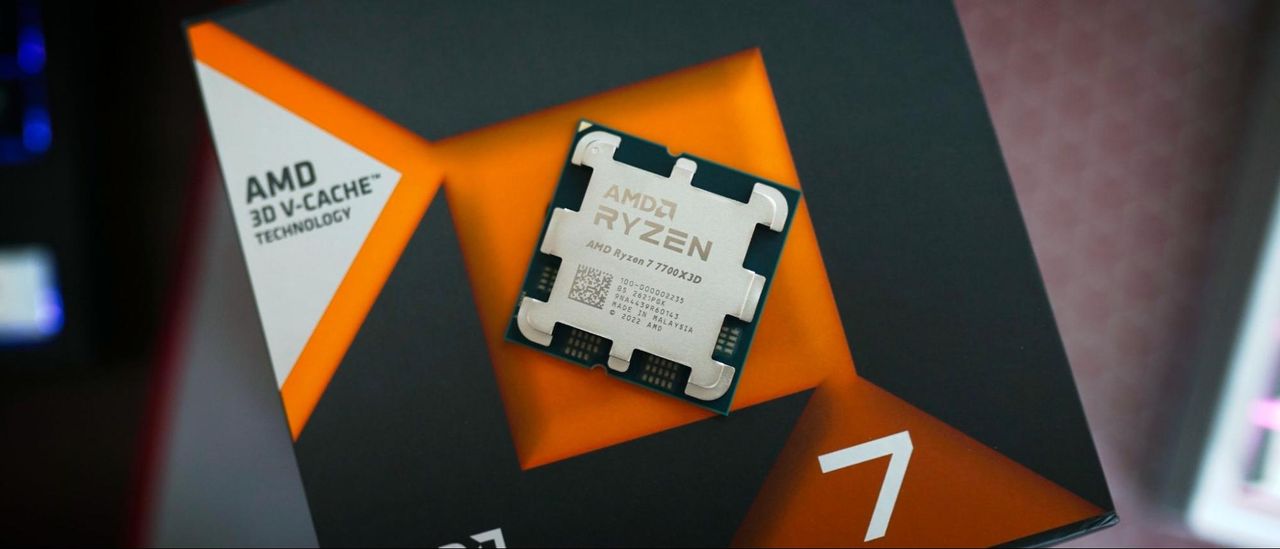
AMD’s Ryzen 7 7700X3D is arriving as a cheaper, lower-clocked version of the Ryzen 7 7800X3D, and Tom’s Hardware’s review says the chip performs about as expected: strong in games, efficient under load, and priced a little too close to better or cheaper alternatives.
The processor lists for $330 and is available exclusively through Newegg, according to Tom’s Hardware. It uses AMD’s Zen 4 X3D design with eight cores, 16 threads, and 104 MB of combined L2 and L3 cache. That cache figure includes 64 MB of L3 stacked on the chiplet, the bit of AMD’s 3D V-Cache trick that often helps games by keeping more data near the CPU instead of bouncing out to system memory.
The catch is clocks. Compared with the Ryzen 7 7800X3D, the 7700X3D drops from a 4.2 GHz base clock to 4.0 GHz and from a 5.0 GHz boost clock to 4.5 GHz. Tom’s Hardware described it as the only material specification cut versus the 7800X3D. Both chips carry a 120 W TDP and 162 W maximum power rating.
Performance is fine. The pricing is the problem.
In Tom’s Hardware’s 1080p gaming test suite, run with an RTX 5090 to reduce GPU bottlenecks, the Ryzen 7 7800X3D was 4% faster than the 7700X3D on average. The cheaper Ryzen 5 7600X3D was only 2% behind the 7700X3D despite having six cores instead of eight.
That makes AMD’s neat product stack look less neat at checkout. Tom’s Hardware noted that the Ryzen 5 7600X3D can be about $90 to $100 cheaper, while the Ryzen 7 7800X3D has recently appeared close enough in price that even a small sale can erase the 7700X3D’s value argument. The review said the new chip would make more sense around $260 to $280.
Intel also complicates the story. Tom’s Hardware reported that Intel’s Core Ultra 7 270K Plus sits near the same price and lands within 5% of the 7700X3D’s average gaming performance, while offering roughly twice the multi-threaded performance and about 40% higher single-core performance. For buyers building a machine that does more than games, that is a very normal thing to care about, despite what cache-partisans on forums may imply.
Efficient, compatible, and cooler-free
The 7700X3D appears easy to drop into an existing AM5 build. AMD told Tom’s Hardware that the chip should boot on existing AM5 BIOS images for 600-series and 800-series motherboards, though AMD recommends updating firmware. Tom’s Hardware said its test system booted without a special BIOS image or new chipset driver.
AMD does not include a stock cooler with the chip. That is worth spelling out, since Tom’s Hardware said the processor ships in AMD’s larger box style previously used for chips that may look more complete on a shelf than they are in a parts list.
Power and thermals were the cleaner part of the result. Tom’s Hardware said the 7700X3D stayed below 100 W in its testing, averaged 4.5 GHz in games, and posted an average temperature of 55 degrees Celsius. Its real-world power draw sat close to the Ryzen 5 7600X3D, despite the 7700X3D carrying the same rated TDP as the 7800X3D.
The review’s bottom line is less about silicon competence than product timing. AMD is adding another Zen 4 X3D option more than three years after the 7800X3D launched at $450. The older 5700X3D worked because it brought much of the 5800X3D’s appeal down to a much lower price. Tom’s Hardware found the 7700X3D does not repeat that move at $330.
This story draws on original reporting from Tom's Hardware.