Server memory vendors are preparing faster DIMMs for the next wave of x86 servers, giving system builders more bandwidth per memory channel just as Intel and AMD work on new CPU platforms. ServeTheHome reported seeing Micron DDR5-8000 registered DIMMs and Samsung second-generation MRDIMMs at Computex 2026.
For buyers of dense servers, the short version is useful and annoying in equal measure: bandwidth is going up, but the old trade-off between speed, capacity, and cost has not been repealed by a nicer sticker on the heat spreader.
Micron pushes conventional RDIMMs to DDR5-8000
Current server RDIMM platforms top out at DDR5-6400, according to ServeTheHome. Micron is working on DDR5-8000 RDIMMs for future systems, with modules spotted not only in Micron material but also at vendor booths including Asus.
Micron’s plan includes both standard RDIMMs and 3D-stacked, or 3DS, versions. ServeTheHome reported that the 3DS modules are intended to reach 256GB capacities while still running at 8000 MT/s, using 32Gbit dies.
The practical point is straightforward: if the CPU memory controller and platform support the speed, each channel can move more data without adding another channel. That matters because modern server CPUs keep adding cores, accelerators, and data-hungry workloads, while memory bandwidth remains one of the least glamorous ways to lose performance.
Micron is also pitching the faster modules on efficiency, not just raw transfer rate. ServeTheHome said Micron is tying that claim to its 1y manufacturing process and arguing it has an advantage in energy per bit moved. That is a vendor claim, and the useful number will be what complete systems draw under real workloads, not what a booth flyer implies.
Samsung’s MRDIMM Gen2 aims at 12,800 MT/s
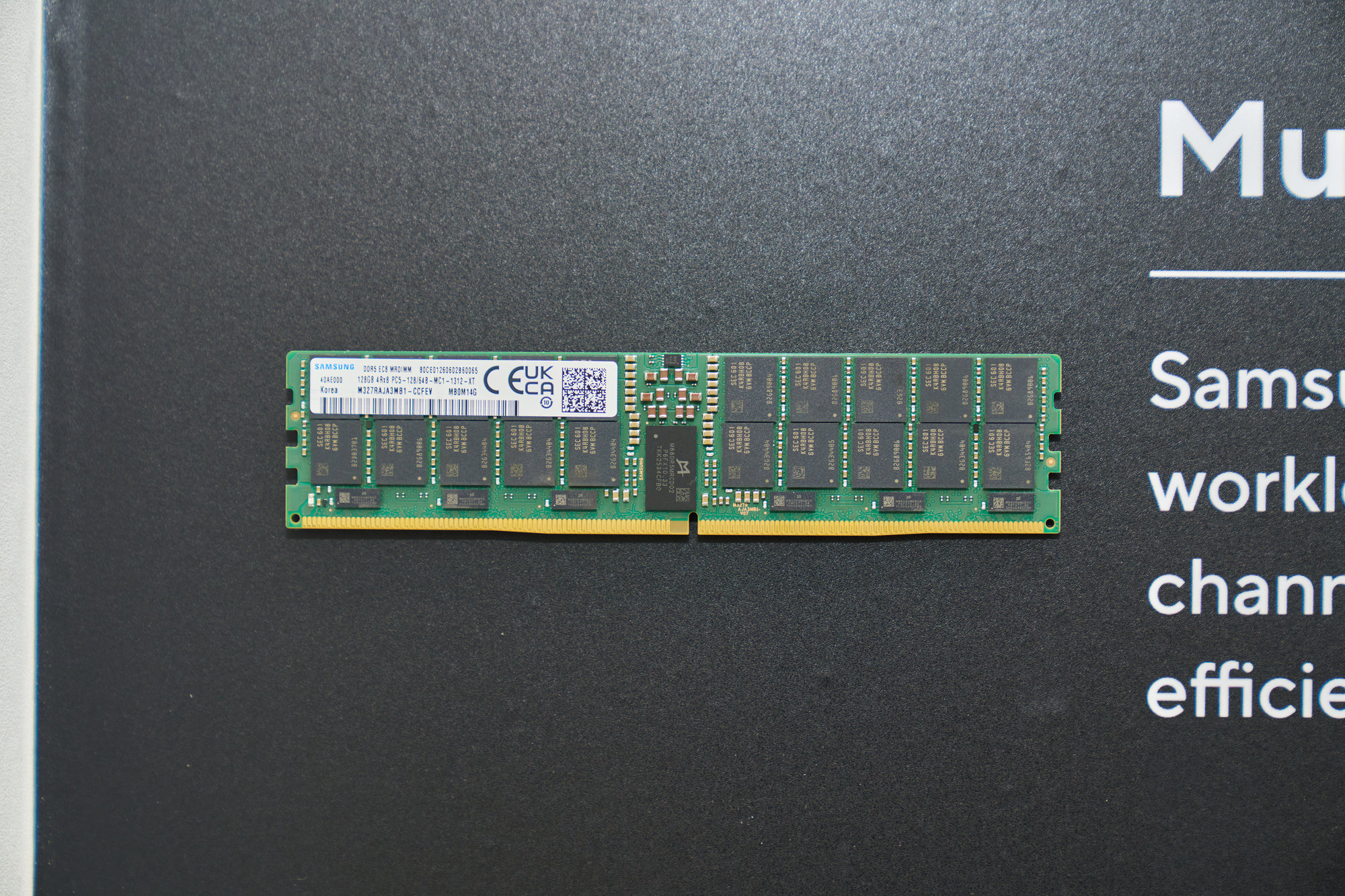
Samsung’s display focused on second-generation multiplexed-rank DIMMs, or MRDIMMs, which target a much higher 12,800 MT/s data rate. ServeTheHome reported that first-generation MRDIMMs reach 8800 MT/s on current platforms, so the second generation would raise per-DIMM bandwidth by 45%.
MRDIMMs get there by using multiple ranks of DRAM and multiplexers that switch between those ranks in an interleaved pattern. The module presents a faster stream of data to the host than a conventional DIMM using the same underlying DRAM speed could normally supply.
The first generation effectively paired DDR5-4400-class memory with that interleaving scheme, according to ServeTheHome. The second generation moves the underlying memory to DDR5-6400 while keeping the same broad architecture. That still leaves MRDIMMs behind the fastest conventional DDR5 speed grade at the chip level, but ahead on delivered module bandwidth.
Capacity is the catch. ServeTheHome reported that Samsung is promoting MRDIMM Gen2 capacities up to 128GB, even though the design uses twice as many memory chips as a standard RDIMM. That is half the capacity of the largest 3DS RDIMMs discussed in the report. Server buyers chasing bandwidth will be giving up some maximum memory footprint to get it.
ServeTheHome said MRDIMM Gen2 is expected to arrive first with AMD’s EPYC “Venice” platform later this year, while noting that this has not been confirmed. If Samsung’s 12,800 MT/s figure lands on a 16-channel Venice system, ServeTheHome calculated memory bandwidth at 1.6TB/s. Today’s 12-channel EPYC 9005 platform with DDR5-6400 is cited at 0.6TB/s.
Intel’s Diamond Rapids Xeon platform is also expected to move to 16 memory channels in 2027, according to ServeTheHome, after Intel canceled an interim eight-channel version. The direction is not subtle: CPU vendors are adding channels, memory vendors are raising speeds, and server customers will still have to choose which bottleneck they can afford to move.
This story draws on original reporting from ServeTheHome.