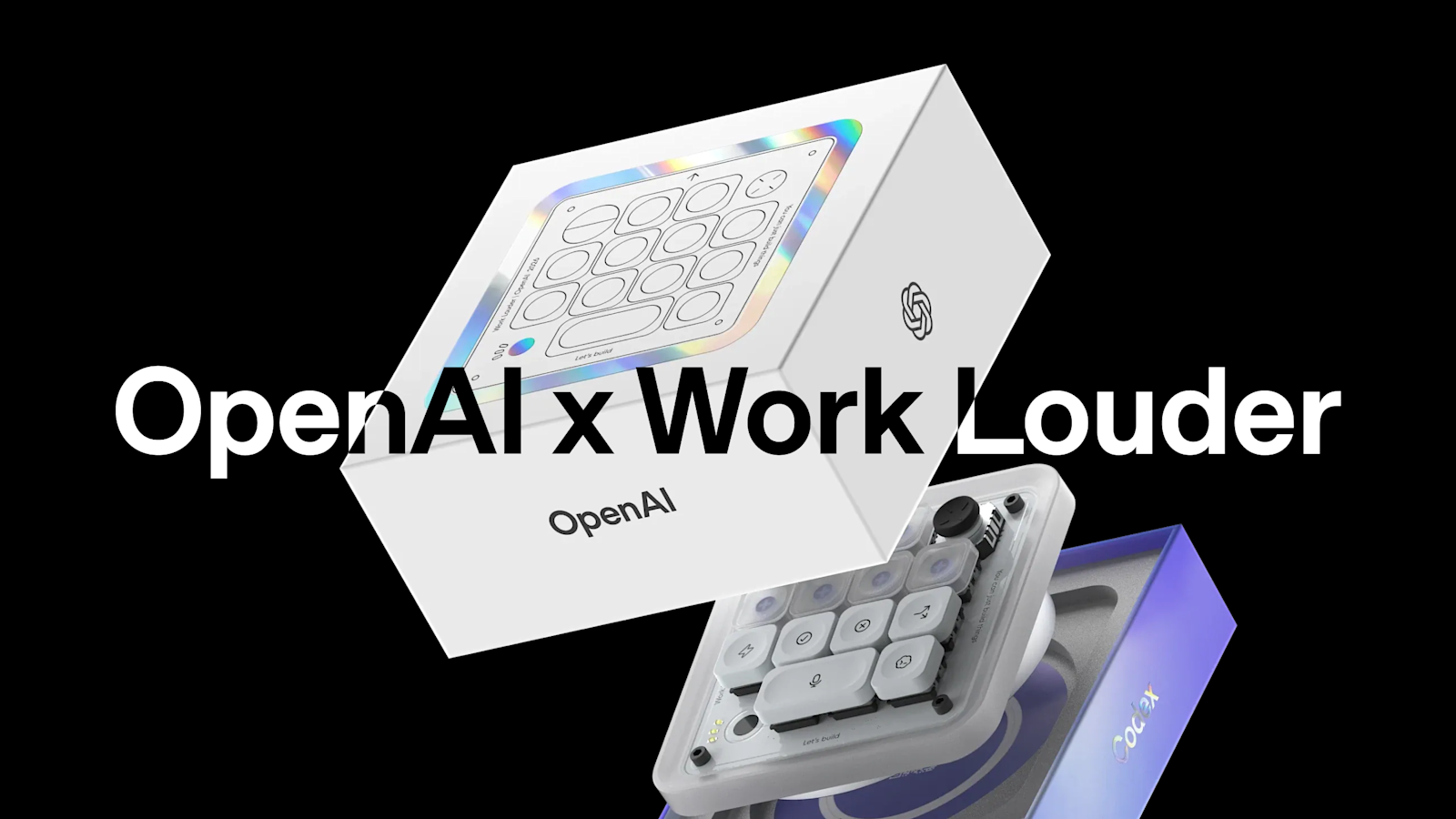
OpenAI and hardware maker Work Louder have put a $230 Codex Micro keypad in OpenAI’s Supply shop, pitching it as a desk controller for ChatGPT Codex rather than another normal keyboard. The device is already marked out of stock.
The product page describes the Codex Micro, also named kbd-1.0-codex-micro, as a compact controller for people running coding agents in Codex. The basic idea is familiar to anyone who has used a macro pad: take actions that normally live in software menus or keyboard shortcuts, put them on physical controls, then add enough lighting to make the desk look like mission control.
OpenAI and Work Louder say the keypad can show the state of Codex agents through RGB lighting on dedicated agent keys. According to the listing, those lights can indicate whether an agent is idle, thinking, running, waiting or done, so a user can glance at the pad before switching between chats.
The device also includes a joystick, command keys and a rotary dial. The companies say the joystick can start common Codex workflows such as reviewing a pull request, debugging an error or refactoring code. The command keys are meant for actions including accept, reject, push-to-talk and starting a new chat. The dial is presented as a way to change the reasoning level during a task, with lower settings for faster work and higher settings for heavier reasoning.
What is in the hardware
The spec sheet lists Bluetooth and USB-C connectivity, Mac and Windows compatibility, RGB lighting, and a body made from CNC polycarbonate and aluminum with a sandblasted anodized bottom. The keycaps use PBT and polycarbonate, the joystick has a rubber cap, and the switches are listed as POM and POK. Buyers can choose clicky or silent switches, though the listing currently shows no stock available.
The control layout is small: 13 mechanical switches, one touch sensor, one rotary encoder and one planar joystick. The product includes a USB-C to USB-C cable and a Codex icon keyset. The keyset is described in two places on the page: one section says it includes 32 extra keycaps, while the specs list 30 one-unit caps and one two-unit cap, plus 11 solid color caps.
On the software side, the listing names ChatGPT Codex and Work Louder Input. That suggests the keypad depends on both OpenAI’s coding-agent product and Work Louder’s configuration layer, although the page does not spell out setup steps, latency, remapping limits or whether every control works outside Codex.
The Codex Micro sits in a familiar category: expensive niche input hardware for people who would rather press a labeled object than remember another shortcut chord. OpenAI and Work Louder are selling that idea specifically to developers using coding agents. The listing provides the design pitch, the materials and the control scheme. It does not say when more units will be available.
This story draws on original reporting from OpenAI.