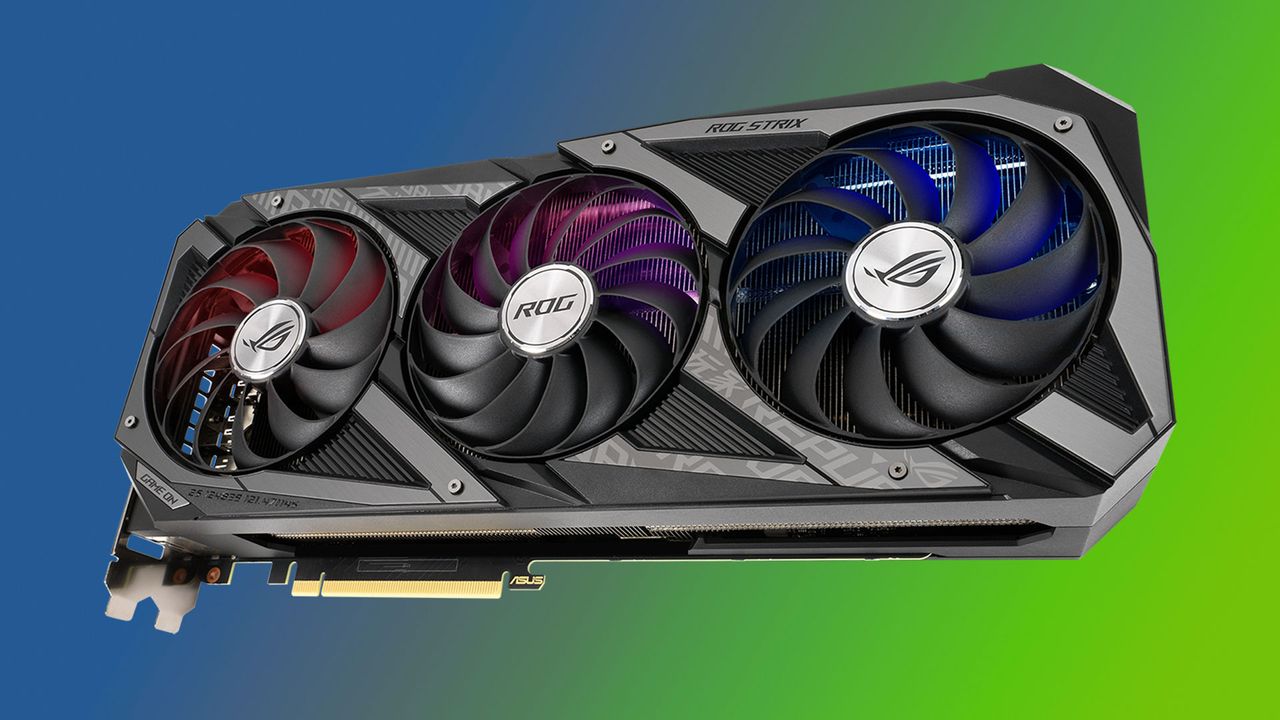
TrashBench tested the dream of every airflow absolutist: keep adding fans to a GeForce RTX 3080 until the frame rate gives in. The card ran far cooler. The games did not care very much.
In a recent video, the hardware modder used an Asus ROG GeForce RTX 3080 as the test subject, then stripped, cleaned, repasted, and progressively reworked its cooling with case fans, server fans, duct tape, top-mounted screamers, backplate cooling, and finally a 360mm all-in-one liquid cooler. TrashBench described the project as coming from a “punk-rock GPU death lab,” which is one way to label a graphics card surrounded by enough spinning plastic to make a desk sound like a runway.
The baseline was already decent. With the stock Asus cooler set to 100 percent fan speed, the RTX 3080 held 63°C in Unigine Heaven, down from 70°C before the fan speed was maxed out. That matters because the Asus ROG card was not a weak reference blower gasping for air. It started with a capable triple-fan cooler, so the mod had less easy waste heat to remove.
More airflow, less heat
TrashBench first removed the Asus cooling shroud and replaced it with three Arctic case fans. That dropped the reported GPU temperature to 52°C under the same stress test. Swapping those for thicker server fans cut the temperature to 50°C.
The duct-tape phase went less well. TrashBench taped around the server fans to stop air escaping from the sides, but the change raised the stable temperature to 54°C. The lesson, as ever with airflow, is that blocking leaks can also block the route the air was actually taking.
The next version added five small Arctic server fans along the top edge of the card, rated for up to 15,000 RPM. According to TrashBench, the setup sounded like a jet engine, but it did not keep the GPU below 50°C during longer testing.
Backplate fans also failed to produce the breakthrough. The biggest thermal drop came only after TrashBench put a 360mm all-in-one liquid cooler on the backplate. With that setup, the RTX 3080 reported a stable 41°C in Heaven, nearly 30°C cooler than the initial 70°C reading.
The frame-rate payoff was tiny
TrashBench then moved from temperature watching to game benchmarking with Shadow of the Tomb Raider at 1440p. The plain stock configuration ran at 178 frames per second. The 11-fan setup reached 180 FPS.
- Stock: 178 FPS
- 11 fans: 180 FPS
- Stock overclocked: 183 FPS
- 11 fans overclocked: 187 FPS
The extra cooling did create overclocking headroom, but the measured gain remained small: 4 FPS over the stock cooler with overclocking, and 2 FPS without it. That points to the boring answer. In this test, temperature was not the main performance limit once the Asus cooler was doing its job.
TrashBench’s verdict was appropriately unsentimental. The modder said the card “nearly cut the temperatures in half,” and praised the look and sound, then added: “And it got me 2 FPS. So, not worth it.”
As a cooling stunt, the build worked. As a practical RTX 3080 upgrade, it mostly proved that bolting a tiny wind farm to a competent graphics card is a loud way to learn about diminishing returns.
This story draws on original reporting from Tom's Hardware.