The MIS-I medical information system, an early attempt to put a hospital’s records and work orders on computers, has received IEEE Milestone recognition at El Camino Hospital in Mountain View, California. The designation marks a system built by Lockheed Missiles and Space Company and the hospital between 1965 and 1974, not the moment health care somehow stopped using paper.
IEEE’s Engineering and Technology History Wiki describes MIS-I as the first hospital-wide computerized medical information system. That distinction matters. Other organizations had been building computer systems for laboratory orders and results, but MIS-I was intended for use across hospital departments.
According to IEEE Spectrum’s account, clinicians used the system to admit patients, access and enter patient information, send requests to pharmacies and laboratories, and print documents. A 1973 Datamation report, as summarized by IEEE Spectrum, also listed laboratory and imaging orders, follow-up scheduling, and billing among its functions.
How did the MIS-I medical information system work?
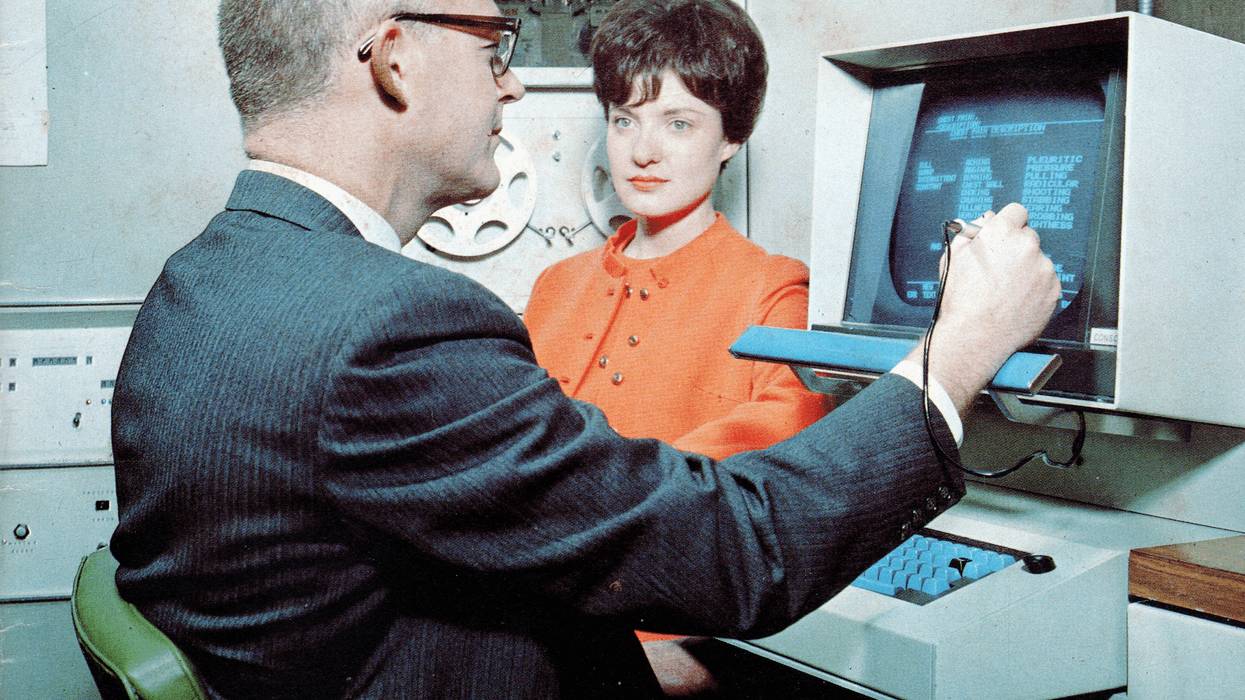
MIS-I combined a 14-inch television display, keyboard, printer, badge-based access, and a light pen. The display was, improbably enough, a television bought from a department store, IEEE Spectrum reported. Staff could enter information in a patient file or issue requests to other hospital services.
The light pen addressed an awkward but practical constraint: many doctors at the time did not know how to type. IEEE Spectrum reported that Melville Hodge, who helped lead MIS-I’s development and became the driving force behind the program, drew on light-pen technology previously used with MIT’s Whirlwind computer. The evidence does not establish exactly how clinicians operated the pen on the display, only that it was part of the terminal.
Lockheed had entered health-care computing while looking to diversify in 1964, according to IEEE Spectrum. In 1966, it won a Mayo Clinic contract to assess the computer needs of the clinic and two associated hospitals. Hodge and a small engineering team then worked with Mayo physicians for two years on the prototype that became MIS-I.
MIS-I was an early model, not the end of paper charts
The system belongs in the longer, messier history of medical informatics. The National Academy of Medicine says computer systems for scheduling and order entry helped begin digitizing clinical records in the 1970s, alongside systems at Massachusetts General Hospital, Duke University, and the University of Vermont. Yet the academy says most providers continued to rely on paper charts throughout the 20th century.
An electronic health record is more than a scanned folder of notes. A 2011 CDC presentation described structured digital records as information systems that can support statistics, reminders, warnings, and communication. Its medication example was straightforward: entering an electronic prescription can update a medication list and flag a possible interaction.
Later standards helped make sharing and interoperability more practical. The National Academy of Medicine says HL7 was founded in 1987 to develop standards for exchanging electronic health information; the National Library of Medicine released its first Unified Medical Language System knowledge sources in 1990 to promote interoperability. Privacy and national exchange rules arrived later, including HIPAA’s standards process and the 2004 creation of the Office of the National Coordinator for Health Information Technology.
That does not make MIS-I the sole origin of modern records. It makes the project a consequential early proof that the hospital, rather than only its lab, could run part of its information flow through a computer.
This story draws on original reporting from IEEE Spectrum.