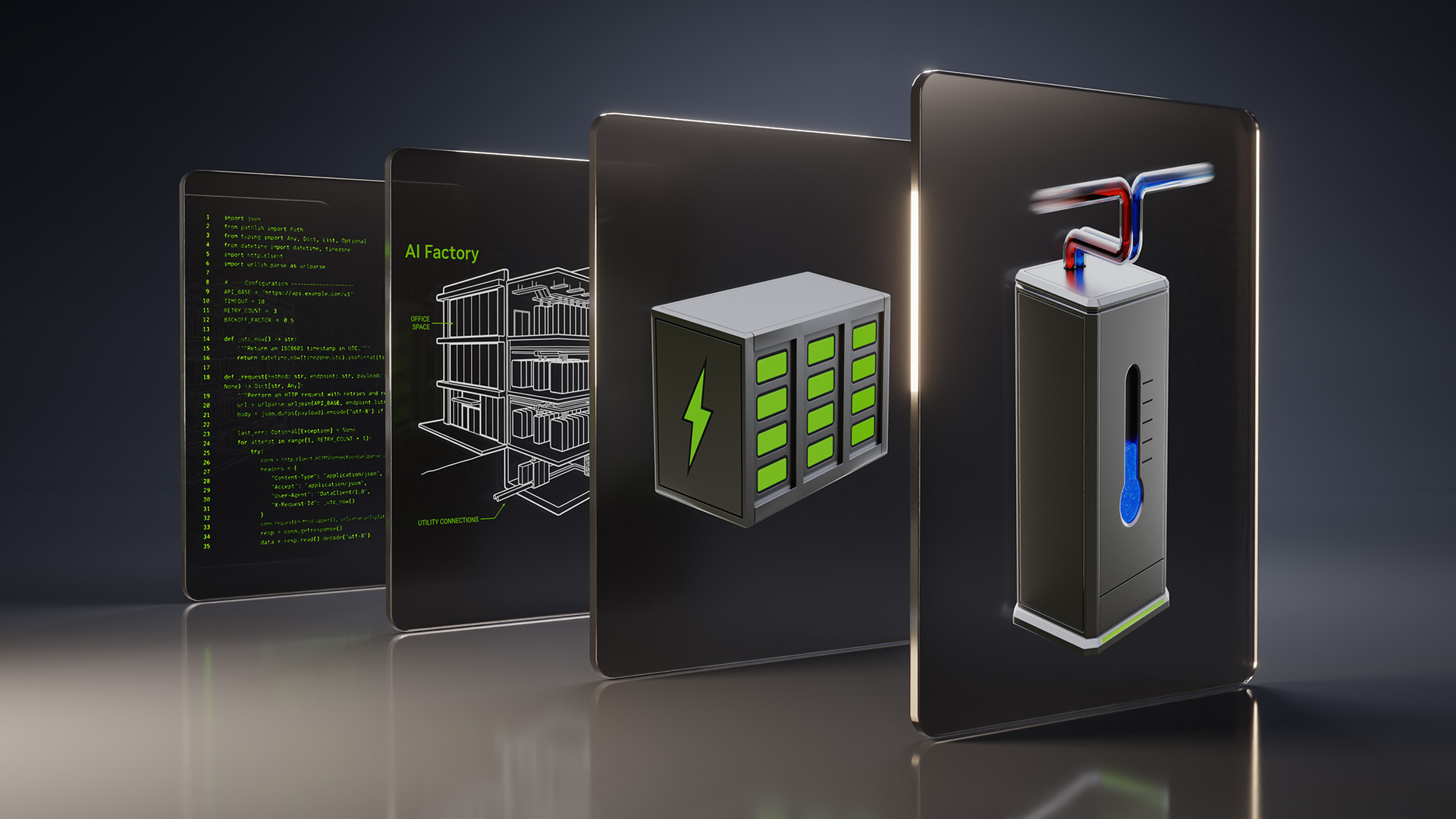
Nvidia has launched DSX Ready, a qualification program for partner power and cooling products used in data centers built around its DSX AI-factory reference designs. The nvidia dsx ready label is meant to help builders identify products that meet requirements for a defined category. It is a product-level signal, not a substitute for designing an actual facility.
The program starts with two infrastructure categories: battery energy storage systems, or BESS, and cooling distribution units, or CDUs. BESS equipment forms part of a facility’s power infrastructure. CDUs move liquid through cooling systems used for dense computing equipment. Both sit in the unglamorous but unavoidable part of an AI deployment: keeping servers supplied with power and removing their heat. For the broader machinery involved, see how a data center works.
What does Nvidia DSX Ready qualify?
Nvidia says a DSX Ready product or solution has completed the qualification requirements that apply to its category and aligns with applicable DSX reference-design requirements. Requirements and the validation path vary by type of equipment, according to the company.
The designation does not cover an entire supplier or every product it sells. Nvidia’s DSX Ready FAQ says qualification applies to the specific offering that was reviewed. That distinction matters for buyers reading vendor marketing: a listed company is not thereby certifying its full portfolio.
Battery energy storage: Nvidia lists qualified BESS solutions from Hitachi Energy, LG Energy Solution and Tesla. Nvidia says partners run required qualification tests and submit supporting data for its review and approval within a defined qualification boundary.
Cooling distribution: Nvidia lists qualified CDU solutions from LG Electronics, LiquidStack and Vertiv. For these products, Nvidia says suppliers use a CDU self-qualification suite to determine whether a particular offering meets applicable functional requirements.
What DSX Ready does not cover
Nvidia says passing BESS qualification does not replace site-level engineering or demonstrate site-level stability. Builders still have to assess whether a qualified product fits their facility, configuration and operating requirements. A CDU can meet relevant cooling criteria while remaining a poor fit for a particular building’s planned piping, layout or operations. The badge does not make those decisions disappear.
Nvidia frames the program as a way to reduce integration risk and make it easier for AI-factory builders to find relevant partner equipment. That is the company’s intended use, not an independently established guarantee of deployment outcomes.
Partners seeking qualification must first review the relevant guidelines and contact Nvidia, according to the company’s DSX Ready page. Nvidia then reviews the request and collects qualification data; products that qualify are added to the Nvidia Marketplace. Nvidia says the process length depends on the product category, scope and readiness of the submission.
The company says it plans to add infrastructure and software categories over time, without giving a timetable or identifying further categories.
This story draws on original reporting from ServeTheHome.