Researchers have synchronized a grid of 105,000 nano-oscillators in 45 nanoseconds, according to a Business Standard report on work from IIT Bhubaneswar and an associated research paper on arXiv. The result matters because oscillator-based computing is one of the many attempts to get useful computation out of physics directly, rather than forcing every problem through transistor switching and memory shuffling.
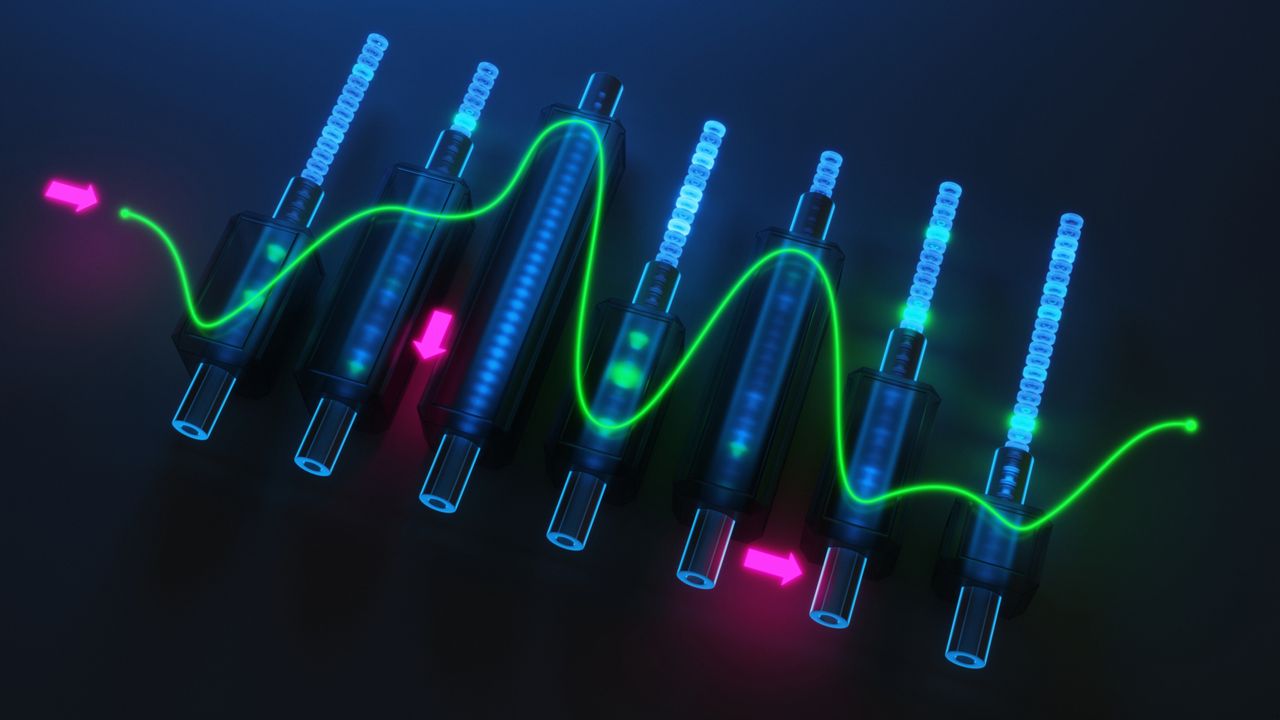
The devices in the experiment are tiny magnetic oscillators, each about 10 to 20 nanometers across, according to the research described. After the grid is disturbed, the oscillators settle into a shared rhythm using their spin dynamics. The rough mental model is a surface of interacting ripples, except the ripples are magnetic oscillations on a nanoscale array rather than water doing something photogenic for a lab video.
The reported scale is the useful part. The same work cites an earlier demonstration using 64 oscillators. In this experiment, synchronization time rose from 10 nanoseconds for 100 oscillators to 45 nanoseconds for 105,000 oscillators. That is the claim to watch: adding far more oscillators did not make the settling time balloon in proportion.
Oscillator-based computing does not replace a general-purpose CPU by pretending to be a smaller, weirder CPU. It is aimed at problems that can be mapped onto interacting waves, phases, frequencies and coupling strengths. The research paper points to Ising machines and reservoir computing as examples of architectures that can be implemented with oscillator networks.
In an Ising-style system, a problem can be encoded into the relationships between many interacting elements. The machine’s answer is read from the state the network settles into. In reservoir computing, a dynamic system transforms input data into patterns that can be interpreted for tasks such as approximation or pattern recognition. In both cases, the trick is to use the physics of the system as part of the computation, rather than simulate that physics step by step on conventional hardware.
The paper says these oscillator grids could operate at tens of gigahertz while using comparatively little energy. It also frames the 45-nanosecond stabilization time as analogous to completing one operation across a whole matrix on a conventional processor. That comparison is useful, with the usual caveat: a research array proving a physical effect is not the same thing as a programmable, manufacturable processor with software tools, yield data and boring reliability numbers.
The researchers also contrast the oscillator approach with quantum computing. Quantum systems often need extensive error correction to preserve delicate states. The oscillator array, according to the paper, produced a clear settled signal with a quality factor above one million, meaning the output frequency was sharply defined and easier to read.
The claimed applications include high-speed communication networks, financial and scientific modeling, real-time analytics and AI acceleration. Those are plausible target areas for a fast matrix-like physical computing substrate, but they remain targets. The confirmed result is narrower and still valuable: a very large nano-oscillator array synchronized quickly, and its timing scaled better than a transistor-first intuition might expect.
This story draws on original reporting from Tom's Hardware.