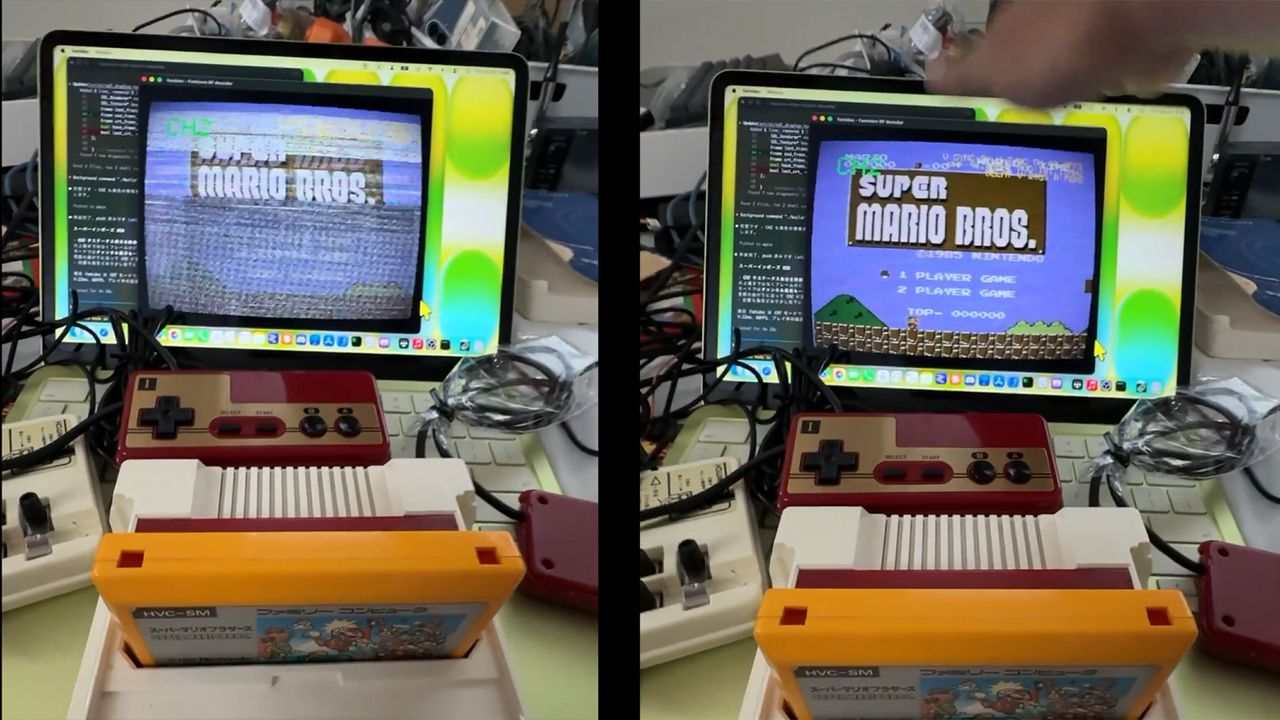
Former Sega and Facebook software engineer GOROman has shown a macOS CRT-style display project that lets a user “repair” a shaky Famicom picture by tapping the screen, a small joke layered on top of a more serious bit of retro video plumbing.
The project, called famicom-rf-hackrf-decoder, is published on GitHub under the MIT license. According to GOROman’s project description, it takes the VHF RF output from a Nintendo Famicom, the Japanese version of the NES, through a HackRF One software-defined radio. The software then decodes the console’s NTSC-J video signal and draws the result in real time on the desktop using SDL2.
That is a more specific trick than applying a generic scanline filter to an emulator. The Famicom is still producing its old RF-modulated television signal. HackRF One receives that signal, and GOROman’s software does the job an analog TV would have done: lock onto the video, decode color, and keep the picture coherent enough to display on a modern LCD.
GOROman says the Famicom’s signal is awkward material for modern software to digest. The project notes that the console output is not broadcast-compliant, using non-interlaced 240p video, chroma phase advancing 120 degrees per line, and one short line per frame. The decoder therefore has to compensate for instability that can show up as drifting, wobbling, or color burst problems.
Earlier demonstrations leaned hard into those faults. Some commenters treated the result less as CRT nostalgia and more as a broken-TV simulator, because the image included heavy flicker, noise, and distortion. GOROman later explained that the rougher look came from deliberately shifting the VHF frequency in an exaggerated way, according to a machine-translated post.
The newer demo adds what GOROman described on X as support for tapping the television screen in response to user requests. In the clip, the rendered display settles after a physical tap, mimicking the old household ritual of fixing a misbehaving CRT with percussive maintenance. The joke lands because the decoder is already modeling the annoying analog behavior that made such rituals feel plausible.
How the tap is detected is less clear. Some social media users speculated that the effect might use an Apple MacBook lid-angle sensor. A look at the GitHub project shows an input variable labeled “audio tap,” which suggests the feature may instead be listening for a sound through the microphone. GOROman has not, in the material reviewed, given a definitive implementation note for that gag.
The project sits in the increasingly busy corner where retro hardware preservation meets software-defined radio and theatrical shader work. It is not just pretending a clean emulator frame came from a tube. It starts with the Famicom’s RF output, decodes the messy signal, and then lets the mess become part of the experience.
One commenter has already asked GOROman for a magnet mode, another classic way to abuse a CRT image. Given the current pace of joke features, that request may not be as absurd as it sounds.
This story draws on original reporting from Tom's Hardware.