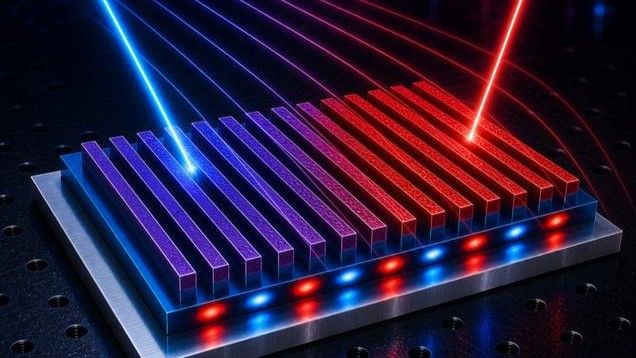
Researchers at Osaka Metropolitan University say they have built a programmable thermal device that can change how it emits infrared heat and keep that setting after power is removed. The work, published in Laser & Photonics Reviews, is still a laboratory demonstration, but it points at a useful target: hardware that can steer heat with more precision than a passive heatsink or coating.
The device combines indium arsenide, a magneto-optical semiconductor, with germanium-antimony-tellurium, better known as GST. Indium arsenide changes how it interacts with infrared light under a magnetic field. GST can switch between amorphous and crystalline phases, with different optical behavior in each state, and it keeps the selected phase after the write energy is gone.
That memory is the important bit. Many experimental thermal-control structures need a magnetic field, voltage, heat input, or other active drive to preserve their behavior. The Osaka Metropolitan University researchers say their design can be programmed through the GST layer and then retain its mode without continuous energy input.
How the device bends the usual heat rule
Ordinary materials follow Kirchhoff’s law of thermal radiation: if a surface absorbs radiation efficiently at a given wavelength and direction, it also emits efficiently under the same conditions. That is a tidy rule for physics and an annoying one for engineers trying to send heat one way while receiving it another.
To get around that symmetry, researchers try to break Lorentz reciprocity, the principle that usually links incoming and outgoing electromagnetic waves. Prior nonreciprocal thermal designs have often depended on magneto-optical materials, magnetic Weyl semimetals, or actively modulated metasurfaces. According to the Osaka team, those approaches have had two practical problems: they tend to work best only when light hits at steep, grazing angles, and many lose their configured behavior as soon as the control signal disappears.
The new structure uses a microscopic GST grating placed above an indium arsenide layer, forming what the researchers describe as a magneto-optical metagrating. The indium arsenide supplies directional asymmetry under a magnetic field, separating absorption behavior from emission behavior. The GST layer acts as the non-volatile switch, storing the optical state until it is deliberately rewritten.
In the team’s reported prototype, the nonreciprocity factor approached 0.9 at an incidence angle of 3 degrees. That is much closer to straight-on operation than the extreme angles commonly needed in earlier designs, which matters because grazing-angle systems waste much of the usable thermal radiation and produce less practical emission patterns.
The researchers also report two control modes. The magnetic field or the incident angle can continuously tune the response, while the GST phase transition provides digital on-off switching. Their analysis found that the nonreciprocal effect weakens after GST changes state because of optical field redistribution and increased damping, rather than absorption losses alone.
Why chip engineers might care, eventually
The immediate result is not a product for cooling an AI accelerator. The paper describes an early research device, and the researchers acknowledge that substantial engineering work remains before programmable thermal emitters show up in commercial electronics.
The possible uses are still easy to see. Dense processors, chiplet packages, and silicon photonic systems all suffer when heat lands in the wrong place or shifts optical behavior with temperature. A future thermal metasurface that can be set, remembered, and later rewritten could help direct radiation away from hotspots, reduce thermal coupling between nearby components, or stabilize photonic devices.
The Osaka Metropolitan University team also names radiative cooling, thermophotovoltaic energy conversion, infrared emitters, thermal communication, infrared sensing, and photonic memory as potential applications. Those remain prospective uses, not demonstrated deployments. For now, the useful claim is narrower and more concrete: the group has shown a programmable, non-volatile thermal surface that works near normal incidence, which clears two obstacles that made earlier nonreciprocal thermal devices look more like physics exercises than engineering candidates.
This story draws on original reporting from Tom's Hardware.