TV makers are pushing a new LCD backlight trick for 2026: red, green and blue LEDs behind the panel instead of the usual white or blue LEDs. Hisense says the design is meant to create “pure colors directly at the source.” WIRED reviewer John Brandon’s testing suggests the pitch has some substance, with brighter daytime viewing, strong contrast and more vivid color than conventional LED or QLED sets.
The catch is familiar: first-wave hardware costs a lot, the naming is a mess, and the best results may require more menu fiddling than most people want after spending several thousand dollars on a screen.
Same LCD bones, different light engine
Brandon writes that the first RGB TVs arrived in 2025, with broader availability across sizes and prices in 2026. Samsung and LG call their versions “micro RGB,” while TCL and Hisense use “mini RGB.” Sony uses “True RGB” and says there is no meaningful difference between mini RGB and micro RGB. The mechanism, according to Brandon, is broadly similar: colored LEDs shine through an LCD panel.
That distinction matters. OLED panels can light or switch off individual pixels, which is why they remain difficult to beat for black levels. RGB LED sets still rely on LCD panels, so the backlight has to do the heavy lifting. In WIRED’s testing, the newer backlights delivered strong brightness, contrast and off-angle viewing, but Brandon stopped short of calling them a replacement for OLED.
Prices are also doing early-adopter nonsense. Brandon says most mini RGB and micro RGB sets he tested were closer to $4,000, while 65-inch flagship OLED models from LG and Samsung tend to sit around $2,700. LED and QLED sets can cost far less, with some starting near $500.
LG led WIRED’s picks
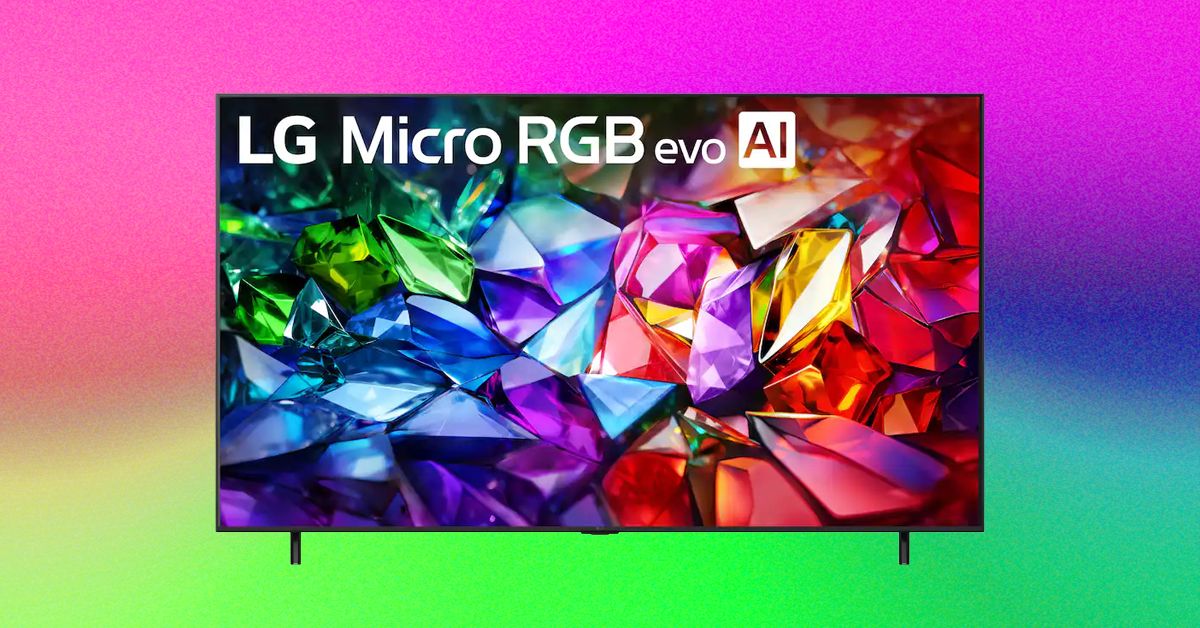
Brandon named LG’s Micro RGB Evo the best overall RGB TV among the models he tested. The 75-inch unit was listed at $4,500 after a $500 discount. He praised its color, console gaming performance and unusually deep picture controls, including white balance, saturation and clarity settings.
The LG set includes four HDMI 2.1 ports, Ethernet, optical audio, coaxial and two USB 2.0 ports. Brandon found LG’s webOS usable but crowded with apps and advertising. He also reported that some default picture modes made Netflix’s Awake look too dark, while Tron: Ares on Disney+ showed strong blacks and reds after adjustment.
Gaming was more mixed. Brandon said the TV handled consoles well, but LG’s variable refresh rate feature, called Motion Booster, did not behave correctly with an Alienware 16X Aurora laptop. At its native 165-Hz refresh rate, he found games looked excellent. LG also offers Gallery+ artwork for $5 a month, with about 4,500 museum-curated images, though Brandon said it lacks the texture and realism of Samsung’s Frame Pro 2026.
Hisense and TCL made sharper cases for specific rooms
For gaming, Brandon picked Hisense’s UR9 RGB MiniLED. WIRED listed the 65-inch set around $2,200 at Best Buy, far below the other RGB models in the guide. It runs Google TV, uses a single stand, and includes three HDMI 2.1 ports plus a USB-C DisplayPort connection. Brandon says that port supports 180-Hz gaming, or 330-Hz VRR, with a high-end gaming PC.
Hisense came close to LG on picture quality in Brandon’s testing, including movie scenes from The Last Duel and Xbox Series X gameplay in 007: First Light. Its weakness, he said, was less useful picture tuning. Some settings did not change the image as much as expected.
TCL’s RM9L RGB-Mini LED took WIRED’s movie-night slot, largely because TCL sells it only in very large sizes: 85 inches and up. WIRED listed the 85-inch model at $5,999, with a 98-inch version at $9,000 and a 115-inch version at $25,000. Brandon said the scale and vivid color made it his pick for 4K movies. Buyers planning to wall-mount a set that weighs more than 100 pounds, he noted, should account for multiple studs and extra mounting brackets.
This story draws on original reporting from WIRED.