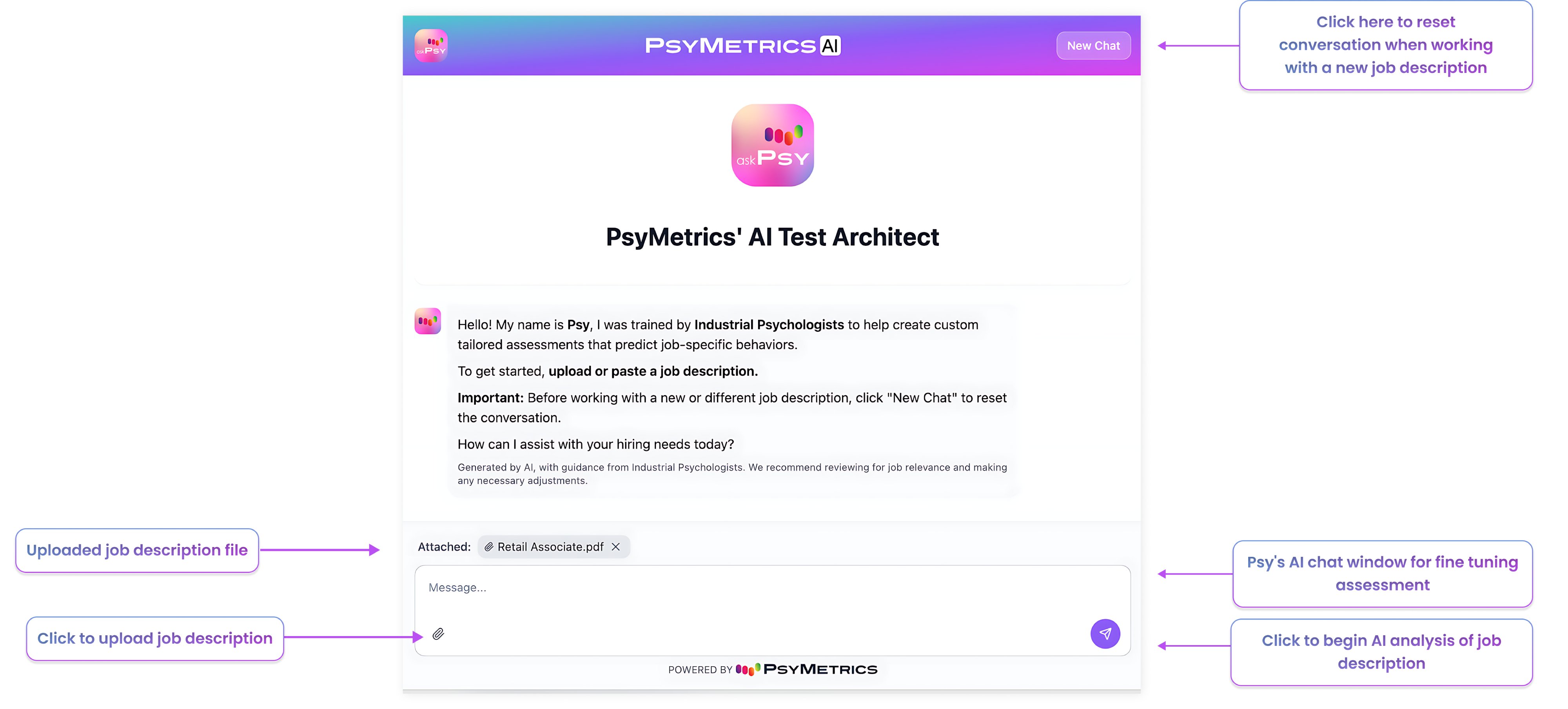
PsyMetrics has launched AI Test Architect, an enterprise tool for building pre-employment assessments with a generative system constrained by the company’s psychometric content and competency models.
The product is aimed at HR teams, boutique talent consultants and recruitment process outsourcing providers that want faster assessment design without handing job screening logic to a general-purpose chatbot. That distinction matters in hiring, where a model that invents a competency, overweights a soft trait or generates inconsistent criteria can create more than a bad workflow. It can create evidence problems if an employer has to defend a selection process under Equal Employment Opportunity rules.
PsyMetrics is pitching the system as “Controlled AI,” its term for a domain-limited generative engine that draws from more than 30 years of the company’s industrial-organizational psychology research, assessment content and competency mapping work. The company says the tool is powered by Psy, its proprietary AI assistant, rather than an unconstrained large language model producing assessment content from open-ended prompts.
The mechanism is straightforward. A user enters role requirements or uploads a job description into a white-labeled advisor portal. The system extracts competencies from that material, maps them to cognitive, behavioral and skills benchmarks in PsyMetrics’ library, then builds a draft assessment using psychometric items tied to job-related indicators such as logical reasoning, stress management and technical skills.
That makes AI Test Architect part generator and part rules-bound test assembly system. In employment screening, that boundary is the whole fight. Generic LLMs are good at producing plausible text, which is exactly the problem when plausibility gets mistaken for validity. A hiring assessment needs traceable job relevance, consistency across candidates and some defensible connection between what is measured and what the role requires.
PsyMetrics says its recommendations are intended to be explainable through the underlying competency mappings and validated assessment library. It also says the system is designed to align with the Federal Uniform Guidelines on Employee Selection Procedures and EEO standards by centering evaluations on job-relevant behavioral, cognitive and skill-based measures.
The company is keeping humans in the approval chain. AI Test Architect creates assessment drafts for consultants and other users, who can review, change and authorize evaluations before they are used with candidates. That is a governance choice as much as a product feature: human review does not make an assessment fair by itself, but it gives organizations a control point before an AI-shaped test enters a hiring process.
Jesse Llobet, PsyMetrics’ founder, said raw generative AI is a poor fit for high-stakes screening because a fabricated behavioral requirement can turn into both a hiring error and a compliance risk. He framed AI Test Architect as a way for consultants and RPOs to get AI-assisted speed while staying anchored to psychometric methods.
The product is integrated into PsyMetrics’ white-label partner infrastructure, so consultants can build and deliver branded assessments through their own client portals. The company says the controlled AI hiring assessment system can create role-specific assessment drafts in seconds, rather than the longer manual process typically associated with custom test construction.
The launch lands in a crowded market where vendors are trying to make generative AI acceptable for HR without importing the legal and statistical mess that comes with opaque model output. PsyMetrics’ bet is that narrower models and auditable assessment logic will be easier to sell than chatbot-style flexibility in a regulated employment setting.