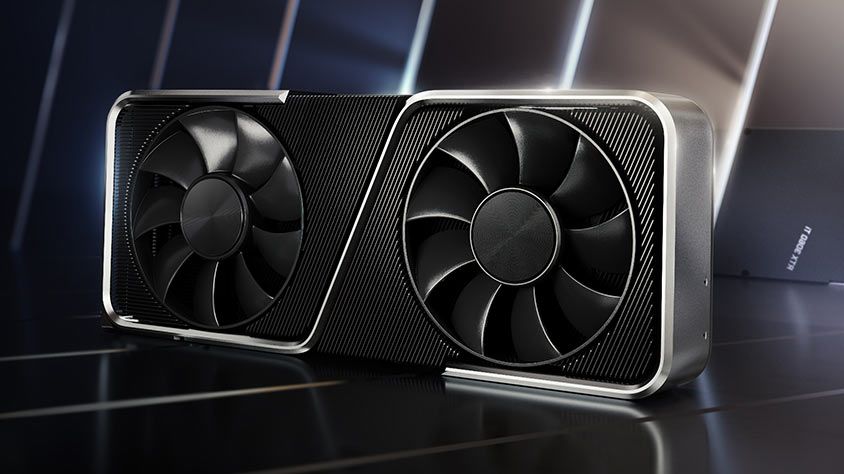
Palit has announced a new GeForce RTX 3060 model, bringing Nvidia’s 2021 Ampere card back into circulation as the PC component market remains distorted by demand for AI hardware.
The card, called the Palit GeForce RTX 3060 Infinity 2 OC, is less a new GPU than a rerun with a fresh shroud. Palit’s announcement follows earlier retail appearances of renewed RTX 3060 cards from Gigabyte and Manli, according to Tom’s Hardware, but Palit is the first board partner cited as making a formal launch.
The reason this old part is relevant again is memory. The RTX 3060 carries 12GB of GDDR6 on a 192-bit bus, a capacity that remains awkwardly useful while newer budget and midrange cards often ship with less VRAM. AI workloads have put pressure on memory and storage supply, and Tom’s Hardware reports that those shortages have pushed up prices across commodity silicon.
A 2021 GPU with a 2026 problem to solve
Palit’s spec sheet does not show a meaningful architectural change. The Infinity 2 OC uses the familiar RTX 3060 configuration: 3,584 CUDA cores, 12GB of GDDR6 memory, and a 192-bit memory interface.
The overclock is also modest. Palit lists a boost clock of 1,792 MHz for the OC version, compared with Nvidia’s 1,777 MHz reference boost clock. That is less than a 1 percent increase. Palit also plans a non-OC Infinity 2 version, according to Tom’s Hardware.
The cooler design is plain, with the black styling typical of lower-cost graphics cards. Palit says the card has a protective backplate intended to reduce PCB flex. The company also claims 0dB noise levels, although Tom’s Hardware notes that the card lacks zero-RPM fan technology, so buyers should treat that noise claim with care rather than as magic.
Why Nvidia’s old silicon is back
The RTX 3060 revival appears to be a supply-chain workaround. Nvidia’s current Blackwell graphics cards use GDDR7, which Tom’s Hardware describes as more expensive. Memory manufacturers are also prioritizing high-bandwidth memory, or HBM, for AI accelerators because those products can command higher margins.
That leaves board makers with a less glamorous option: return to older GPUs built on older manufacturing processes. Tom’s Hardware says resurrecting the RTX 3060 makes sense for manufacturers because Samsung’s older 8nm process can offer better yields than the pricier TSMC N5 node used for Ada and Blackwell-generation products.
The idea of bringing back older cards surfaced publicly at CES 2026, when Tom’s Hardware’s Paul Alcorn raised it during a Q&A with Nvidia chief executive Jensen Huang. Huang said he would “go back and take a look at this,” according to Tom’s Hardware. Palit’s launch suggests that idea has now reached retail hardware, at least in some form.
Palit has not announced pricing for the Infinity 2 OC, and Tom’s Hardware said it had not found the card listed at retailers. Similar RTX 3060 relaunch models have appeared around $329, according to the publication.
That pricing puts the revived card in an uncomfortable spot. Tom’s Hardware noted that an RTX 5060 Ti was listed on Newegg for $369, with stronger performance, better efficiency, DLSS 4.5 support, and multi-frame generation. The trade-off is memory: that listed RTX 5060 Ti model has 8GB of VRAM, while the RTX 3060 has 12GB.
For buyers, the revived RTX 3060 is a reminder that the GPU market is being shaped as much by memory allocation and manufacturing economics as by clean product generations. Palit is selling an old chip because old chips can still be made, still have enough memory to matter, and may be easier to source while AI hardware keeps eating the good stuff first.
This story draws on original reporting from Tom's Hardware.