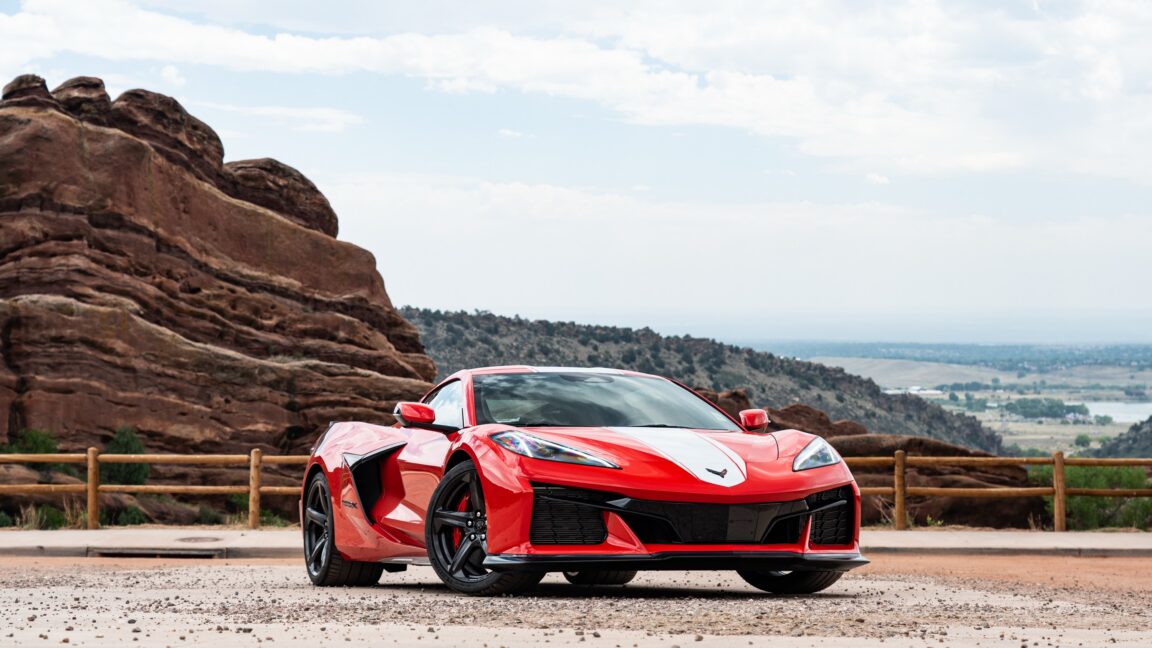
The 2027 Corvette Grand Sport X gives Chevrolet’s hybrid, all-wheel-drive Corvette role a new name and a changed calibration strategy. Chevrolet introduced the Grand Sport and Grand Sport X on March 26, pairing both with a new 6.7-liter naturally aspirated V8. The X puts that engine at the rear axle and adds a front electric motor and compact battery pack, Chevrolet says.
The Grand Sport X takes over from the discontinued E-Ray, though Ars Technica reports Chevrolet does not regard it as a direct replacement. That distinction is more than badge work: the new car gains powertrain hardware, while its engineers also rewrote the software governing several of the systems that decide how it behaves when the road stops being polite.
What changed in the 2027 Corvette Grand Sport X?
The hardware changes are substantial. Chevrolet rates the LS6 V8 at 535 horsepower and 520 lb-ft of torque, with power sent through an eight-speed dual-clutch transmission. Ars Technica reports that the engine makes 40 hp and 50 lb-ft more than the E-Ray’s V8, while the X’s 186-hp front motor adds 26 hp over the E-Ray motor. By that accounting, the new model has 66 more hp and 70 more lb-ft than its predecessor.
The Grand Sport X also uses the more powerful front motor developed for the ZR1X, according to Ars Technica. The publication reports carbon-ceramic brakes and standard Magnetic Ride Control; GM Authority separately reports that the X has carbon-ceramic brakes as standard and comes only with its dedicated sport-performance package.
Yet the chassis is not a wholesale new parts-bin exercise. Keith Badgley, lead development engineer for the E-Ray, Grand Sport X and ZR1X, told Ars Technica that Chevrolet considered changing components but retained the E-Ray’s damper, spring and anti-roll-bar part numbers outside the powertrain. That makes the software work harder to earn its keep.
How does the Grand Sport X software change the car?
Badgley told Ars Technica that the team uses a predictive algorithm in the car’s dynamic-control systems and used the added engine torque to tune the front axle’s behavior. The publication reports revised software for the adaptive suspension, stability control and electronic differential, all intended to give the X a sharper response.
In plain terms, those systems are no longer passive hardware accessories. Their calibration determines how the car responds as grip, steering input and acceleration change. Ars Technica’s reviewer found the Grand Sport X more willing in corners than the E-Ray, while still detecting initial understeer. That is a road-test impression from an early vehicle, not controlled proof that a new algorithm alone produced the result.
The E-Ray feedback supplies some context, not a clean market thesis. Badgley said owners had taken E-Rays to track days and some called the car “a little tight.” Ars Technica characterized the older model’s understeer as useful for predictable road handling but less desirable on a circuit. The Grand Sport X appears to address that behavior, but Chevrolet has not said it was designed specifically for those owners.
Code helps, but it did not replace the hardware
The stronger conclusion is narrower than the marketing-friendly slogan. Chevrolet changed the Grand Sport X’s engine and electric motor, so there is no evidence-based way to declare software the equal cause of its altered performance. But retaining core suspension part numbers while revising the controls around them shows where modern performance-car development has moved: mechanical parts set the limits, and calibration has considerable influence over what drivers experience within them.
This story draws on original reporting from Ars Technica.