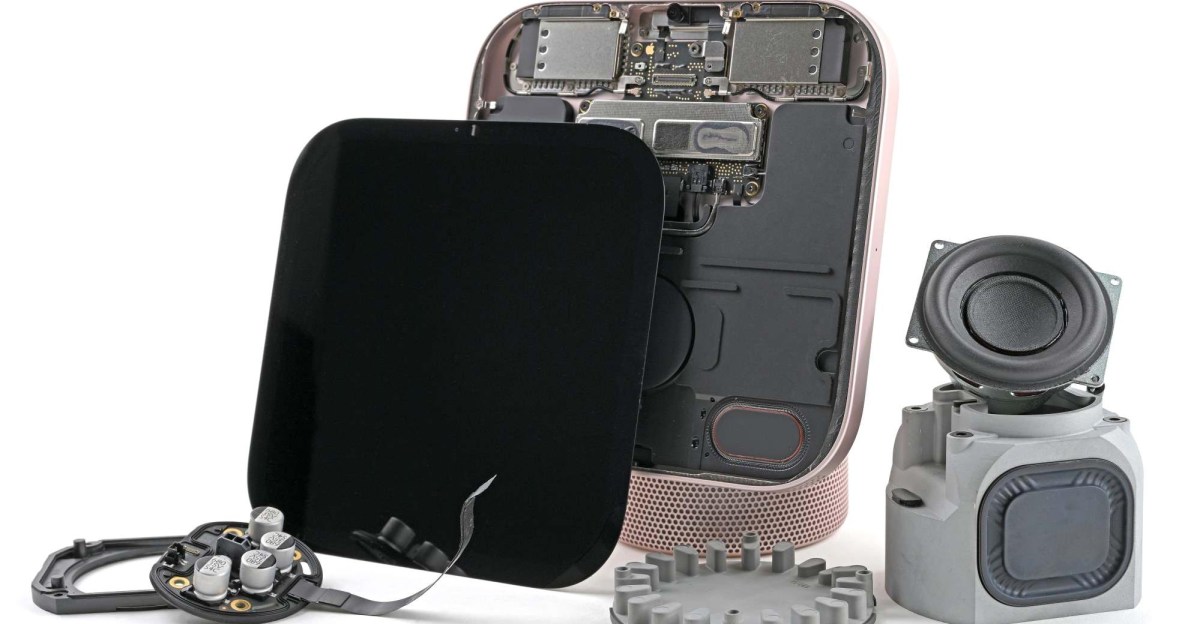
An iFixit Apple HomeView teardown published November 17 found that reaching many of the smart-home hub's parts requires a repairer to fight adhesive, fragile connections and a logic-board heat assembly bonded to the chassis. The result, according to iFixit, is a device that is unusually difficult to take apart without damage.
That assessment comes from one repair specialist's disassembly, not from reports of parts failing in ordinary use. During the teardown, iFixit said it tore a connector, broke a speaker and had to put more force on the logic board than it considered comfortable.
Why is Apple HomeView hard to repair?
The trouble starts at the front. iFixit said access to the display section's internals begins by removing the fragile front glass. Heating the display did not make that easy: the aluminum enclosure dispersed heat away from the adhesive, and iFixit said the glue held more firmly than on any recent Apple product it had opened.
Once inside, the team found a display-connector bracket fastened with both Phillips and Torx screws. The antenna connectors used Phillips screws, while the camera bracket required a larger Torx bit. Switching among driver types does not prevent a repair, but it adds needless tool changes to an already awkward job.
The speaker connections were the larger problem. iFixit said that after it removed visible adhesive around one connector and tried to lift it, the leads pulled out of their plastic housing. The housing remained on the board. On the other side, the group said scraping adhesive, applying heat and cutting through the connector seams still did not allow removal without damage.
The logic board presented a different kind of trap. A shield beneath it moves heat into the rear aluminum enclosure, effectively using the chassis as a heat sink. iFixit described that thermal approach as sensible for cooling, but said the shield was thoroughly bonded in place. Separating the board therefore required force on a thin component, making the operation risky.
Is any part of the HomeView easier to replace?
There is a limited bright spot in the tabletop model. iFixit found its USB-C port is modular and relatively accessible from the speaker base, which it said was easier to open than the display assembly. The teardown does not establish repair procedures, parts availability or the outcome of particular repairs.
iFixit also examined the wall-mounted model, which has a different internal layout from the tabletop version. Reports on the teardown say the wall model uses a larger logic board and smaller speakers, while the tabletop version has larger speakers and a pivot mount. The designs should not be treated as interchangeable.
For owners, the practical takeaway is narrower than a verdict on every possible repair: iFixit's teardown suggests that work involving the screen, speakers or logic board may not be routine. The modular USB-C port is an exception, not evidence that the rest of the device was designed for easy service.
This story draws on original reporting from The Verge.