AI is pushing robots into more kinds of paid work, but the near-term story is warehouses, factories and inspections, not a Rosie-in-the-kitchen appliance. Researchers and robotics executives told Ars Technica that modern machine learning has widened what robots can attempt on their own, while the physical world remains rude, expensive and full of ways to break a demo.
Matt Malchano, vice president of software at Boston Dynamics, said robot autonomy used to mean getting a machine from one point to another. He said the field now aims at broader sequences of tasks done without direct human control. The International Organization for Standardization defines robotic autonomy as performing intended tasks from current state and sensing without human intervention.
Sergey Levine, a University of California Berkeley computer scientist and cofounder of Physical Intelligence, described the current frontier as robots doing useful work reliably in unstructured environments. His company is pursuing general AI models that could run different robot bodies, rather than betting that one humanoid shape should do every job.
Training the body is harder than training the chatbot
Levine said researchers are combining reinforcement learning with large pre-trained models. Reinforcement learning can tune a robot through trial and error, in simulation or with physical hardware. Foundation models trained on large data sets, including vision-language systems, can give robots background knowledge that helps them avoid some dumb mistakes.
The catch is data. Text and images can be scraped at scale. Robot training often requires teleoperation rigs, lab trials or simulations that miss messy real-world physics. Some companies are also collecting first-person video of people doing chores to train world models, according to Ars Technica. That is cheaper than running robots through every scenario, but it still costs compute and may fail on physical interactions.
Levine put the limitation plainly: current systems can be highly reliable at one narrowly defined task, or broadly competent at many tasks without the robustness industry wants. Getting both remains a research problem.
Factories and warehouses come first
Boston Dynamics already sells autonomy in narrower packages. Its Spot quadruped has performed inspections for National Grid converter stations in Massachusetts and for culvert pipes beneath California highways. Malchano said Spot can move through facilities, take photos and capture sensor readings for customers who are not roboticists.
The company also sells Stretch, a wheeled robot with a large arm, for warehouse package handling. DHL is one listed customer. Boston Dynamics is training its electric Atlas humanoid at Hyundai Motor Group’s Robot Metaplant Application Center, with a goal of putting trained Atlas robots to work at Hyundai’s electric vehicle plant in Ellabell, Georgia, by 2028.
Hyundai and Boston Dynamics are aiming for capacity to build 30,000 humanoid robots a year by 2028, according to Ars Technica. That ambition has a labor edge: Hyundai’s union approved a potential strike on June 25 while negotiating job protections tied to the planned Atlas deployment.
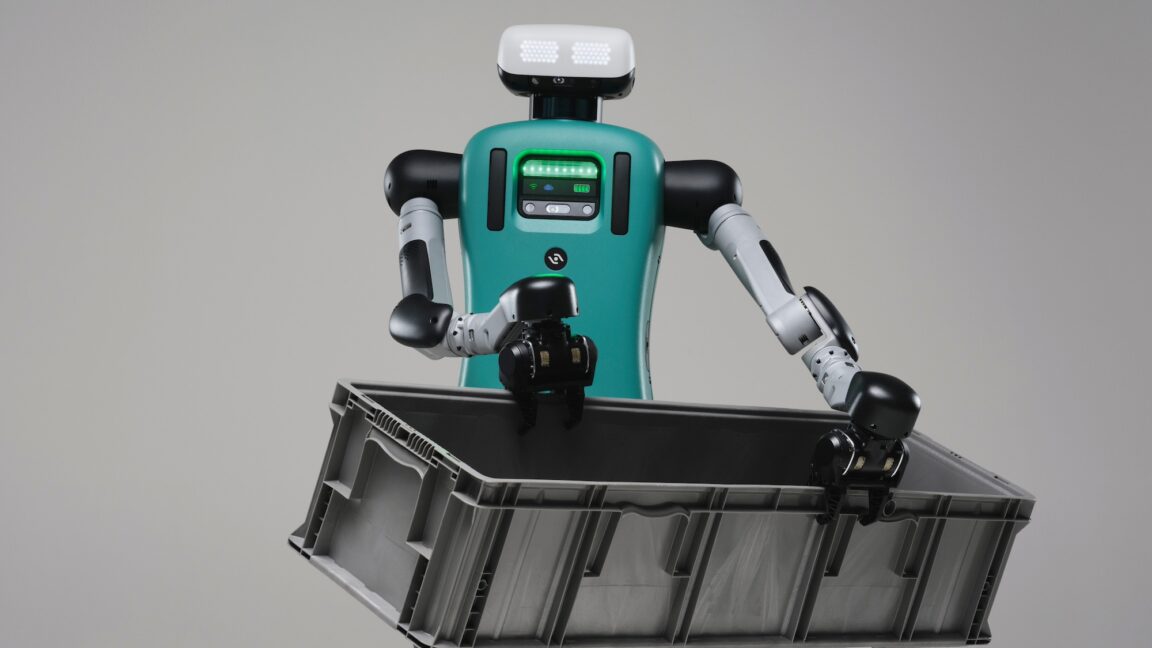
Agility Robotics has taken a more constrained route with Digit, its humanoid robot. Cofounder Jonathan Hurst, also a robotics researcher at Oregon State University, said embodied AI will not get a sudden ChatGPT-style jump because the needed robot-control data does not exist in the same way Internet text does.
Digit robots began a long-term commercial deployment at a GXO logistics warehouse in Atlanta in 2024, moving totes from picking areas to conveyors. Agility has also announced deployments or agreements involving Toyota Motor Manufacturing Canada, Schaeffler, Mercado Libre and Amazon warehouse testing. The company said on June 24 that it plans to go public through a merger with Churchill Capital Corp XI and said its robots have logged more than 65,000 operating hours across deployments and pilots.
Safety is the gate
Hurst said safety is the main reason Agility has deployed only a small number of robots. Digit units have worked in isolated work cells rather than shoulder to shoulder with people. Agility plans to launch Digit v5 commercially within 12 months as what Hurst called an AI-enabled, cooperatively safe humanoid robot.
Agility and Boston Dynamics are participating in an ISO working group on safety rules for industrial mobile robots. The draft ISO 25785-1 standard is under committee review and would later go to ISO member nations for a vote.
Homes are further out. Hurst said robots that can safely operate unsupervised around children and household chaos are still decades away. He was blunter about companies promising near-term humanoids inside homes: he said they are “either lying or wrong.”
This story draws on original reporting from Ars Technica.