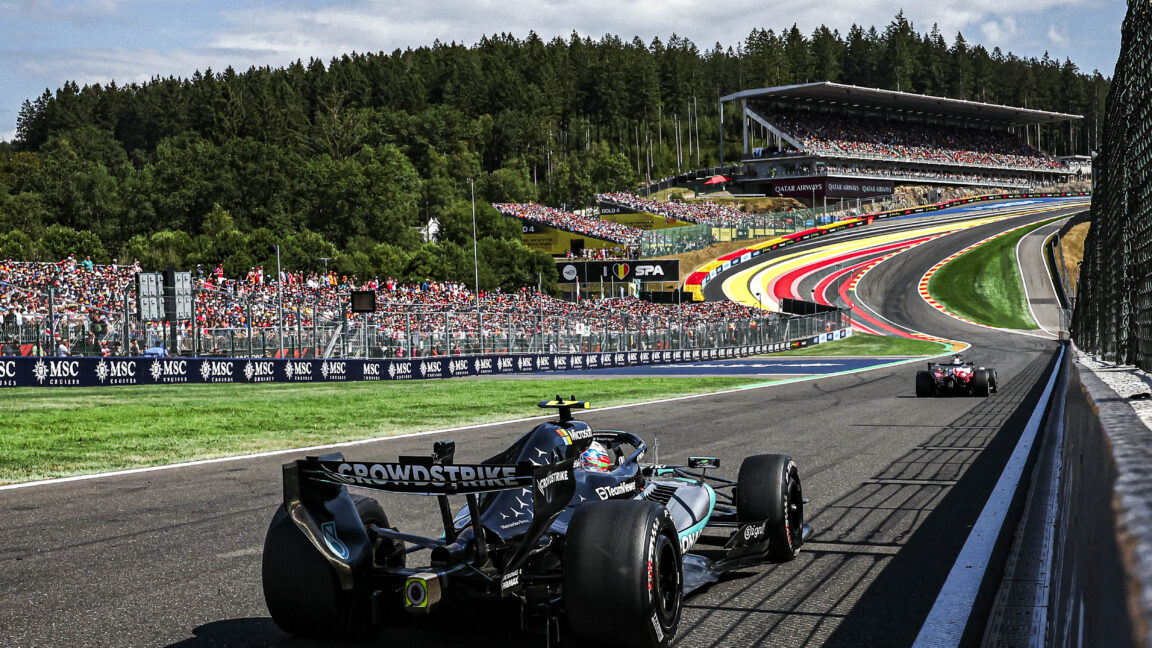
Mercedes driver Kimi Antonelli won the Belgian Grand Prix at Spa-Francorchamps on Sunday, but the weekend’s bigger story was the machinery under him: 2026 Formula 1 cars that appear poorly matched to one of the sport’s most celebrated high-speed circuits.
Ars Technica’s Jonathan M. Gitlin reported that the new cars are again exposing the limits of F1’s current hybrid rules. The problem is energy, not romance. The 2026 battery can deliver electric assistance for only a short part of a lap, leaving drivers to manage deployment and regeneration rather than attack every fast section flat out.
At Spa, that changes the character of corners that built the track’s reputation. The modern 4.3-mile circuit, reworked in 1979 from the old public-road layout, still includes Eau Rouge and Raidillon, the famous uphill left-right sequence that climbs 77 feet. Pouhon and other quick corners have become major tests in the high-downforce era. This year, according to Gitlin, those tests were blunted by lift-and-coast driving as cars saved and harvested energy.
Drivers are fighting the battery as much as the track
Red Bull’s Max Verstappen described the experience bluntly after qualifying. “For most of sector two, you run just on the engine,” Verstappen said. “So what is that? 450 bhp, 500 bhp? Something like that, which is, I guess, more or less what a Formula 3 car has but with F1 downforce. So you can imagine, of course, that that is not very exciting to drive.”
Verstappen added that he was trying to adapt. “I’m mentally just adjusting to it. I’m trying to make the best out of it,” he told media after qualifying, while also saying the new style was not what he enjoyed about Formula 1.
The energy-management issue hit Mercedes driver George Russell harder. Russell qualified well behind teammate Antonelli and said his focus had shifted almost entirely to a straight-line speed problem. “My whole focus for the last 36 hours has been on straight-line speed,” Russell said after qualifying. He said he was losing speed on the straight while at full throttle and did not believe the power unit itself was the cause.
Gitlin reported that teams’ self-learning systems for managing electric deployment across a lap are becoming a likely culprit. With only 4 megajoules of battery capacity available, small bursts of torque assistance or wheelspin can upset the planned energy budget. The driver then reaches another part of the lap expecting power that is no longer there. That is a miserable kind of software surprise at 180 mph.
Antonelli converts pole into another win
Antonelli started from pole after beating Verstappen by three tenths of a second in qualifying. Verstappen briefly got ahead at the start, pleasing the many Dutch fans at Spa, but Antonelli was back in front by Les Combes and stayed there to take his sixth victory of the season.
Russell’s race ended after a clash with Lewis Hamilton’s Ferrari. Gitlin reported that Russell regenerated enough energy while other drivers lifted and coasted into Les Combes to attempt a move on Hamilton, then clipped the Ferrari and spun into the gravel. Russell responded over Mercedes radio with an angry tirade. The stewards gave Hamilton a five-second penalty, though Gitlin described the contact as a racing incident and noted that Russell later said Hamilton was not to blame.
Audi’s Gabriel Bortoleto finished eighth, scoring four points for himself and the team.
Spa has hosted racing since before the Formula 1 world championship existed, with the first Belgian Grand Prix held in 1922 and F1 visiting in its inaugural 1950 season. The 2026 edition still produced a winner, points and a podium. It also strengthened the case that F1’s current hybrid package is making its best circuits feel less like tests of nerve and more like battery scheduling exercises.
This story draws on original reporting from Ars Technica.