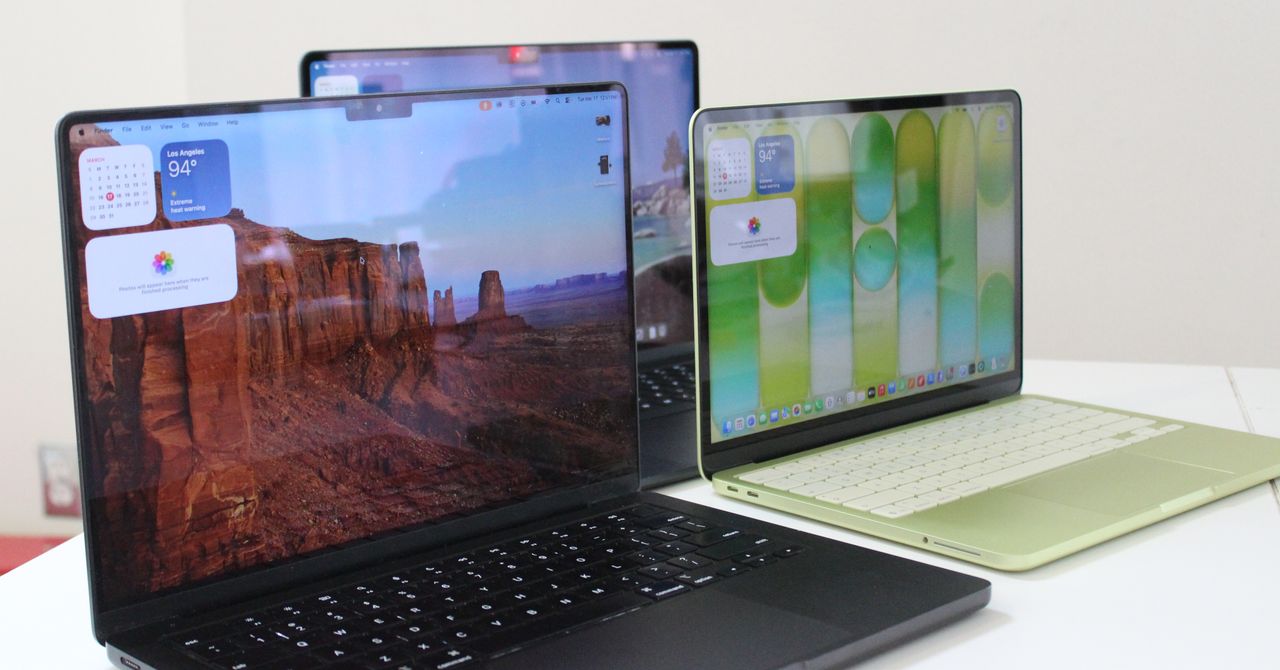
Apple’s 2026 MacBook lineup is now fully refreshed, which gives buyers current hardware and longer expected software support. It also gives them worse prices. WIRED reported that Apple raised prices across MacBooks and iPads on June 25, only months after finishing updates to the MacBook Air, MacBook Pro and new MacBook Neo.
Apple blamed the increases on higher memory and storage costs, saying demand from AI data centers has created an unusual squeeze on component supply. That is a tidy corporate explanation, and it may even be accurate, but the practical result is less delicate: the cheapest MacBook is no longer as cheap, and the Pro machines now start much higher.
- MacBook Neo: $699, up from $599
- 13-inch MacBook Air: $1,299, up from $1,099
- 15-inch MacBook Air: $1,499, up from $1,299
- 14-inch MacBook Pro: $1,999, up from $1,599
- 16-inch MacBook Pro: $2,999, up from $2,699
The MacBook Neo is the new low end of the range. WIRED says it has replaced the old M1 MacBook Air that Apple had continued selling through Walmart for $599. The Neo uses Apple’s A18 Pro iPhone chip rather than a Mac-class M-series processor, a choice that makes the machine cheaper than the Air but also puts it in a different performance category.
The chip split is now the buying decision
Apple’s base M5 chip, introduced in late 2025, now appears in the MacBook Air as well as other Apple devices. WIRED says the M5 keeps up to a 10-core CPU and 10-core GPU, with CPU performance roughly 10 to 15 percent faster than the previous generation and larger gains in graphics, AI workloads and storage speed.
The 14-inch and 16-inch MacBook Pro models carry the heavier silicon. The M5 Pro offers up to an 18-core CPU and 20-core GPU, while the M5 Max goes up to 40 GPU cores. WIRED says the M5 Pro and M5 Max use a “Fusion Architecture” that connects two dies across a fast interconnect, a cousin of Apple’s UltraFusion approach. In plain English, Apple is stitching chiplets together to get more cores and bandwidth without treating the laptop like a space heater, at least in theory.
For most buyers, that means the Air remains the sane default if the work is browsing, writing, spreadsheets, coding light projects or photo edits. The Pro models make sense for people who already know they need sustained graphics, video, AI or development performance. Paying Pro money for email is still a very Apple-flavored way to punish a checking account.
Software support is cutting off old Intel Macs
Apple announced macOS 27 Golden Gate at WWDC 2026, according to WIRED. The update focuses on Siri, including deeper Spotlight integration, a dedicated Siri AI app and Apple Intelligence features exposed through Finder and the right-click menu.
Golden Gate is also the first macOS release to drop support for pre-2020 Intel Macs. Supported notebooks include MacBook Air models from 2020 and later, MacBook Pro models from 2020 and later, and MacBook Neo models from 2026 and later. Apple Intelligence remains limited to Macs with M-series chips, according to WIRED, which excludes Intel Macs even when they can still run recent macOS versions.
The current macOS 26 Tahoe release is the last major version for a small set of Intel machines, including the 2019 16-inch MacBook Pro, the 2020 13-inch MacBook Pro with four Thunderbolt 3 ports, the 2020 27-inch iMac and the 2019 Mac Pro. WIRED says those machines will receive three years of security updates after Tahoe.
Rumors point higher, not cheaper
Bloomberg has reported that Apple may be preparing a higher-end MacBook with an OLED display, a touch-optimized interface, an M6 chip and a thinner chassis, possibly branded as a MacBook Ultra. Bloomberg has also reported that the M6 may arrive without Pro, Max or Ultra variants, which would leave current M5 Pro and M5 Max MacBook Pros near the top of Apple’s laptop range for longer than usual.
Those are still reports, not products. For buyers who need a machine now, the confirmed situation is easier to read: the hardware is fresh, the prices are worse, and the dividing line is clear. Buy the Air for normal Mac work. Buy the Pro only when the workload can explain the invoice.
This story draws on original reporting from WIRED.