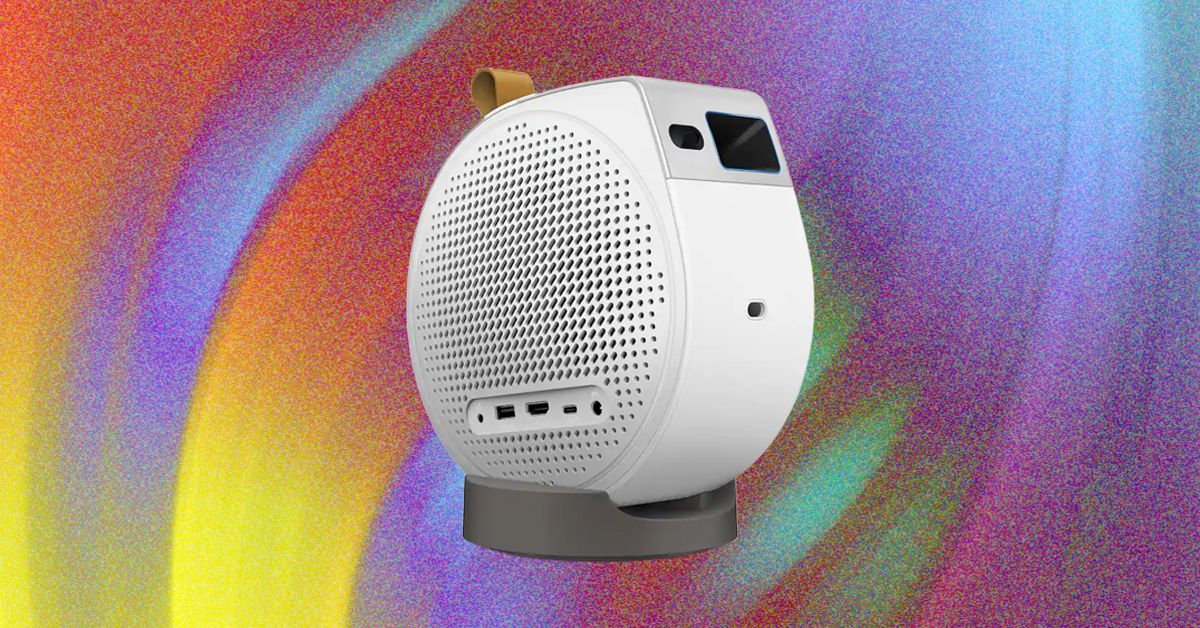
This BenQ GV50 review comes down to priorities. BenQ’s compact projector is built for moving from room to room and throwing a show onto a wall or ceiling without assembling a small home-theater shrine. Reviews agree that it succeeds at that job. They also find that the price of that flexibility is modest image performance, limited wired connectivity and streaming hardware that can get bogged down.
WIRED gave the GV50 a 7 out of 10, praising its portability, adjustable stand and generally straightforward setup while faulting its picture quality, contrast and onboard performance. RTINGS likewise describes it as a portable 1080p DLP projector with a laser light source, built-in battery, carry handle and two-axis gimbal stand.
Is the BenQ GV50 worth buying for ceiling projection?
For casual viewing in a dark room, the evidence points to yes, provided image quality is not the deciding factor. WIRED found the 4.6-pound, 8-inch-tall unit easy to move, and reported that its base lets owners shift the projector vertically and tilt it toward a wall or ceiling. RTINGS says the gimbal can aim the image from a table, shelf or floor.
That mechanism is the GV50’s actual trick. A conventional projector can make a large image but usually demands more careful placement. The GV50’s movable base is meant to reduce that friction, including for ceiling viewing from bed. It can also project on a wall or screen, according to WIRED.
Google TV is built in, providing access to streaming apps without an external stick. WIRED’s reviewer used Google Home to scan a QR code during setup and reported that automatic keystone correction worked on a screen, wall and ceiling. The reviewer’s first software update took roughly 45 minutes, a reminder that “portable” does not mean software has stopped wasting an evening.
Where does the BenQ GV50 fall short?
Its native resolution is 1080p. In WIRED’s viewing tests, contrast, brightness and color intensity did not hold up especially well: dark foreground details merged into black backgrounds and colorful material looked muted. A Digit reviewer separately said ambient light reduced visible detail, particularly in darker scenes. These are reviewer observations, rather than universal lab conclusions, but they point in the same direction: this is best used in controlled, dim lighting.
Battery operation also comes with a compromise. WIRED reported a runtime of a few hours, with the image dimming to conserve power; Digit estimated two to three hours in its use. Runtime will depend on settings and viewing conditions.
Connectivity is functional but thin. WIRED lists one HDMI port, USB-A, USB-C and a 3.5-mm jack, with no Ethernet port. The HDMI connection supports ARC 5.1 audio pass-through, not HDMI eARC, and WIRED says Dolby Atmos is unsupported. The projector uses Wi-Fi 5; its reviewer had trouble joining a Google Nest mesh network. Readers needing the networking basics can see how Wi-Fi works.
WIRED also found Google Cast and Apple AirPlay playback choppy, with fast-forwarding sometimes causing streams to pause or fail. The review attributed that experience to the GV50’s 1.5-GHz processor and 2 GB of RAM. Audio is less clear-cut: WIRED found it unremarkable, while PCMag called it robust for the size and Digit liked its built-in 2.1-channel system.
The practical verdict is narrow but useful. The GV50 fits viewers who want uncomplicated, battery-capable streaming on a wall or ceiling in a dark room. Buyers who need strong contrast, better ambient-light performance, fast casting, wired networking or eARC audio should treat its portability as a feature, not an excuse for the missing pieces.
This story draws on original reporting from WIRED.