Shopping for the best dehumidifiers 2026 means separating a room appliance from a small-space one before comparing apps, buckets, and marketing labels. Reviewed’s current six-pick guide spans general-purpose, value, smart-feature, family-safety, small-space, and closet categories. Its list is a useful shortlist, not a universal ranking: different publications tested and recommended different models, and several earn commissions from retail links.
The practical split is capacity. Consumer Reports defines large models as removing 40 pints or more per day, medium models as roughly 30 to 40 pints, and small models as under 30 pints. Its testers advise buying somewhat more capacity than the bare minimum when practical, since that can dry a room faster and reduce trips to empty the tank.
Which dehumidifier should I buy for my space?
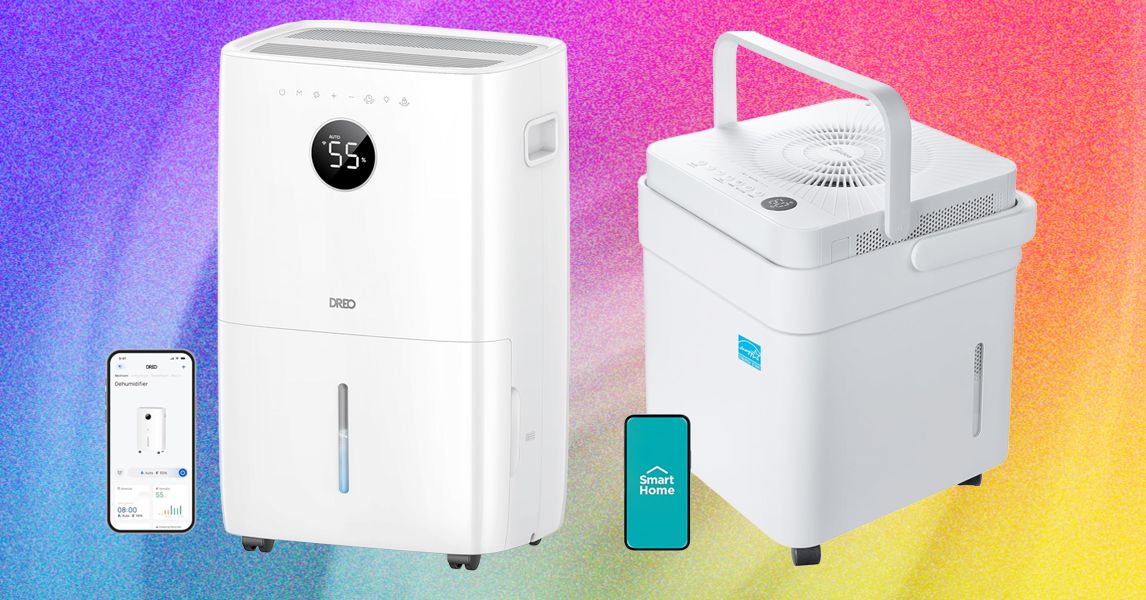
- Midea Cube: Reviewed’s overall pick has a stackable tank, a large reservoir, smart features, and low energy use, according to the publication. Reviewed also flags its bulkier form factor. WIRED separately named a 20-pint Midea Cube its overall pick.
- Hisense DH7021K1W: Reviewed’s value selection has an auto mode, low operating temperature, efficient operation, and an easy-empty design. The publication lists lower sturdiness as a drawback.
- Frigidaire Gallery FGAC5044W1: Reviewed chose this model for smart features, including iOS and Android connectivity and support for Amazon and Google Home. It also has a front reservoir, though Reviewed characterized its humidity reduction as average.
- Dreo 50-Pint Smart Dehumidifier DR-HDH001S: Reviewed’s family-oriented pick includes a child lock, tilt shutoff, sleep mode, and Wi-Fi control. High-speed fan noise and a less-polished app remain listed tradeoffs.
- Eva-Dry EDV-1100: Reviewed recommends this compact, portable unit for warm small spaces. It is described as quiet and low-power, with limited water capacity and warm-temperature-only operation.
- Eva-Dry E-333: This is Reviewed’s closet pick. That is the supported use case; it should not be treated as a replacement for a full-size unit in a damp room.
Can a dehumidifier prevent mold in a wet basement?
It can reduce excess moisture, which Consumer Reports says makes living spaces less susceptible to mold and mildew. The publication recommends maintaining humidity between 30% and 50%; above that range, it says mold and dust mites begin to thrive. That is moisture management, not mold removal or a guarantee against future growth.
A dehumidifier also cannot fix water entering the building. Consumer Reports says these machines are meant to make a damp space more comfortable, not dry puddles or carpet saturated with water. Persistent leaks call for fixing the water path, such as drainage or gutter problems. For flooding or standing water, remove wet materials and water, increase airflow, and use fans before letting a dehumidifier help finish drying the space.
Consumer Reports tests water removal against a manufacturer’s claimed daily-pint figure in a chamber at 65 degrees Fahrenheit and 60% relative humidity. Real homes are less tidy than a test chamber, so capacity band, moisture load, drainage access, and the actual source of dampness deserve more attention than a single “best” badge.
This story draws on original reporting from WIRED.