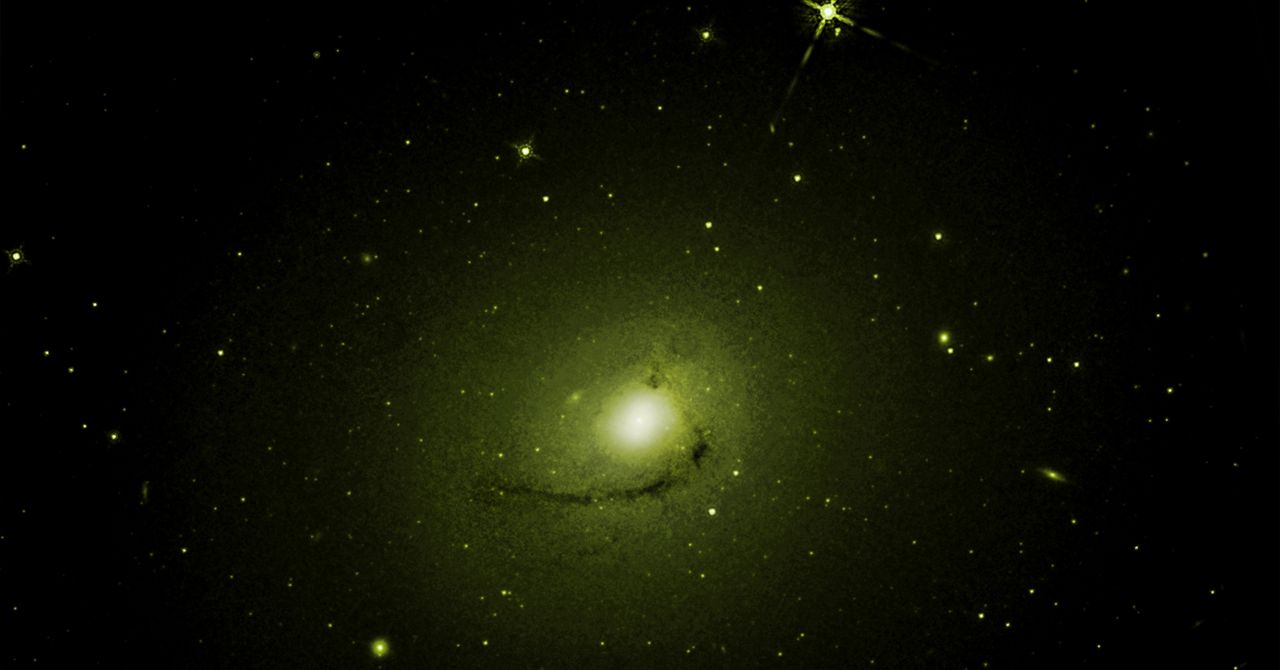
Researchers say they have directly traced a black hole cosmic recycling route in NGC 4696, a galaxy in the Centaurus Cluster about 145 million light-years from Earth. The result matters because supermassive black holes are supposed to be messy eaters: they swallow nearby gas, then blast energy back out in jets that heat and push away the same material they need to grow.
An international team led by Julie Hlavacek-Larrondo, a professor at the University of Montreal, used the James Webb Space Telescope to study the galaxy’s core and reported a physical link between cooled gas filaments and the central black hole. The work supports a long-running idea that black holes can keep feeding because some of the gas they disturb later cools, condenses and falls back inward.
How do black holes feed themselves?
Supermassive black holes grow by drawing in surrounding matter. According to astronomers, the puzzle is that their jets heat nearby gas and slow star formation, which should also make it harder for the black hole to keep finding fuel.
The proposed answer is a feedback loop with bad table manners but decent efficiency. Gas pushed away by heating can cool in interstellar space, form narrow filaments, then stream back toward the galaxy’s center. If it reaches a rotating gas disk, it can eventually be supplied to the black hole.
For NGC 4696, that pathway is now visible in more detail. The team observed the galaxy’s central region for about eight hours with JWST’s Near-Infrared Spectrograph, or NIRSpec. The instrument resolved structures about 30 light-years across, fine enough to examine gas motion close to the black hole on galactic-core scales.
Earlier observations had shown an S-shaped spiral around the center of NGC 4696. The new JWST data indicate that the structure is a rotating gas disk, about 800 light-years wide, circling the black hole. The gas moves at several hundred kilometers per second, with a measured velocity difference of roughly 600 kilometers per second between opposite sides of the disk.
The key observation is where the filaments go. The researchers found condensed gas streams feeding directly into the disk’s edge. Gas travels along those filaments, collects in the disk, and can then become fuel for the black hole.
What the simulations add
The team also ran computer simulations to test how the returning gas can avoid being flung away. Their model suggests that stretched magnetic fields behave like ropes, applying torque that strips angular momentum from the filament gas. With less angular momentum, the gas can fall into the disk instead of missing the center.
The simulations also suggest that the disk does not keep a steady orientation. Since filaments arrive from multiple directions, the disk’s axis can wobble. That wobble would redirect the black hole’s jets over time, spreading their heating through more of the cluster’s central region and limiting runaway cooling in one place.
The researchers caution that black holes with stronger jets may behave differently. In other central cluster galaxies, jets could be energetic enough to prevent a clean gas disk from forming, leaving the surrounding gas more chaotic.
The NGC 4696 paper is the first of three planned studies using the JWST observations. This one examined relatively warm gas at about 10,000 Kelvin. Additional papers will analyze gas at other temperatures, and the result has already led to more JWST observing programs and coordinated work with ground-based telescopes to test whether similar recycling loops operate in other galaxies.
This story draws on original reporting from WIRED.