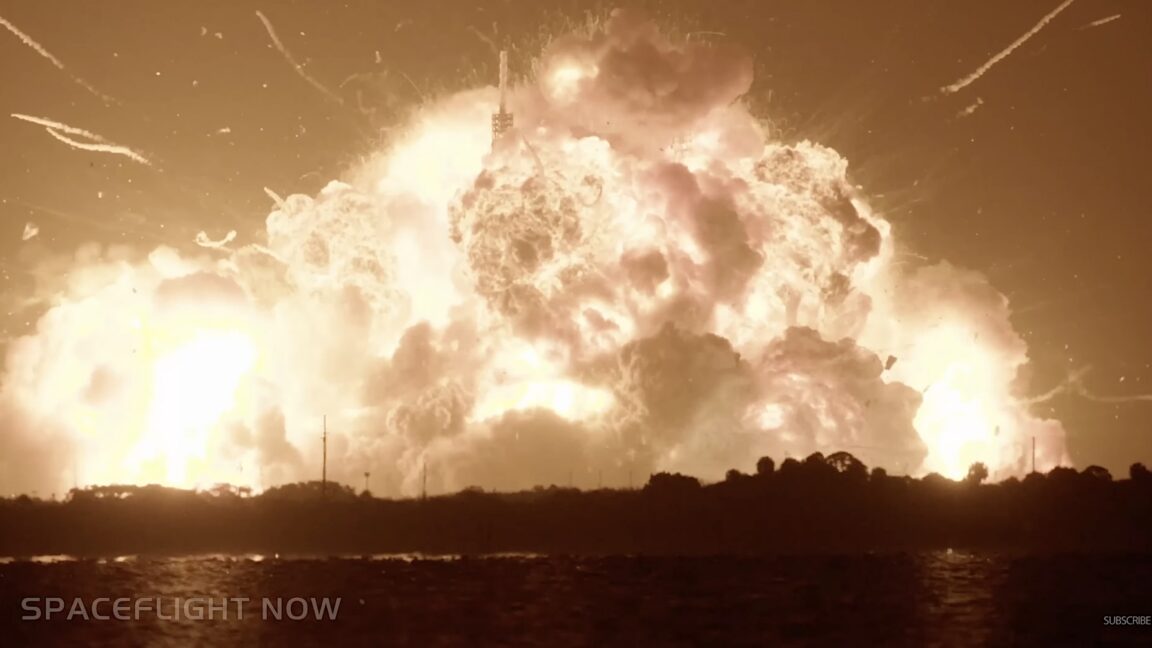
Blue Origin New Glenn root cause investigators have located where May’s destructive hot-fire accident began, but the company has not publicly identified the underlying failure mode. Blue Origin says the anomaly originated at the main oxygen valve of one BE-4 engine, while its remaining fault-tree analysis continues.
The New Glenn vehicle exploded during a May 28 hot-fire test at Cape Canaveral Space Force Station’s Launch Complex 36. In such a test, engines fire while the rocket remains fixed to the pad. Blue Origin said all personnel were accounted for; local outlet ClickOrlando reported that no one was hurt.
In an August 5 update, CEO Dave Limp said hardware recovered from the accident and subsequent inspections confirmed the valve as the origin point. That finding narrows the investigation, but it does not establish why the valve malfunctioned or whether other contributing factors were involved. Ars Technica reported that Blue Origin had not yet publicly announced a final root cause.
Has Blue Origin found the cause of the New Glenn accident?
Blue Origin has identified the main oxygen valve on one BE-4 engine as the point where the anomaly began. It is still completing its fault-tree analysis, so the company has not publicly declared a final root cause or a confirmed failure mode.
Limp said Blue Origin has run component-level and engine hot-fire tests to better understand the failure mode and inform mitigations. The company has not released results from those tests or described the specific mechanical or operational failure inside the valve.
Planned valve modifications and return-to-flight target
Blue Origin says it is making small modifications to the valve that it expects can be retrofitted to engines already built. Limp said the company expected the revised hardware to be ready by the end of August. That is a stated recovery step, not evidence that the modification has yet been demonstrated in flight or that New Glenn is cleared to return.
The company is also rebuilding its ground operations at LC-36A. Rather than restore the pad to the same configuration, Blue Origin says it will use a hybrid approach: stages will be joined horizontally in the Integration Facility, moved to the pad, then raised vertically by crane before the payload is attached.
Blue Origin said in June that its propellant farm, oxygen, liquid-hydrogen and LNG tanks, plus the water tower, were in good condition. It said the damaged support tower could be repaired in place. The company is targeting a return to flight before the end of 2026, a schedule that remains a company goal while the technical investigation is unfinished.
- What is confirmed: Blue Origin says the anomaly began at a BE-4 main oxygen valve.
- What remains open: The failure mode and final root cause have not been publicly disclosed.
- What Blue Origin plans: Valve changes, more analysis and a revised pad operating configuration.
This story draws on original reporting from Ars Technica.


