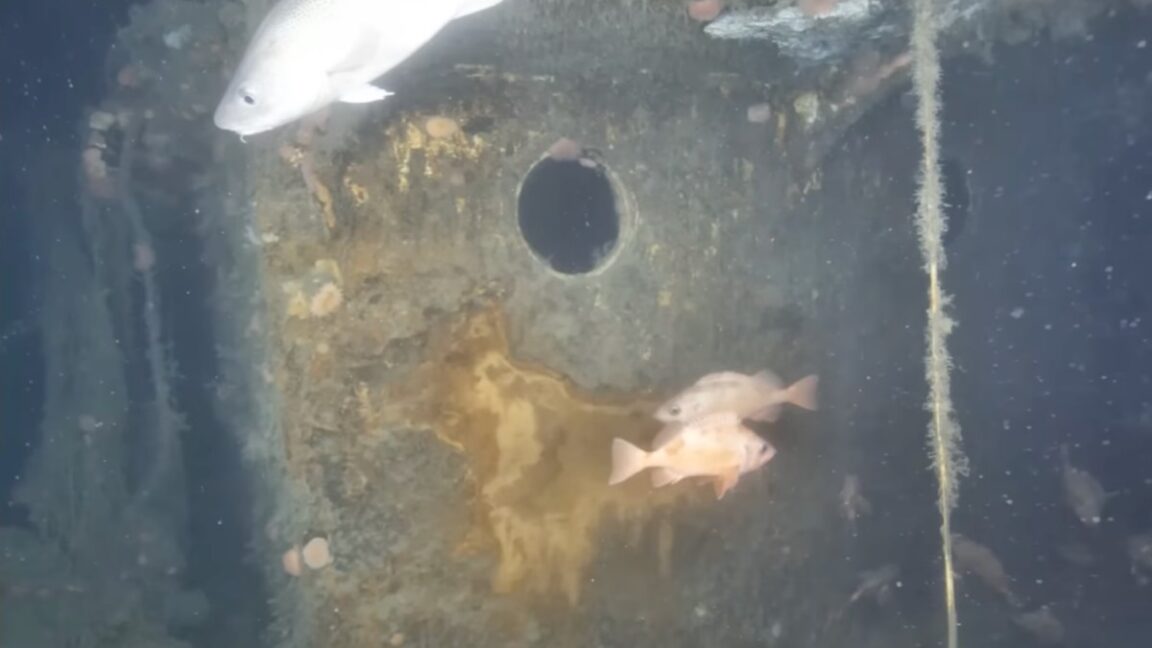
The Royal Canadian Geographic Society has released the first underwater images of the Quest, the polar ship best known as Ernest Shackleton’s final vessel, Canadian Geographic reported. The pictures matter for more than maritime nostalgia: they show a wreck that has been damaged by modern fishing gear and, at the same time, turned into habitat for marine life.
The Quest was located in 2024 in the Labrador Sea, more than six decades after it sank off Canada’s Atlantic coast. The Royal Canadian Geographic Society led that search, with chief executive John Geiger heading the effort. According to Canadian Geographic, the project cost about $365,000 and began with the unglamorous part of shipwreck hunting: logs, navigation records, and other archival material.
The search team left port on June 5, 2024, and spent 17 hours scanning the seabed with sonar while dealing with fog and equipment problems. Geiger later identified a shape on the sonar display as the Quest, according to the account published by Canadian Geographic.
A ship with an overloaded biography
Quest began life as a wooden Norwegian whaler called Foca I. Shackleton bought it for a planned Arctic expedition, and his wife, Emily, renamed it Quest. The mission changed after Canadian government support fell away, shifting the plan back toward Antarctica.
The ship was modified heavily before the 1921 voyage. Its additions included a new deckhouse, a heated crow’s nest, wireless equipment, an odograph for automatically recording the route, a Lucas deep-sea sounding machine, extensive camera gear, and a small airplane.
Shackleton did not reach Antarctica on that expedition. He became ill after the ship reached Rio de Janeiro and died aboard Quest at South Georgia on Jan. 5, 1922. The recorded cause of death was coronary thrombosis. His body was buried at Grytviken in a Norwegian cemetery.
The expedition continued only in reduced form. Some scientific papers, geological work, and survey work resulted, but the voyage is generally remembered more for Shackleton’s death than for its research output.
Quest stayed in service for decades. It was refitted more than once, used in other expeditions in the 1930s, worked on rescue missions, served in the Royal Canadian Navy during World War II as a minesweeper and light cargo vessel, and later returned to commercial sealing. On May 5, 1962, during a seal-hunting trip, ice pierced the hull and the ship sank. As with Shackleton’s Endurance, the crew survived.
The wreck is not pristine
The new expedition, conducted with the Woods Hole Oceanographic Institution as a partner, began July 2 and used a Falcon remotely operated vehicle and the ALVIN deep submergence vehicle to inspect the site, according to Canadian Geographic. The team plans to use underwater photogrammetry to build a 3D digital model of the wreck.
The first sonar images from 2024 suggested the ship might be in relatively good condition. The new visuals complicate that. Canadian Geographic reported that fishing nets, floats, and other bottom-trawling gear are caught around the stern and much of the starboard side. The bridge superstructure is gone, though the aluminum bridge remains attached.
Antoine Normandin, the expedition’s research director, told Canadian Geographic he was initially disappointed by the condition of the wreck, then reconsidered it as a research site in its own right. “Quest itself is now becoming a science experiment,” he said.
Woods Hole biologist Kirstin Meyer-Kaiser told Canadian Geographic that the wreck has become a thriving ecosystem. Soft corals are growing near the bow, and the site hosts species including the threatened spotted wolffish. Meyer-Kaiser said human history has created habitat there, increasing biodiversity around the wreck and possibly helping some species spread regionally.
This story draws on original reporting from Ars Technica.


