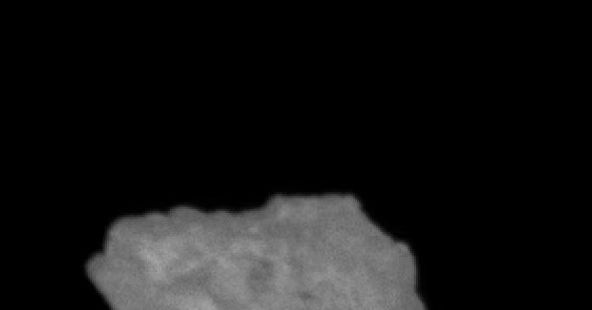
China’s Tianwen-2 asteroid probe has arrived at Kamoʻoalewa, a small object that travels around the Sun on a path close to Earth’s, according to the China National Space Administration. The arrival gives Chinese mission controllers a shot at something much harder than a flyby: touching a fast-rotating asteroid about the size of a city bus cluster, collecting material, and getting it back to Earth.
The spacecraft first detected Kamoʻoalewa on June 6, 2026, after a series of trajectory adjustments in deep space. On July 2, Tianwen-2 took what CNSA described as the first images of the object from roughly 20 kilometers away. The encounter came after a 400-day trip covering about 1 billion kilometers.
Kamoʻoalewa is classified as a quasi-satellite of Earth. That label can be misleading if read too casually. It does not orbit Earth like the Moon does. It orbits the Sun, but its solar orbit is close enough to Earth’s and synchronized enough with our planet’s motion that, from Earth, it appears to hang around nearby. Among Earth’s known quasi-satellites, Kamoʻoalewa is considered the most stable, which makes it a tempting target for a sample-return mission.
Tempting is not the same as cooperative. Kamoʻoalewa’s average diameter is about 41 meters, and it spins quickly. Tianwen-2 will need to make stable contact during a short operational window if it is going to collect samples. Small asteroids have weak gravity and awkward surfaces, which is a polite way of saying spacecraft have to do precision work around rubble that may not behave like a tidy lab object.
If the sample collection works, Tianwen-2 is expected to release the material in a return capsule during an Earth flyby in November 2027.
What Tianwen-2 is carrying
The probe has several cameras with different focal lengths, including narrow-field and wide-field systems that can be used depending on the viewing geometry. It also carries a detachable camera intended for the sample-collection phase. Imaging the asteroid requires fine attitude control, so the spacecraft has to line up its instruments during brief chances rather than just point and click like a tourist with better funding.
Mission planners intend to study Kamoʻoalewa’s shape, composition, and interior structure in more detail before the sampling attempt. Those measurements could matter well beyond this one rock.
Han Siyuan, deputy director of the Lunar and Space Exploration Engineering Center and a spokesperson for Tianwen-2, said material from Kamoʻoalewa is likely to preserve information from the early solar system and could help researchers study its original composition, formation, and later evolution.
The origin story is still unsettled
Researchers have argued that Kamoʻoalewa may be a chunk of the Moon blasted away by an ancient impact. That idea was supported by reflected-light spectra resembling silicate minerals on the lunar surface, and by simulations cited in earlier work.
A May paper by an international research team, including scientists from the Chinese Academy of Sciences, challenged that leading explanation. The team reexamined available observations and found that a key absorption-band wavelength was more consistent with LL chondrites, a class of meteorites with low iron and metal content.
The researchers also irradiated powdered LL chondrite meteorite samples with a laser to mimic space weathering from solar wind and micrometeorites. They reported that the treated samples closely matched observations of Kamoʻoalewa. Their proposed alternative is that the object came from the Flora family in the asteroid belt and later moved into Earth’s neighborhood.
A returned sample would give scientists something better than spectra and simulations: actual material in a lab. Japan’s Hayabusa and Hayabusa2 missions and NASA’s OSIRIS-REx have already shown the value of bringing asteroid samples home. Tianwen-2 now has to do the less glamorous part first, which is getting down to the surface of a tiny, rotating target without botching the handoff.
This story draws on original reporting from WIRED.