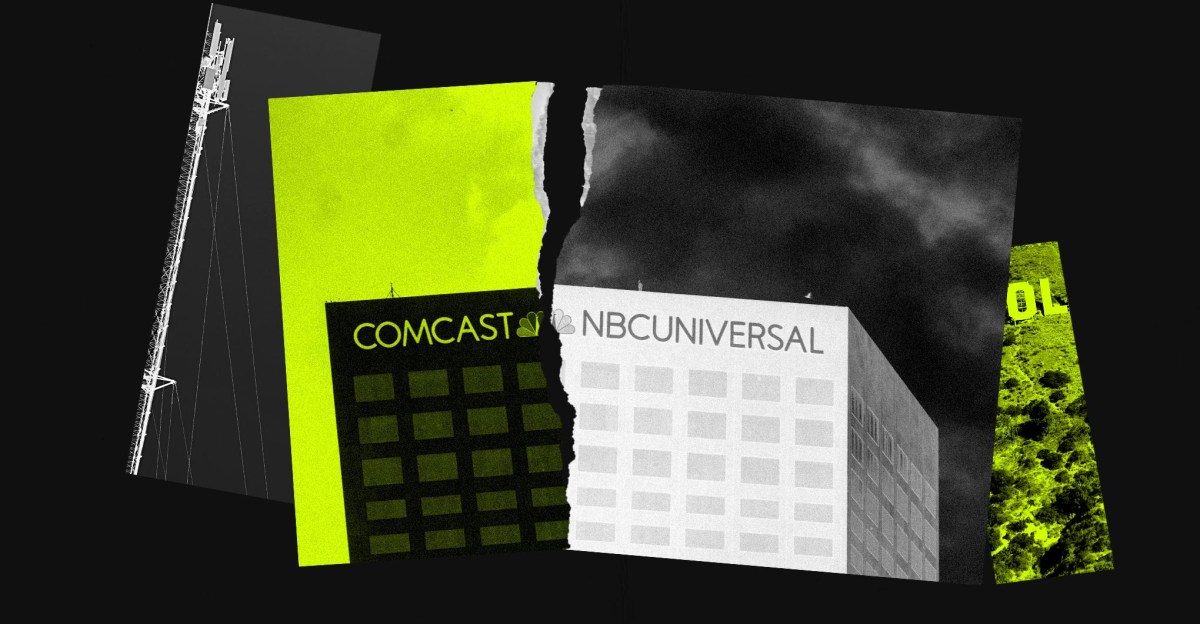
Comcast has announced a plan to separate its broadband business from NBCUniversal, cutting apart a 15-year experiment in owning both the network that carries media and the media itself.
The move follows an earlier Comcast separation of cable assets including CNBC and MS.NOW into a new company called Versant. On The Verge’s Decoder podcast, Business Insider chief correspondent Peter Kafka described that first step as financial engineering aimed at improving how investors valued Comcast. He said it did not move the company’s stock.
The next split would leave one company focused on Comcast’s broadband business. The other would contain NBCUniversal’s entertainment assets, including NBC, Bravo, Peacock, Universal Studios theme parks, and Universal’s film and television studio, according to Kafka’s breakdown on Decoder.
A 15-year bet loses its favorite excuse
Comcast bought NBCUniversal from GE and held it far longer than other telecom and media combinations survived. Kafka said NBCUniversal may have performed well as an asset inside Comcast, pointing to the theme parks as a substantial business and the studio as valuable despite uneven performance. His sharper point was that Comcast never demonstrated much benefit from pairing those assets with the broadband operation.
That was supposed to be the magic trick: a company sells internet access, owns the programming people want, and somehow the two parts make each other more valuable. Media and telecom executives have tried versions of that idea repeatedly. Decoder host Nilay Patel and Kafka cited AT&T’s purchase of Time Warner, Verizon’s purchases of AOL and Yahoo, and AOL’s earlier Time Warner deal as examples that ended badly.
Kafka argued that Comcast persisted partly because it is publicly traded but still controlled in practice by the Roberts family. He said Comcast CEO Brian Roberts spent years defending the combination even as Wall Street showed little interest in valuing the entertainment business as part of the broadband company.
According to Kafka, Comcast was still considering expansion in media recently, including a bid for part of Warner Bros. Discovery. He characterized the new split as Comcast accepting investor pressure after years of being told that the broadband business mattered more to the market than the media holdings.
Net neutrality made the merger harder to exploit
The regulatory backdrop matters because a broadband owner with a streaming service has obvious temptations. Patel and Kafka discussed net neutrality, the principle that internet providers such as Comcast must treat traffic equally rather than slow Netflix or favor Peacock.
Patel suggested that the ability to privilege owned content may have been one of the premises behind marrying distribution and programming. Kafka and Patel disagreed over whether regulators or market power prevented the internet from becoming a cable-style bundle controlled by access providers.
Netflix sits at the center of that argument. Patel referred to a 2017 Code Conference moment when then-Netflix CEO Reed Hastings said Netflix was large enough that net neutrality no longer mattered to it in the same way. Kafka said Netflix’s scale helps explain why the Comcast model looks less relevant in 2026: distributors had to deal with Netflix because audiences were already there.
Comcast executives have said the breakup is not a prelude to selling assets, according to the discussion. Kafka treated that claim cautiously, saying companies can mean that until the day they choose otherwise. For now, the confirmed fact is simpler and more telling: Comcast is preparing to put the pipes and the programming back into separate boxes.
This story draws on original reporting from The Verge.