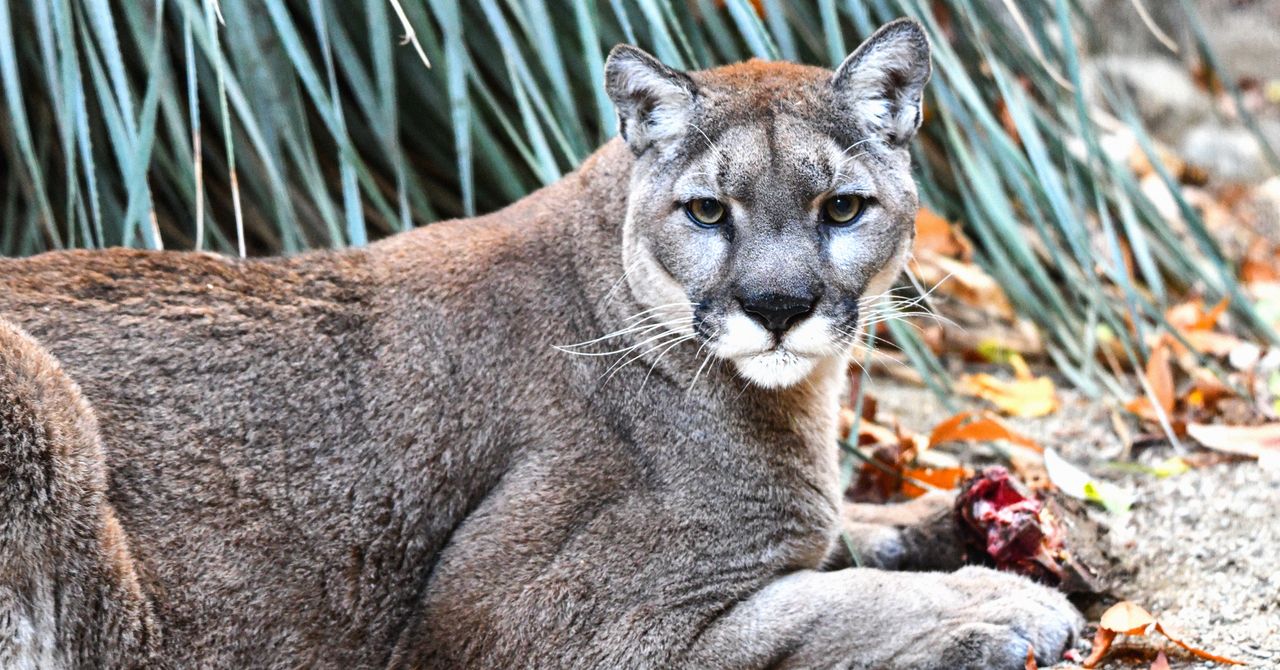
Cougar deer car crashes were more than 76% lower in parts of Washington’s Olympic Peninsula with higher cougar presence than in places with few cougars, according to a Current Biology study reported by Wired. The result matters to drivers because the researchers’ proposed mechanism is about where deer move, not merely how many deer a cougar kills.
The study examined cougars, deer behavior and deer-vehicle collisions on the peninsula, where Panthera has operated a cougar-monitoring program since 2018, building on decades of observations by tribal biologists. Wired reported that the team drew on more than 500 camera sites and a year of deer-involved crash data.
How do cougars reduce deer car crashes?
Cougars hunt by ambush. They can use cover around forest edges, including roads passing through woodland and lower-density development beside forests, to approach deer feeding outside the trees. That risk appears to push deer away from the road-adjacent edges where drivers and animals meet at speed.
According to Wired’s account of the research, deer were 15% more likely to avoid road areas where cougars hunted, 86% more likely to spend time in denser woods, and more active during daylight. Each shift reduces time spent at roadside, though the study does not establish that introducing cougars into towns would be safe, feasible or an effective road-safety policy.
Justin Suraci, a lead author and senior scientist at Conservation Science Partners, told Wired that the team used prior work on carnivores and vehicle collisions to help separate this behavioral effect from a simpler explanation: fewer crashes because predators had reduced the total deer population.
A local finding, not a national forecast
The 76% figure is a place-specific comparison from the Olympic Peninsula over a five-year period. It is not an estimate for all U.S. roads, nor a guarantee for another region with a different deer population, road network, habitat or level of human development.
Laura Prugh, a University of Washington wildlife-sciences professor who coauthored earlier work on the subject, told Wired that the new analysis is limited by its focus on summer behavior. Deer behavior changes during the autumn rut, a period when deer-vehicle collisions rise, so the reported result does not settle what happens across every season.
Why does the older 22% estimate keep appearing?
It comes from a different study with a different question. A 2016 Conservation Letters paper led by Sophie Gilbert and coauthored by Prugh modeled potential cougar recolonization across 19 eastern states. The model projected a 22% drop in deer-vehicle collisions within 30 years, equivalent to five fewer deaths, 680 fewer injuries and $50 million in avoided annual costs, according to the University of Washington.
That was a projection based on cougar predation and deer populations, rather than a direct measurement of deer changing their behavior near roads. The 2016 researchers also acknowledged costs of re-establishing cougars, including possible attacks on people, pets and livestock. The newer Olympic Peninsula research adds evidence that predators may affect crash risk by changing deer movement before any population-level effect enters the picture.
This story draws on original reporting from WIRED.


