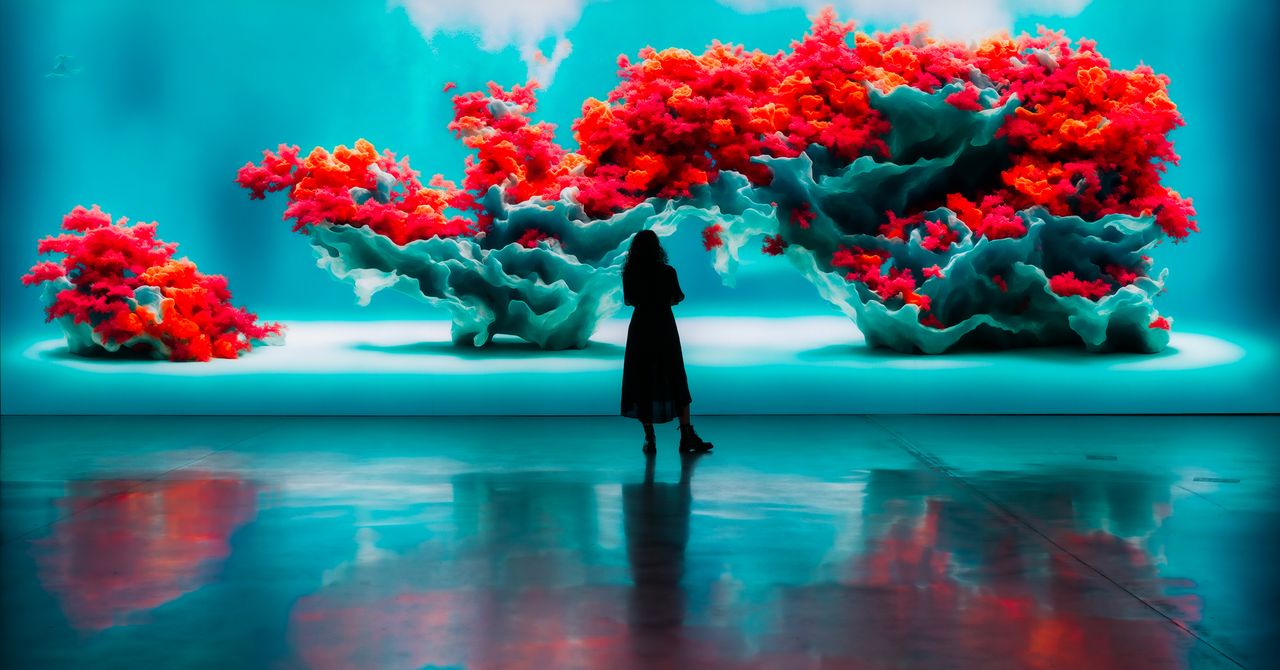
Dataland, a new downtown Los Angeles venue co-founded by artist Refik Anadol and studio partner Efsun Erkılıç, opened to the public on June 20 with an AI-driven rainforest installation that reacts to the people inside it. The gallery is billed as the world’s first museum devoted to AI arts, a claim that will make some curators reach for a pencil, but the opening numbers are real enough: Anadol told WIRED that more than 10,000 people visited in its first two weeks.
The debut exhibition, Machine Dreams: Rainforest, is built around Anadol’s Large Nature Model, an AI system trained on natural science archives and field material collected by his team. The pitch is ambitious: use machine learning, projection, sound, scent and biometric sensing to make a synthetic rainforest that responds to visitors rather than sitting politely on a wall.
Anadol told WIRED his team spent three years building its own models and datasets. He said the project uses 5 petabytes of raw data the team collected itself, including material gathered during trips to the Amazon and other rainforests. He also said Dataland worked with researchers’ consent and participation, a pointed distinction in an art world still furious about AI companies training on creative work without permission.
The institutional data behind the model includes scientific collections from groups such as the Smithsonian. Anadol said the Smithsonian’s Encyclopedia of Life contributed data covering more than 2 million species. In one part of the show, the Latent Gallery, visitors can inspect categories of training data, including grids of animal images, rather than being asked to clap at the magic box and move along.
The machinery is not subtle. Visitors can choose to enter without biosensors, but the full version uses wearable devices that Anadol described as modified medical-grade hardware. WIRED reported that visitors receive a smartwatch and a U-shaped shoulder device after a waiver and app-based setup. Those sensors feed movement and biometric signals into the installation, changing projected imagery, sound and other sensory effects.
In the main gallery, projected rainforest and circuit-like visuals move across walls and floors in a 40-minute sequence. WIRED reported that visitors’ movement affects elements such as rainfall patterns and watery rings around their feet. The shoulder device can also emit scents, including tree and storm smells, making the work less like a screen saver and more like a very expensive argument with a terrarium.
Privacy is the obvious question when an art show straps sensors to visitors. Anadol told WIRED the restroom is not connected to the system. He also said Dataland discards visitor data when a person leaves, while making it available to that visitor through a personal token given at the exit. That is Dataland’s account of its data handling, not an independent audit.
The show also depends on big-company infrastructure. Anadol said Google DeepMind provided access to experimental low-energy resources, and Google has said Dataland runs on Google Cloud. Anadol has a long history with Google, including a 2016 Google Artists and Machine Intelligence residency.
The final room, called the Sanctuary, combines group biometric inputs such as heart rate, skin temperature, route through the gallery and visit speed into a temporary 3D visualization. Anadol told WIRED the room treats emotion as an input, including signals such as goosebumps. That framing will not quiet every critic of generative AI art, especially those tired of scraped datasets and disposable AI video. Dataland’s opening bet is narrower and more defensible: if AI art is going to ask for museum space, it should at least show its data, explain its sensors and do more than autocomplete a picture.
This story draws on original reporting from WIRED.


