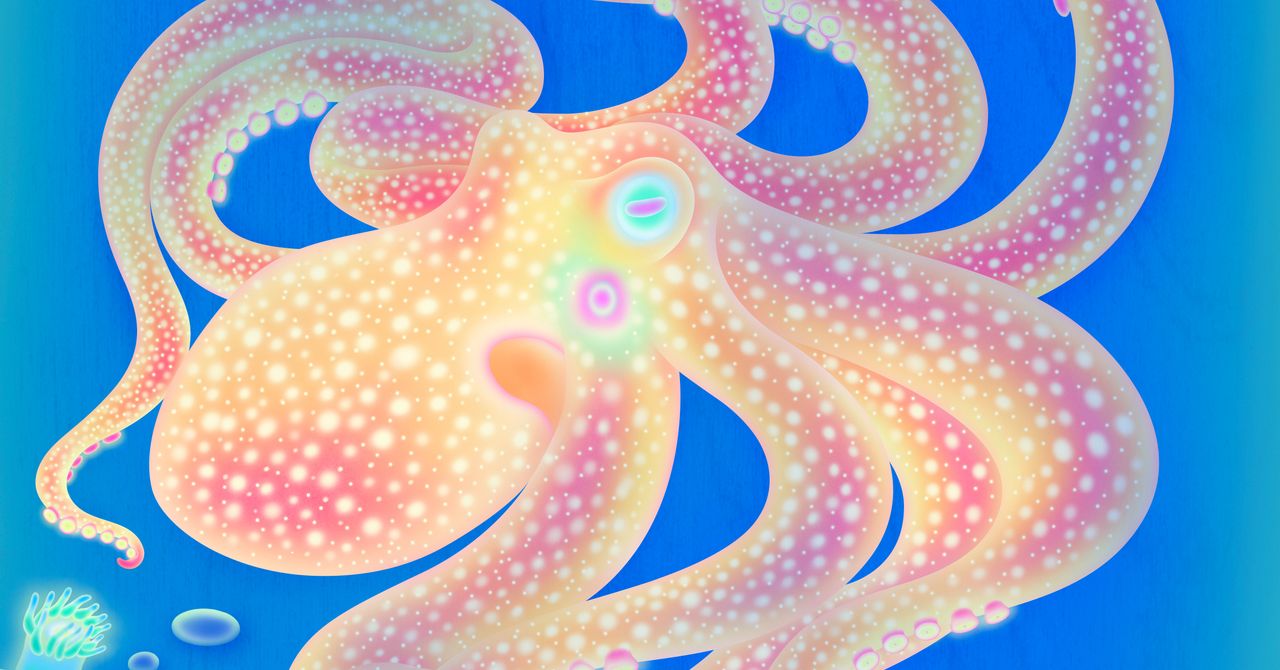
Do octopus arms have minds of their own? The catchy answer is no, at least not in the literal sense. An octopus does not have nine separately thinking brains. It has a nervous system built very differently from a vertebrate’s: a great deal of neural processing sits outside the central nervous system, including in eight arms packed with sensory receptors.
That arrangement gives the arms substantial local control over sensing and movement. It does not establish that an arm has its own consciousness, personality, or independent store of learned knowledge. The evidence points to a connected system in which peripheral circuitry handles some local work while remaining integrated with the central nervous system.
Why can octopus arms act independently?
Octopus arms have an unpleasantly large control problem to solve. They are highly flexible, and each arm carries more than 200 suckers capable of feeling, tasting and smelling the surroundings, according to the Okinawa Institute of Science and Technology. Rather than forcing the central brain to micromanage every bend and sucker contact, the animal has extensive neural hardware in its body and arms.
A 2020 Current Biology study by Tamar Gutnick, Letizia Zullo, Binyamin Hochner and Michael J. Kuba reported that only about one-third of an octopus’s neurons are in its central nervous system. The remainder are in the peripheral nervous system, including the arms, which contain many types of sensory receptors.
That anatomy helps explain why an arm can explore and react to nearby conditions with considerable autonomy. OIST says researchers have also observed reflex loops that create coordinated arm movements. Continued movement by a discarded limb demonstrates resilient local circuitry, but it is not proof that the limb has a separate mind.
What did the maze experiments show?
Gutnick and colleagues tested common Mediterranean octopuses with opaque, Y-shaped single-arm mazes. In one version, animals learned to send an arm left or right to reach a food reward. In another, they had to identify a rewarded route by texture, choosing between rough and smooth paths.
Five of six octopuses in each task eventually learned the relevant choice, OIST reported. The important part was where the information came from: the arm in the maze detected movement-related or tactile cues that the animal could not see. The study concluded that the central nervous system can use sensory information gathered in the periphery to direct movement.
The learning also transferred to arms that had not been used during training. That result cuts against the tidy but wrong idea of eight miniature brains each learning alone. Gutnick described the result as one brain working with eight “very clever arms.”
What remains unresolved?
The research supports both sides of the octopus puzzle. Arms have significant capacity to sense and act locally, while central control helps produce organized behavior across the animal. Scientists still have not fully mapped how the arms and central brain coordinate in every situation, including how control shifts during complicated actions.
Questions about whether an octopus arm could be conscious are separate and unsettled. A 2022 philosophy paper in Frontiers in Systems Neuroscience treats arm consciousness as a possibility to examine, not an experimental finding. For now, “mind of its own” remains a useful metaphor with more drama than precision.
This story draws on original reporting from WIRED.


