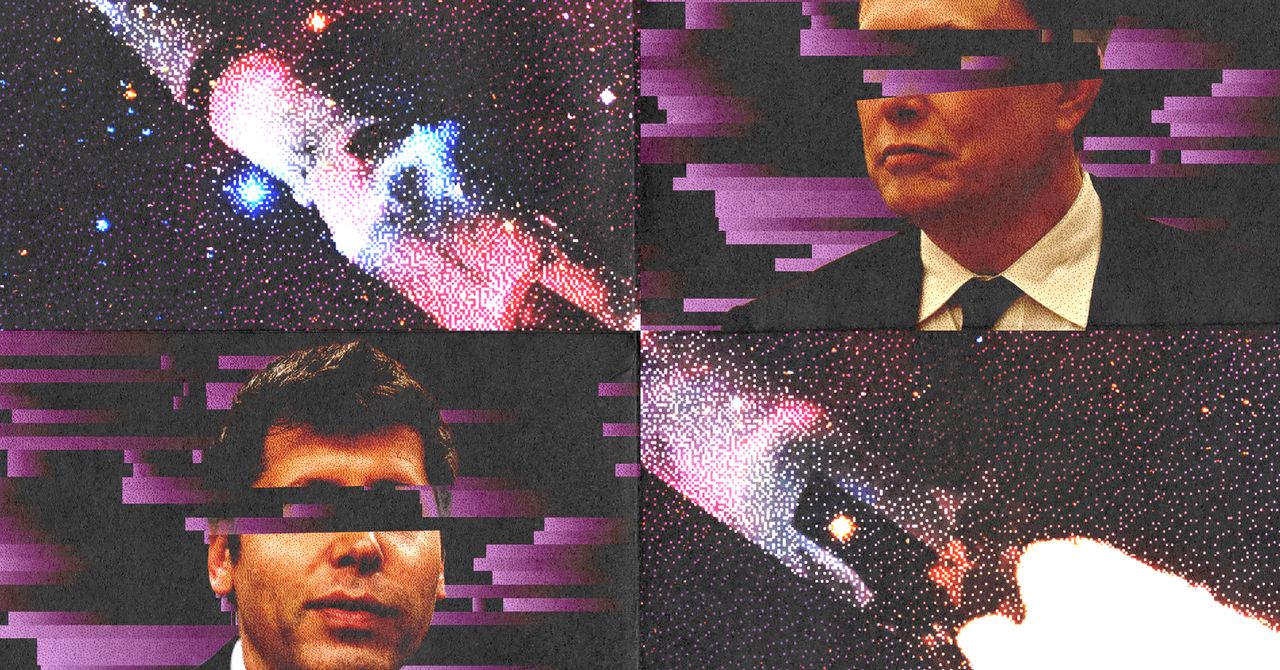
The Elon Musk Sam Altman science fiction debate is the subject of a new Wired excerpt from historian Jill Lepore’s book, The Rise and Fall of the Artificial State. Lepore’s argument is not that fiction caused the companies these men run. It is a critique of how powerful technology executives draw on stories of AI, space settlement and digital consciousness while, she argues, overlooking those stories’ warnings about power and human values.
Lepore calls the resulting vision the “Artificial State.” In her account, it is a political idea as much as a technological one: a future organized around escaping earthly limits through advanced AI and space, with far less attention to democratic control over the institutions building it.
The distinction matters. Musk’s and Altman’s stated interests and public remarks can be reported. Whether they have misunderstood particular novels is a literary and political judgment, and Lepore makes that judgment explicitly.
Why do critics say Musk and Altman misread science fiction?
The critique is that cautionary fiction can be stripped for its machinery and scale, then repurposed as a product plan. A story may offer spaceships, predictive systems or uploaded minds while also asking who holds power, who bears the costs, and whether an apparently grand mission has made ordinary people disposable.
For Musk, the recurring reference is Isaac Asimov’s Foundation. Aeon’s Ali Rıza Taşkale writes that Musk has cited the series as an influence on SpaceX, and quotes Musk’s 2024 statement that a multiplanetary future is necessary for humanity’s long-term survival. Taşkale reads Foundation differently, as a defense of collective institutions, shared knowledge and checks on concentrated authority. That reading is interpretive, but it frames the disagreement: survival through a lone builder’s project versus survival through durable public institutions.
Altman’s example is Dennis E. Taylor’s We Are Legion (We Are Bob). Wired reports that Altman was especially interested in the novel, whose premise involves a dead person’s consciousness being uploaded after war devastates humanity. Lepore treats that interest as evidence of a wider habit of turning speculative premises into ambitions without accepting the unease built into them.
Wired also points to Altman’s 2025 speculation that data centers could spread across much of Earth’s surface, followed by the tentative suggestion that they might be placed in space. That is a public thought experiment, not proof of a settled plan. It nevertheless fits Lepore’s concern that the industry’s imagined solutions often expand infrastructure before answering who gets to decide its costs and limits.
The King Midas problem is also a reading problem
Lepore uses a dispute over the King Midas story to make the case. Computer scientist Stuart Russell has compared poorly specified AI goals with Midas receiving exactly what he asked for. Writer Ted Chiang, as Lepore recounts, argued that the older parable is about greed and the losses incurred while pursuing wealth, rather than an engineering lesson about instruction-following.
That disagreement captures the article’s point. Science fiction and myth are not technical specifications. Critics such as Lepore and Taşkale argue that treating them as blueprints can preserve the spectacle while deleting the part where the story tells its readers to be careful.
This story draws on original reporting from WIRED.


