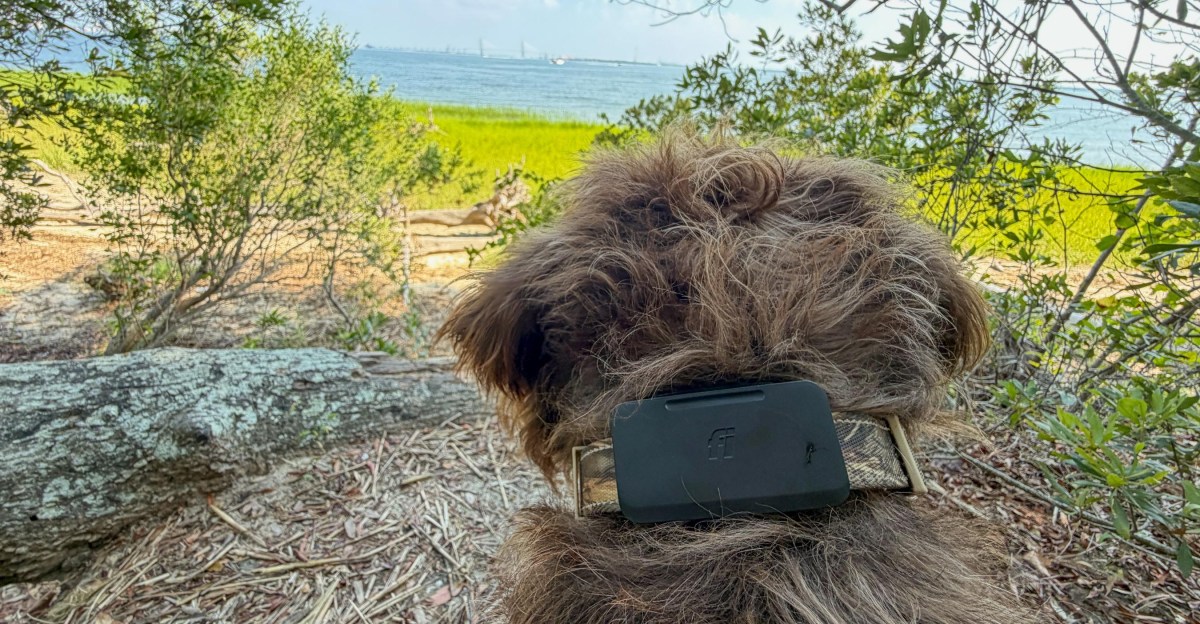
Fi has started selling the Fi Ultra, a pet tracker built to keep reporting a dog’s location after ordinary cellular service disappears. The trick is a fallback connection to T-Mobile’s T-Satellite service, which uses SpaceX’s low Earth orbit Starlink network for direct-to-cell coverage in the US.
The device costs $199, plus a $20 activation fee, and requires a $189 annual subscription. Fi says existing subscribers can add the Ultra for a flat $299 fee. The pitch is narrow but useful: if a dog bolts during a hike or camping trip beyond LTE coverage, the tracker can still send location updates through satellite. That is the kind of feature that sounds boring right up until the dog is gone and the map is blank.
Fi says the Ultra combines LTE, dual-band always-on GPS, Bluetooth, and Wi-Fi. The company describes it as compatible with an owner’s existing collar or harness and aimed at “adventure dogs of any size.” The hardware measures 75mm by 40mm by 25mm, weighs 68 grams, and includes a 513 mAh battery. It is rated IP68 and IP66K for dust and water resistance, including saltwater exposure.
The tracker also includes a vibration motor and speaker for Fi’s shock-free Callback training feature. In the Fi app, owners can see live location, set safe zones, and receive alerts when the dog leaves those areas. A Lost Mode setting increases radio activity to track more frequently instead of waiting for periodic check-ins.
Satellite tracking works, slowly
In early testing near Francis Marion National Forest in South Carolina, The Verge’s Jennifer Pattison Tuohy reported that the Ultra did connect over the Starlink-based T-Satellite network after LTE dropped away. The app marked the satellite connection with an icon, and location updates arrived about every two to three minutes during live tracking.
That cadence roughly matched what Tuohy saw on a weak one-bar LTE connection in a neighborhood test. It is enough to show a general direction of travel, but a moving dog can cover a lot of ground in three minutes. During one 30-minute satellite tracking session, Tuohy said the tracker twice stalled while “reconnecting,” with location updates delayed for nearly five minutes.
Fi told The Verge that the Ultra gives priority to terrestrial cell towers. When using T-Satellite, the tracker must switch among satellites while also checking for cellular coverage, because even a weak LTE signal is usually more stable than the satellite link. Fi said that handoff behavior can cause reconnection delays as the device moves between coverage types.
The battery is the bill
The main compromise is power. Fi rates the Ultra for two days per charge, and Tuohy reported barely reaching that during a week of testing. Long walks pushed charging to a daily chore, while lighter use stretched it to every other day. A single 30-minute live tracking session consumed almost 20 percent of the battery, according to The Verge.
Fi attributed the short runtime to the power cost of supporting satellite connectivity alongside cellular, plus more frequent high-accuracy location checks. The Ultra also depends more heavily on GPS for always-on tracking than Fi’s non-satellite trackers, the company said.
The tracker charges over USB-C in under two hours, according to The Verge’s testing. That helps, but it also puts the Ultra in a different category from Fi’s Mini and Fi 3 Plus collar, which The Verge has reported can run for weeks and include health, sleep, and behavior features.
The Ultra looks less like an everyday tracker and more like a pricey safety layer for owners who regularly take dogs outside cellular coverage. The satellite fallback worked in testing. The trade is size, cost, update lag, and a battery that needs attention before the trail does.
This story draws on original reporting from The Verge.